
Fitch Ratings has affirmed Turkmenistan's Long-Term Issuer Default Rating at 'BB-' and assigned a Stable Outlook, citing an "extremely strong" sovereign balance sheet supported by the country's status as holder of the world's fourth-largest gas reserves.
In its assessment, Fitch emphasised that Turkmenistan sits at the top of its 'BB' and 'B' peer group on two key metrics: sovereign net foreign assets to GDP and general government debt. The agency projects that sovereign net foreign assets will reach 59.3% of GDP by 2027, a level far above the peer median of negative 1.6%.
Fitch's forward-looking reserve metrics underline the country's external buffers. The agency expects foreign exchange reserves to be sufficient to cover an average of 46 months of current external payments in 2026-2027, which it notes is the highest coverage among all Fitch-rated sovereigns. At the same time, Fitch anticipates the current account surplus to narrow to an average of 1.2% of GDP for 2026-2027. That moderation is attributed to lagged windfall export revenue from elevated energy prices in 2026 being offset by constraints on export capacity and by higher imports.
On public debt, Fitch projects a decline in general government debt to 2.7% of GDP by end-2027 and highlights that Turkmenistan carries no domestic debt. That position leaves the country well below the 'BB' median for government debt, which Fitch estimates at 52.1% of GDP.
The Turkmenistan Stabilisation Fund is a significant component of the sovereign buffer. At end-2025 the fund held TMT27.6 billion, equivalent to 10.2% of GDP, of which TMT16.3 billion meet Fitch's definition of fiscal reserves.
Fitch's macro outlook includes a modest expansion in real activity. The agency forecasts GDP growth of around 2.5% in 2026-2027, supported by continued public investment and stable hydrocarbon export volumes.
Despite those strengths, Fitch lists several structural and policy weaknesses. Governance is described as weak, and the agency points to unconventional and opaque economic policymaking and a difficult business environment. The World Bank Governance Indicators place Turkmenistan at the 15th percentile, reflecting substantial centralisation of power and low assessments across voice and accountability, regulatory quality, rule of law and control of corruption.
Fitch also highlights a pronounced divergence between the official and parallel currency exchange rates. The official rate has been fixed at TMT3.5 per U.S. dollar since 2015, while the parallel market trades at about TMT19 per dollar, indicating a sizable discrepancy between official FX policy and market conditions.
On the supply side of exports, gas production accounted for roughly two-thirds of total goods exports in 2025 and is expected to remain largely stable through 2026-2027. Fitch attributes that stability to limited pipeline infrastructure capacity, with China remaining Turkmenistan's largest export market.
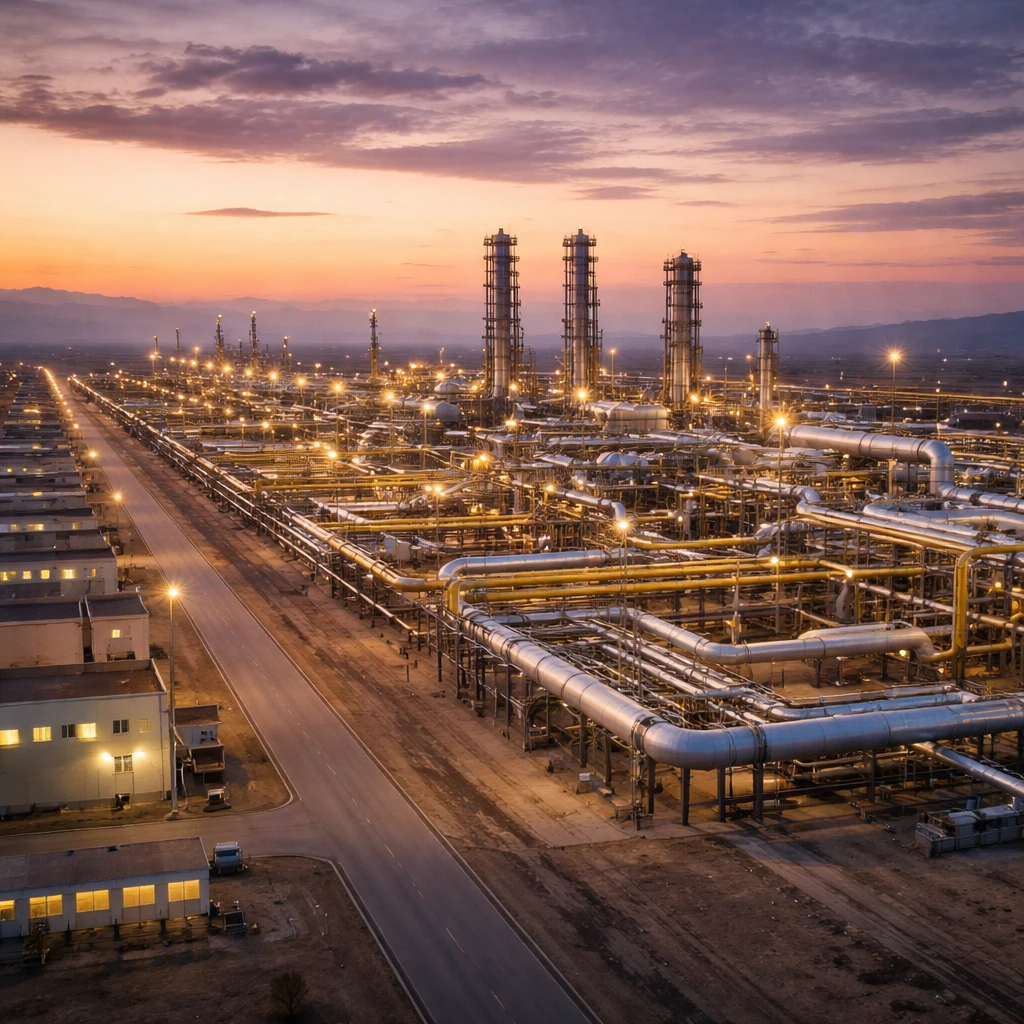
The agency notes progress in expanding production capacity, pointing to the start of work in April 2026 on the fourth phase of the Galkynysh gas field. The project carries a price tag of $5.1 billion and has been fully domestically financed. However, Fitch does not expect the new phase to be operational by 2031.
Overall, Fitch's rating decision balances exceptional external and fiscal buffers against governance shortcomings, an opaque exchange rate regime and logistical constraints on hydrocarbon exports.