
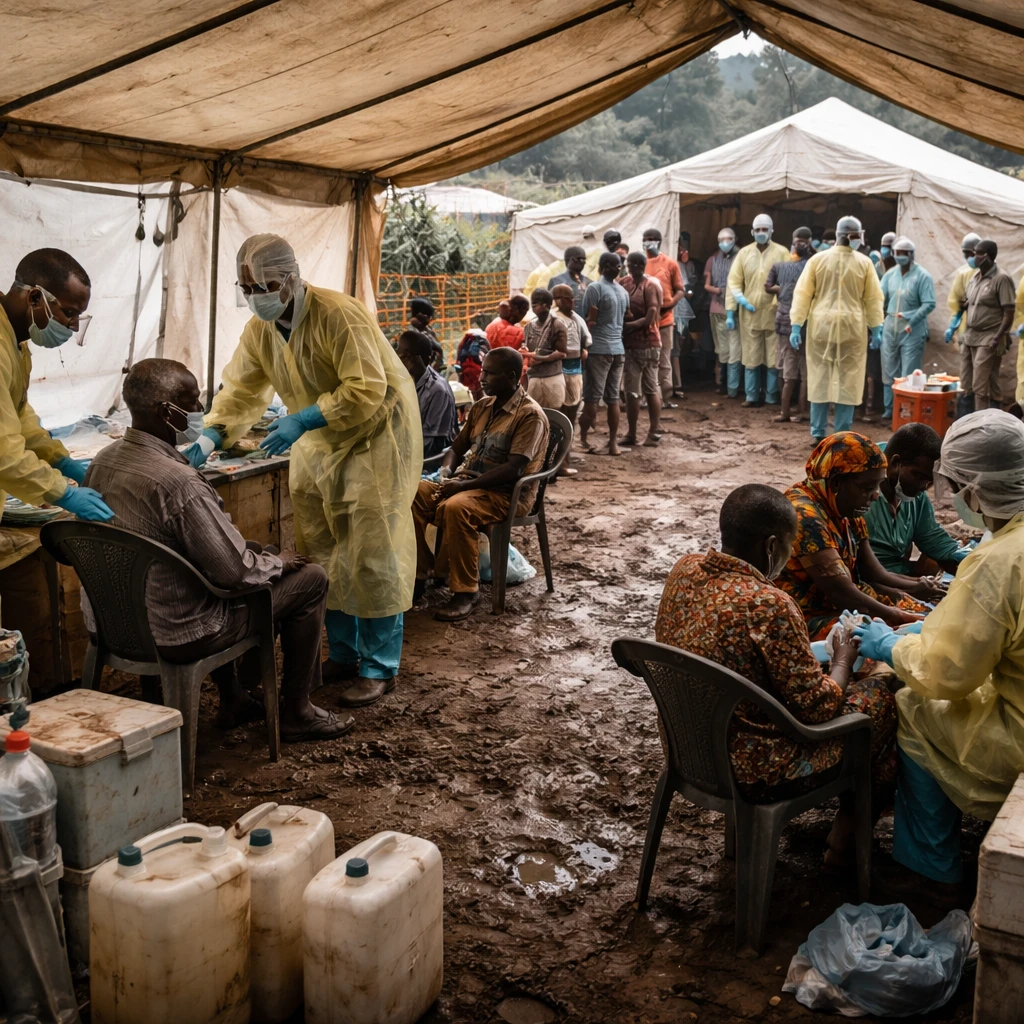
The Democratic Republic of Congo (DRC) announced on Tuesday that confirmed deaths from the current Ebola outbreak have reached 2,011, marking a new and somber milestone in what public health officials describe as the fastest-spreading outbreak on record.
Data from the DRC’s public health institute, reviewed by health officials, also show 4,381 confirmed cases spread across five provinces. Authorities and international observers attribute the rapid transmission to a combination of delayed detection, active conflict in affected areas and health systems already under strain.
Unlike some previous Ebola events, this outbreak is caused by the Bundibugyo strain. According to the available data, there are no approved vaccines or treatments for this strain, a factor that health experts have cited as complicating containment and treatment efforts.
The World Health Organization has declared the outbreak a public health emergency of international concern. The outbreak has also produced cases beyond the DRC’s borders, with neighbouring Uganda reporting infections linked to the current episode.
A recent study published in the journal Science, cited alongside official figures, suggests that transmission in the current outbreak may have begun in January or earlier in Ituri province. That research identified more than 500 suspected cases between mid-January and May 15, indicating a potentially earlier and wider onset of transmission than initial reports indicated.
Response operations have been challenged by shortages of medical supplies and insecurity in parts of the affected zone. Those constraints have made it harder to trace contacts, to isolate and treat patients, and to implement standard measures to curb transmission.
When compared with past outbreaks, government data show that only the 2014-2016 West Africa epidemic was larger in scale. That earlier outbreak recorded 28,616 cases and 11,310 deaths across Guinea, Liberia and Sierra Leone, according to World Health Organization counts.
Timing comparisons underline the speed of the current crisis. The West Africa outbreak took nearly five months after its declaration to reach 1,000 deaths. By contrast, the DRC’s present outbreak has reached the 2,000-death mark in less than three months. In a previous Ebola outbreak in the DRC from 2018 to 2020 it took a little over 12 months to reach 2,000 deaths. In the current outbreak deaths rose from 1,000 to 2,000 in under a month, underscoring the accelerated pace of transmission.
Methodology note: This report is based on the latest figures and studies referenced in official DRC public health data and in the cited scientific publication. Where researchers or agencies reported ranges or suspected cases, those figures are presented as reported.