
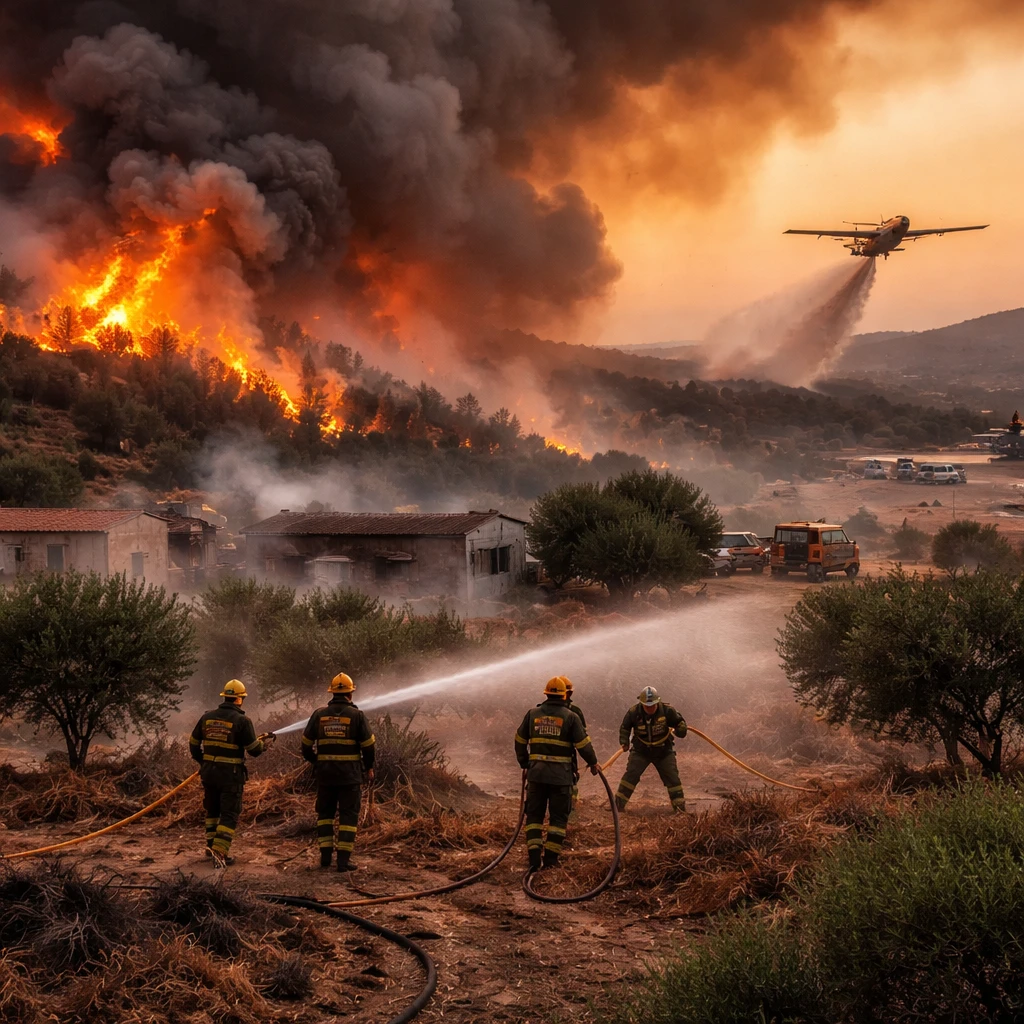
ATHENS, July 30 - Fire crews on the island of Crete continued efforts on Thursday to suppress two active wildfires, as emergency services responded to a wave of blazes sweeping parts of Europe after recent major fires in Spain and France.
Authorities said three Greek firefighters lost their lives on Wednesday while engaged in firefighting operations amid strong winds on Crete and elsewhere on the mainland. Two other firefighters sustained light injuries. Officials reported that two of the fatalities occurred after the firefighters became trapped in a blaze near the central Cretan village of Krya Vrysi while driving between fire fronts. A third firefighter died in a separate incident in the Peloponnese region.
On Wednesday, hundreds of local residents and holiday visitors were moved to safety from Krya Vrysi and adjacent villages in central Crete, with evacuations carried out by sea and by land as gusting winds drove flames toward popular tourist areas.
By Thursday, more than 200 firefighters, supported by dozens of fire engines and water-carrying aircraft, were engaged in battling the two wildfires on Crete. Officials reported that agricultural crops and olive groves had been destroyed in the affected areas, and that warehouses and a small number of houses had been damaged by the fires.
Giorgos Tsapakos, deputy regional governor for civil protection on Crete, told SKAI TV that conditions had not improved and warned of worsening winds. He said,
"Unfortunately there is no improvement, and the latest information indicates that winds will increase later in the day."
Tsapakos also noted operational limits for aircraft early on Thursday, saying,
"Aircraft were unable to operate this morning due to the strong winds."
European emergency officials have signalled a broader elevated risk of wildfires across the southern continent in the coming weeks. On Wednesday the head of the EU’s emergency response centre indicated that Greece and Italy were likely to face heightened wildfire risk as conditions evolve.
Heat and dryness have been significant factors in the recent spate of blazes across Europe. The continent has endured record-setting heatwaves this year, and officials have stressed that human-driven climate change is intensifying the heat and drought conditions that allow wildfires to spread more rapidly.
Recent blazes in Spain and France forced large-scale evacuations, consumed forested areas and resulted in wildlife fatalities. In Spain, authorities reported that conditions had stabilised in a major fire affecting the Avila and Madrid region, enabling some evacuation and shelter-in-place orders to be lifted even as officials warned of difficult conditions ahead. Spanish Interior Minister Fernando Grande-Marlaska cautioned of "three tough days" with strong winds and elevated temperatures expected.
Greek emergency services and local authorities continued to prioritise civilian safety and firefighting operations on Crete, while monitoring weather forecasts and the operational capability of aerial firefighting assets as winds fluctuate.
Context and ongoing response
The situation remains fluid, with firefighting teams focused on containment and protecting populated areas and infrastructure. Damage assessments were ongoing for agricultural land, olive groves, warehouses and residences affected by the fires.