
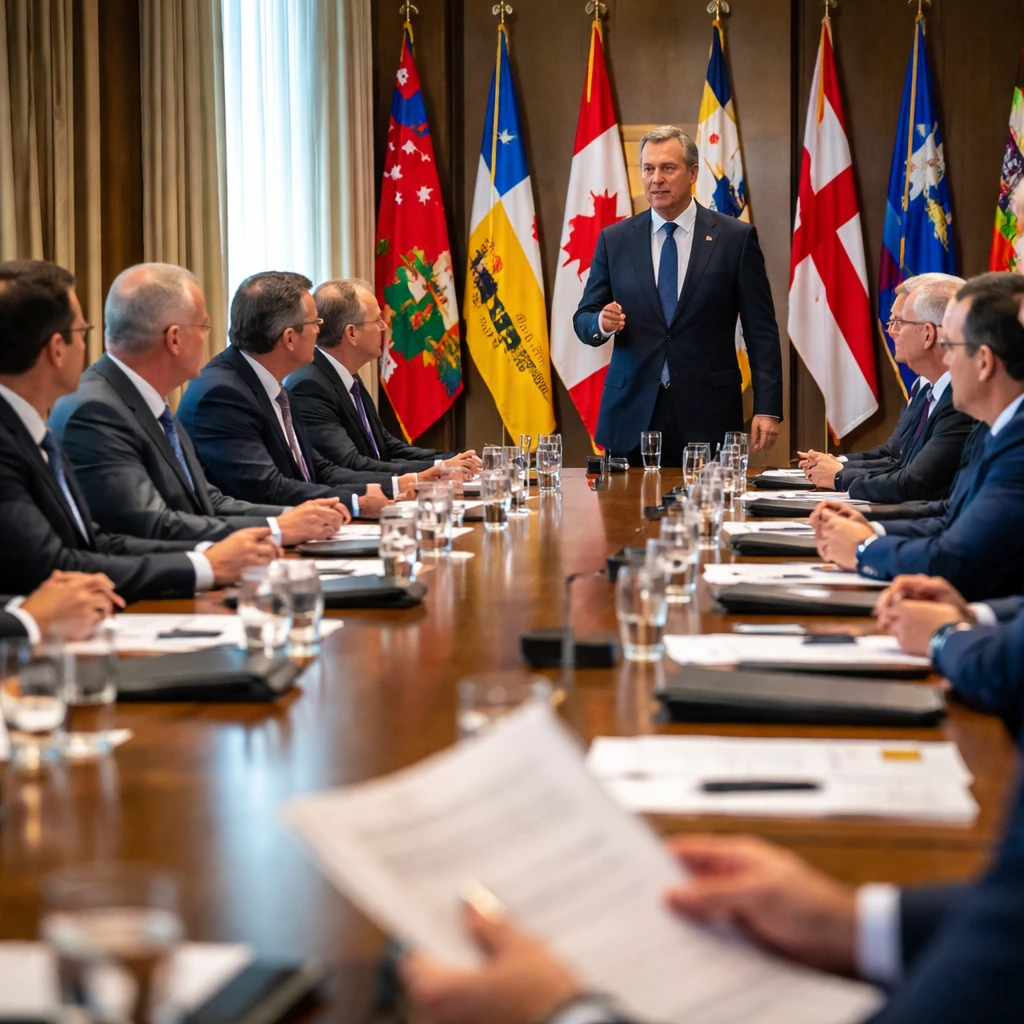
Prime Minister Mark Carney told a gathering of provincial premiers that Canada will defend its interests in the event of a trade confrontation with the United States, including by considering retaliatory measures, after Washington announced new tariffs on a range of Canadian goods.
U.S. President Donald Trump on Monday announced new 50% tariffs on a variety of Canadian products set to take effect on August 19. Carney, speaking at the premiers' meeting in Charlottetown, Prince Edward Island, described the U.S. measures as unwarranted and said Ottawa would escalate trade negotiations with Washington.
"We are intensifying our trade negotiations with the United States and will not hesitate to defend our interests if we have to," Carney said at the meeting. He added that "everything's on the table if there's no agreement," when asked about potential countermeasures, but did not provide details on what specific steps Canada might take.
Carney and President Trump agreed earlier this week to step up bilateral trade discussions. Those talks take place against the backdrop of the U.S. decision on July 1 not to extend the United States-Mexico-Canada Agreement (USMCA) for another 16 years, leaving the pact in force but subjecting it to annual reviews. The United States is negotiating with Canada and Mexico on separate tracks, and Washington has said it is making more progress with Mexico. That dynamic raises the risk, Carney indicated, that the U.S. could seek concessions from Canada that Mexico accepts.
Carney said his preference is to achieve a comprehensive agreement covering multiple sectors rather than piecemeal deals that address specific industries. While he said federal and provincial leaders presented a united front in principle, provincial governments are split over concrete responses.
Alberta and Saskatchewan, which respectively export crude oil and potash to the United States, have ruled out imposing export curbs or duties as a tactic to pressure Washington. Meanwhile, Ontario's Premier Doug Ford urged a dollar-for-dollar matching of the U.S. tariffs and acknowledged the prime minister faces a difficult position. "One day, the prime minister is with him side by side, and the next thing, President Trump turns on him like a rabid dog," Ford said.
British Columbia's Premier David Eby proposed that his province could limit U.S. access to critical minerals exports, which the province identifies as including copper, zinc and aluminum. "If the prime minister calls British Columbia and says he needs support with some big sticks to have conversations at the table, then we will be there," Eby said.
The announcement of steep U.S. tariffs and the differing provincial stances set up a complex negotiation environment for the federal government as it seeks a negotiated resolution while managing regional economic interests tied to energy, mining and agricultural exports.
Context and next steps
Carney emphasized the government's aim of securing a broad, comprehensive trade deal rather than isolated sectoral arrangements. He reiterated Ottawa's willingness to defend Canadian interests and indicated a readiness to consider all options if talks do not yield an agreement, leaving the specifics of any countermeasures undefined.
Provincial divergence on tactics - with some premiers ruling out export restrictions and others advocating matching tariffs or threatening to curb access to minerals - suggests Ottawa will need to balance national negotiating strategy with regional economic priorities as talks with Washington continue.