
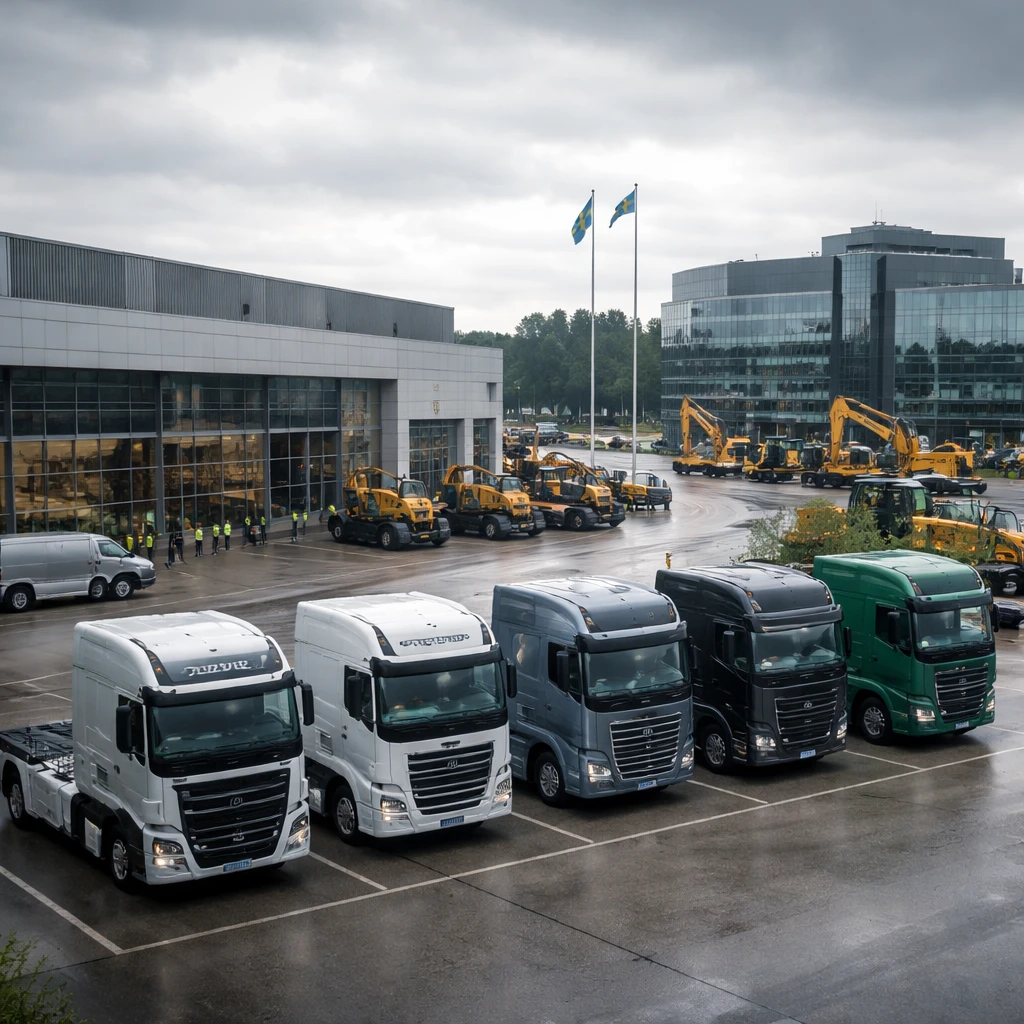
Volvo AB's stock pulled back more than 3% on Wednesday following a Capital Markets Day presentation in Eskilstuna, Sweden, at which management outlined an array of growth objectives across its business units. Morgan Stanley maintained an "equal-weight" recommendation on the shares and held its SEK 342 price target, arguing the firm's quality is largely priced in at roughly 13x next full-year (NFY) price-to-earnings.
The broker noted the shares have fluctuated between SEK 244.90 and SEK 354 over the past 52 weeks. Morgan Stanley said it believes Volvo's investment case remains clear, but that the current market multiple - at the higher end of the company's historical range - means the stock's existing level already captures the company's quality and prospects. The house therefore kept its stance unchanged.
At the event, President and Chief Executive Martin Lundstedt described the group as constructed for "both resilience and growth across the business cycle," pointing to expectations that the Trucks division and Volvo Construction Equipment will outpace their historical growth rates. Management presented specific ambitions for several units.
Volvo Autonomous Solutions is targeting driverless on-highway operations by the first quarter of 2027, and management said the business aims to generate about $3 billion in revenue within five years, with the segment expected to be accretive to the group's operating margin. Volvo Penta has set a target of doubling its revenue, and Renault Trucks is aiming to double its light-duty business.
Morgan Stanley's modelling reflects gradual top-line expansion and margin improvement. The broker projects revenue will increase from SEK 479.18 billion in fiscal 2025 to SEK 492.76 billion in 2026 and SEK 545.58 billion in 2027. Earnings per share are forecast to rise from SEK 16.94 in 2025 to SEK 20.43 in 2026 and SEK 25.60 in 2027.
On profitability metrics, Morgan Stanley expects EBITDA to climb from SEK 65.66 billion in 2025 to SEK 83.41 billion in 2027, and anticipates EV/EBITDA to compress from 11.8 times in 2025 to 9.6 times in 2027 as earnings expand.
On the electrification front, the broker noted that battery-electric trucks generally still carry a higher total cost of ownership than diesel models in most segments without subsidies. Morgan Stanley highlighted that purchase prices for battery-electric trucks remain above combustion-engine counterparts and that residual values are not yet stable. The firm said these conditions do not negate Volvo's electrification strategy, but point to a slower adoption path than some scenarios assume.
Finance chief Mats Backman pointed to upward pressure on cost inflation, citing freight and raw materials as drivers of higher expense. He also said that strong utilisation of trucks and machines is supporting service activity, which can help underlying margins.
Balance-sheet metrics presented at the session show net debt at SEK 174.56 billion, with Morgan Stanley forecasting a decline to SEK 163.76 billion in 2026 and SEK 147.94 billion in 2027. The bank's dividend forecast is for payouts per share to rise from SEK 13 in 2025 to SEK 14.30 in 2026.
Overall, management set out a portfolio of ambitious targets across several businesses - from driverless highway operations in Autonomous Solutions to revenue-doubling aims at Volvo Penta and Renault Trucks' light-duty unit - while the sell-side view encapsulated by Morgan Stanley judged current valuations to be reflective of the company's profile and near-term prospects.
Summary
Volvo AB outlined aggressive growth aims at its Capital Markets Day, including driverless on-highway targets and multiple revenue-doubling ambitions across business units. Despite the strategic roadmap, shares fell after the event and Morgan Stanley retained an "equal-weight" rating with a SEK 342 price target, saying the stock's current valuation - roughly 13x NFY P/E - fairly reflects company quality. The broker projects rising revenue, EPS and EBITDA through 2027, while flagging the higher cost of ownership for battery-electric trucks in most segments without subsidies.
Key points
- Volvo presented growth plans across Trucks, Construction Equipment, Autonomous Solutions, Volvo Penta and Renault Trucks; Autonomous Solutions targets driverless on-highway operations by Q1 2027 and about $3 billion revenue within five years.
- Morgan Stanley kept an "equal-weight" rating and SEK 342 price target, citing a current valuation near the high end of Volvo's historical range - about 13x NFY P/E - and forecasting revenue and EPS growth through 2027.
- Broker forecasts include revenue rising to SEK 545.58 billion in 2027, EPS to SEK 25.60 in 2027, and EBITDA climbing to SEK 83.41 billion by 2027, with EV/EBITDA compressing from 11.8x in 2025 to 9.6x in 2027.
Risks and uncertainties
- Cost inflation is rising, driven by freight and raw materials, which could pressure margins - an issue for sectors exposed to manufacturing and logistics.
- Battery-electric trucks currently display higher total cost of ownership than diesel in most segments without subsidies, with elevated purchase prices and unstable residual values, creating uncertainty for fleet adoption and the commercial vehicles market.
- Net debt remains elevated at SEK 174.56 billion, though forecasts show a declining path; leverage and capital allocation choices could affect financial flexibility in heavy industry and equipment markets.