
President Donald Trump on Thursday said Washington is engaged in talks with Iran and indicated it might not be required to carry out a previously threatened "massive" military strike, while stressing that American forces remain "locked and loaded," according to reporting by Al Jazeera.
Trump described Tehran as demonstrating increased seriousness in negotiations, though he said Iran was not yet ready to finalize an agreement. The president said he was prepared to listen to Iranian overtures, while reiterating that the United States would not permit Tehran to develop a nuclear weapon.
The president also asserted that U.S. strikes had heavily degraded Iran's military capacity, destroying much of its navy, air force and radar infrastructure. Those damage assessments have not been independently verified.
Iranian Foreign Minister Abbas Araghchi dismissed U.S. threats and said Tehran would not yield to pressure. Speaking during meetings with Russian and Chinese counterparts in Kyrgyzstan, Araghchi blamed the United States for breaking prior agreements and for creating instability around the Strait of Hormuz. He also welcomed Moscow's denunciation of U.S. and Israeli military actions.
Russian Foreign Minister Sergey Lavrov offered to help establish a regional security framework, according to accounts of the diplomatic exchanges.
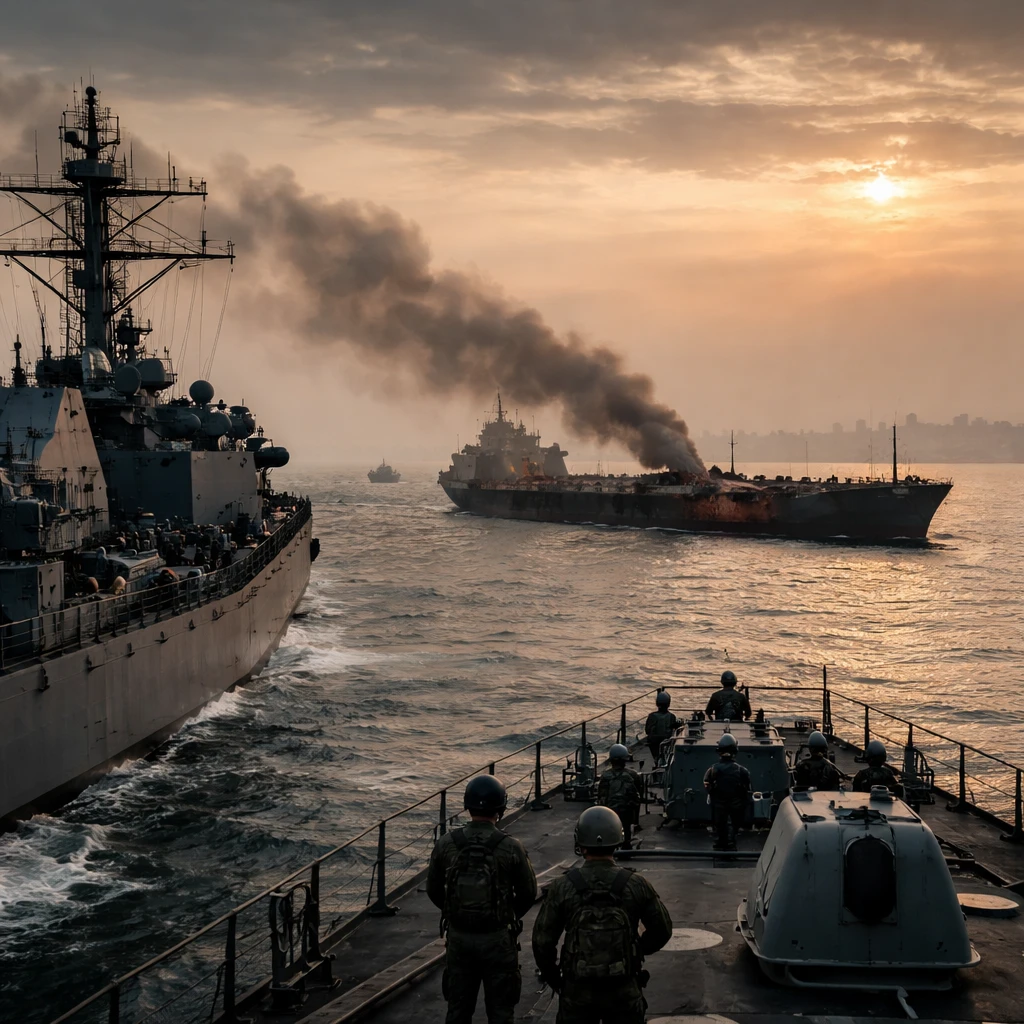
Military tensions remained elevated in the Gulf. U.S. forces disabled a tanker that was attempting to run a U.S.-imposed blockade near Iran after the vessel allegedly ignored repeated warnings. American personnel fired into the ship's engine room, leaving it unable to proceed toward Iran.
Maritime traffic through the Strait of Hormuz has been uneven amid the hostilities. Shipping analytics firm Kpler recorded six confirmed crossings on Thursday, a drop of 60% from the prior day. Before the conflict, the strait carried roughly one-fifth of the world's energy shipments.
Energy markets responded to the heightened risk. Brent crude briefly climbed to around $100 a barrel during the week before easing somewhat. Barclays cautioned that a three-month supply disruption could push spot prices toward $150 a barrel, a move the bank said would increase inflationary pressures and deepen supply risks.
Violence across the broader region has also escalated. Israeli strikes continued in Lebanon and Gaza, where shortages of electricity and shrinking humanitarian assistance have exacerbated civilian hardship. Fighting intensified in the occupied West Bank as well: four Palestinians and two Israeli soldiers were killed near Nablus, after which Israel launched a wider military operation and imposed roadblocks.
The regional security picture widened further when Houthi forces resumed attacks in the Red Sea. Saudi Arabia briefly issued danger alerts for the southern port regions of Jazan and Yanbu as those attacks and other hostilities raised the risk to commercial shipping lanes.
The combination of ongoing diplomacy, persistent military readiness, maritime incidents and uneven shipping through a strategic chokepoint has created a complex environment for global energy and shipping markets. For logistics and freight networks, the unpredictability of vessel transits through the Strait of Hormuz adds an immediate layer of operational risk. For energy markets, even brief spikes in crude prices and warnings from major banks about potential price paths underscore the sensitivity of global supplies to regional disruptions.