
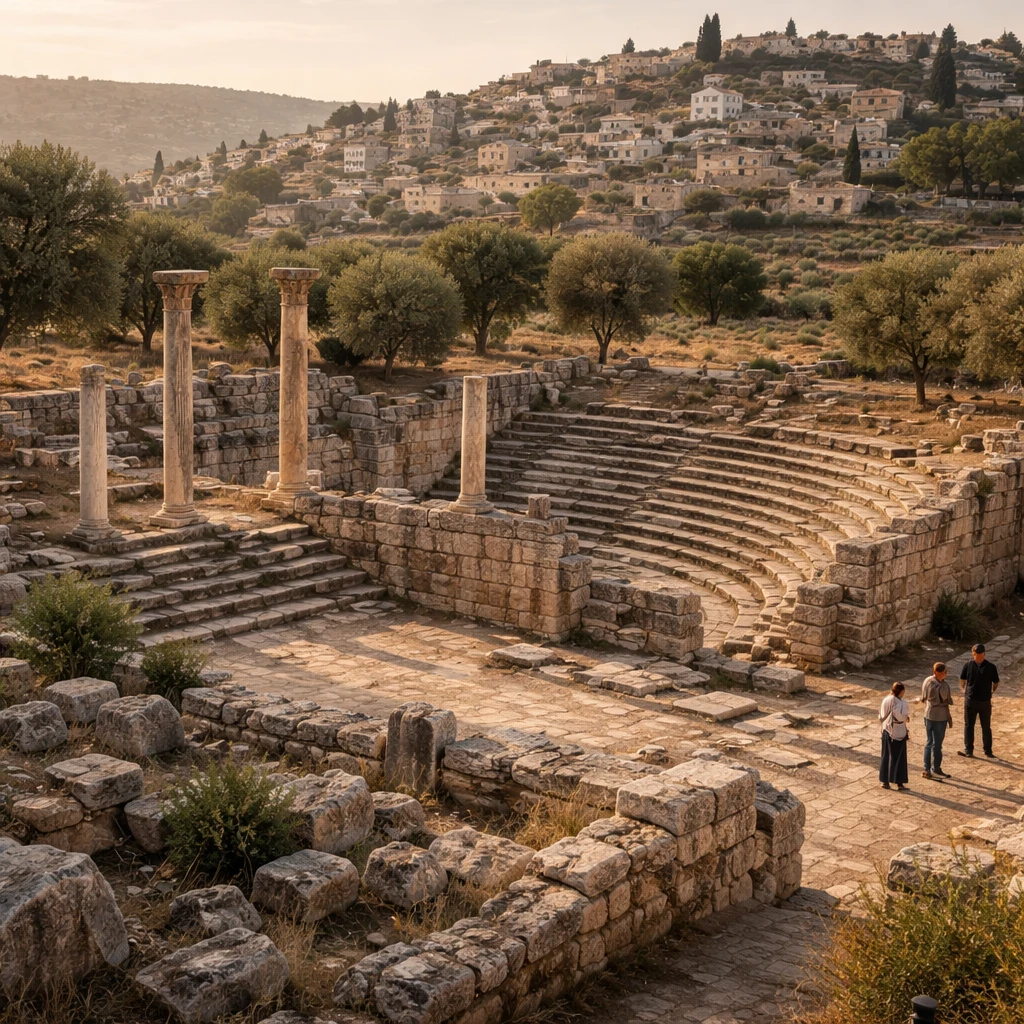
UNESCO's decision to inscribe Sebastia in the northern West Bank as a World Heritage site and to add it to the List of World Heritage in Danger has been met with starkly different reactions from Palestinian and Israeli officials. Palestinian leaders and local residents say the recognition could help prevent Israeli expansion at the ancient site, while Israeli officials denounced the move as politically driven.
According to UNESCO, Sebastia contains archaeological remains spanning multiple historical periods, beginning at least with the 9th-century BC capital of the Israelite kingdom and extending through the Hellenistic, Roman, Byzantine and Islamic periods, along with Crusader and Ottoman layers. The site is characterized by Roman columns, ancient walls, stone steps and an amphitheatre, and is traditionally regarded as the burial place of John the Baptist. Olive trees dot the landscape surrounding these ruins.
Local residents from the nearby village - many of whom depend on tourism for income - have voiced alarm over Israeli plans to seize roughly 1,800 dunams (445 acres) of land in the area. Israeli authorities said the seizure was intended to develop the location. Palestinian officials say the land seizure announcement, made in late 2025, is part of a broader Israeli effort to expand settlements in and around the site.
On Friday, UNESCO formalized Sebastia’s inscription on its World Heritage List and placed it on the List of World Heritage in Danger, the mechanism used to identify listed sites facing significant threats so as to prompt protective action.
"We hope that this decision will enable us to preserve Sebastia," said Nizar Kayed, the deputy mayor of the adjacent village. Palestinian tourism and foreign ministries also expressed hope that UNESCO’s recognition will help marshal international support against Israeli measures targeting the site.
Israel’s Foreign Minister Gideon Saar responded by characterizing the designation as part of a Palestinian campaign to downplay Jewish connections to the land. "No vote in an international organization can change history," he said in a statement.
Beyond the immediate dispute over land seizures, Palestinian officials are tracking proposed Israeli legislation that would extend Israeli civil control over ancient sites in the West Bank. That bill has not yet been enacted into law. Palestinian authorities say such a change would remove oversight of these antiquities from the Palestinian Authority, which under the 1990s Oslo peace accords administers limited self-rule in parts of the West Bank - territory that Israel captured in a 1967 war.
UNESCO’s dual action - inscription and designation as endangered - aims to draw attention to the site’s cultural value and the risks it faces. For residents who rely on visitors, the designation could influence the future of tourism-linked livelihoods, while political and legal changes on authority and land control remain central uncertainties.