
New Delhi, JhunJhunu, Ahmedabad - The unravelling of one of India’s most competitive examinations has exposed a human toll that students, families and activists say cannot be measured by scores alone. For 19-year-old Sheikh Sana, the decision to retake the National Eligibility-cum-Entrance Test - a high-stakes entrance exam for medical colleges - proved unbearable. Her family said that, a day before the scheduled retake, Sana wrote "I am sorry" on a sheet of paper and took her own life.
Her death, and the suicides of other aspiring medical students who faced similar uncertainty after test papers were found to have been leaked, have become a rallying point for thousands of protesters demanding answers and accountability from the government. The protest movement has broadened over roughly two months from a call for action against those responsible for the leaks into a wider expression of frustration over education, opportunity and governmental responsibility in a country where 65% of the population is under the age of 35.
Exam integrity and the retake
More than 2 million students sat the pen-and-paper NEET in May. Following revelations that questions had been illicitly sold prior to the exam, authorities cancelled the release of results and ordered a retake in June, sending candidates back into an intense period of preparation.
India's federal Central Bureau of Investigation (CBI) reported that teachers and agents connected to private tuition centres were implicated in the scheme to sell the paper, charging students large sums for access to the questions. The agency has arrested 13 suspects, among them a doctor and several teachers.
Families of some deceased students have explicitly linked the decision to cancel the first exam and the subsequent uncertainty to the deaths of their children. "The fear killed her. The fear of re-NEET," Sheikh Jaffar Hussain, Sana's father, said while at New Delhi’s Jantar Mantar protest site where students have gathered to demand accountability over the handling of the affair.
Police officials in Rajasthan, Telangana and Gujarat told Reuters they had registered the deaths of Sana and two other students whose parents were interviewed as suicides and that investigations were ongoing. Authorities did not elaborate on causes, and Reuters was unable to independently verify the reasons for the deaths.
Government response and political fallout
Prime Minister Narendra Modi said in a video message he was pained by the paper leaks and promised stringent action, including fast-track trials for those responsible. "I know that paper leaks are not an ordinary issue. And for millions of students and their guardians, this is painful," he said.
Against the backdrop of escalating demonstrations, Education Minister Dharmendra Pradhan resigned on Saturday. In a post on X announcing his resignation, he wrote that he "deeply respect[ed] the aspirations, feelings, and legitimate expectations of the country’s youth." Earlier, he had said the government was committed to discussing NEET and addressing youth concerns.
Opposition leaders and protest organizers had amplified demands for Pradhan's removal. Rahul Gandhi, leader of the main opposition Congress Party, said exam paper leaks have gone unpunished and asserted there had been more than 150 leaks over the past decade. Pradhan and his ministry did not respond to requests for comment on past leaks.
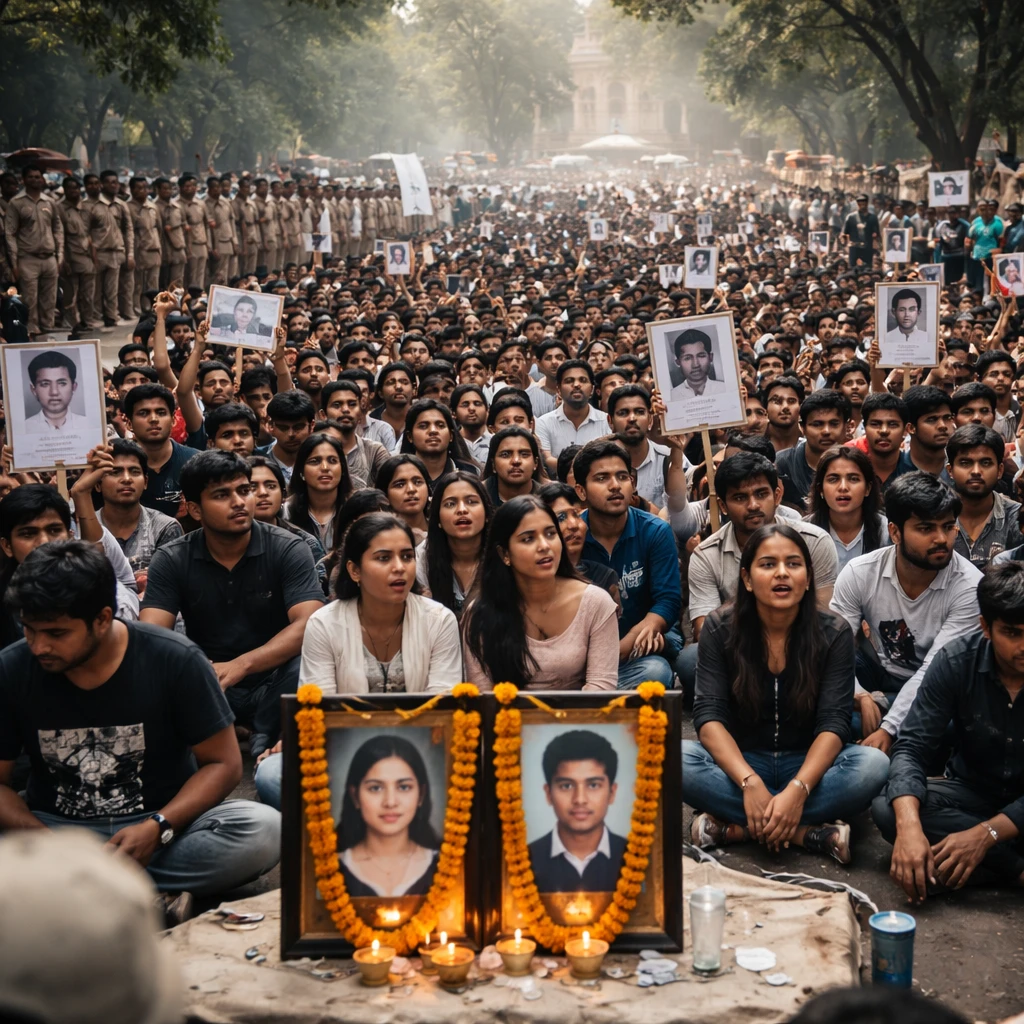
Protests in central Delhi swelled into the tens of thousands this week, with police using batons and tear gas to disperse crowds. Opposition lawmakers disrupted parliament as they echoed calls for ministerial resignation. A Gen Z-led movement known as the Cockroach Janta Party (CJP), active in the capital protests, has asserted that 21 students died by suicide in cases it believes were linked to the exam fiasco; Reuters could not independently verify that number.
Offices of the prime minister, the education minister and the government spokesperson did not respond to multiple requests for comment on the protests and the student deaths.
Human stories and the cost of aspiration
The pressure to succeed in NEET reflects broader social expectations about education and professional qualification. For many families, a place in medical college represents financial security, social mobility and prestige in a system where competition for professional training is intense and opportunities for advancement can be limited.
Despite robust economic growth, India’s official youth unemployment rate stood at 9.9% last year, significantly higher than the national overall rate of 3.1%. Government data indicates that only around 6% of candidates secure a place in medical college through NEET, underscoring the razor-thin odds for aspirants.
In Jhunjhunu district, Rajasthan, farmer Rajesh Kumar said he sold land valued at 2.8 million rupees and took a bank loan of 1.1 million rupees to support his son Pradeep Kumar’s preparations. Pradeep, 22, had moved to Sikar - a known coaching hub - to study for the exam and had aspired to become a doctor since childhood. He died by suicide on May 15, days after the exam results were cancelled, his father said.
Sitting on a red plastic chair outside his modest brick home with a young calf tethered nearby, Rajesh Kumar said the cancellation shattered his son. "We are farmers and hardly educated, but my son always wanted to become a doctor," he told reporters. Kumar said he blamed what he called a "failure of the system" for his son’s death and vowed not to immerse his son’s ashes in the Ganges until the education minister resigned.
Another family in Gujarat recounted the death of 17-year-old Kahaan Patel, who died days before the retake in June. His father, Prashant Patel, said Kahaan had planned to study medicine and pursue higher education in the United States. After the retest was announced, Kahaan tried to prepare again but could not handle the uncertainty. "He wasn’t able to fight more, so he ended it," Prashant Patel said.
Those grieving have in several cases demanded accountability rather than financial compensation. The CJP and the Congress Party have called for compensation for families of students who died by suicide, but the government has not offered any. Many relatives Reuters interviewed said they were seeking responsibility and answers rather than money. "I want accountability," Rajesh Kumar said.
Pressure points in India’s education ecosystem
Education activists and academics point to mounting pressure on students competing for scarce college places and to the expanding role of costly private coaching and commercial interests in shaping educational outcomes. Nandita Narain, a former president of the Delhi University Teachers’ Association, said the protests reflect concern about these pressures and that the anger among young people has finally surfaced.
Observers note the protests do more than demand punishment for those involved in the leak: they channel deeper frustrations with fairness, access and the perceived commercialization of education. For thousands of families, years of savings, loans and sacrifices are invested in the hope a child will secure a coveted medical seat. When the integrity of the exam system is questioned, those investments and aspirations are thrown into doubt.
Political implications and public sentiment
Some political analysts say the street movement presents a significant political moment because it reflects youth discontent in the nation’s capital. "When young people are on the streets of Delhi protesting against a malfunctioning education system, it acquires much larger significance," said Sabyasachi Basu Ray Chaudhury, a political science professor at Rabindra Bharati University in Kolkata.
At the same time, analysts caution it will be difficult to substantially erode Prime Minister Modi’s popularity. Over his 12 years in office, he has faced major protest movements and retained electoral strength, the article noted.
Scene at the protests
At the Jantar Mantar protest site in Delhi, students placed photographs of peers who had died by suicide on the stage as demonstrators continued to chant and demand answers. The protests have spread beyond the capital to other regions of India, heightening public scrutiny of the examination process and the institutions that oversee it.
Police reported using force to disperse large crowds in central Delhi, and parliamentary proceedings were disrupted as opposition lawmakers echoed the demonstrators’ calls.
Looking ahead
The immediate future centers on investigations into the leak, accountability for those involved, and how the government responds to demands for reforms in a high-pressure education landscape. Officials have pledged investigations and faster trials for suspects, while families and activists press for systemic change and clearer protections for vulnerable students navigating an unforgiving exam culture.
The deaths of Sana, Pradeep and Kahaan have become emblematic for protesters who say the education system - and the agencies that manage access to it - must be held accountable for their roles in exacerbating uncertainty and distress for millions of young Indians.
Key takeaways
- Widespread protests erupted after NEET questions were leaked, results were cancelled and a retake was ordered, with families linking several student suicides to the uncertainty created by this sequence of events.
- Education Minister Dharmendra Pradhan resigned amid the unrest; the CBI has arrested 13 suspects alleged to have been involved in the selling of the exam paper.
- Concerns about the role of private coaching, the commercialization of education and intense pressure on youth have come to the fore, amplifying demands for accountability and reform.
Risks and uncertainties
- Ongoing investigations: Police and the CBI are investigating the leaks and associated deaths; outcomes remain uncertain and may influence public trust in educational institutions and regulatory processes - affecting the education sector and private coaching industry.
- Political fallout: The protests and ministerial resignation heighten political risk and could intensify scrutiny of government handling of youth issues - a dynamic relevant to political actors and public-sector policy in education.
- Student mental health and social consequences: Continued pressure and uncertainty may produce further distress among candidates and families, underscoring vulnerabilities in social and mental health services aligned with educational sectors.
Questions that remain
Investigations are ongoing into the deaths and the paper-selling scheme. Authorities have registered the deaths of students as suicides in multiple states, but reasons are still subject to probe and independent verification. The precise number of deaths linked to the exam controversy remains contested among protest groups and officials.
Tags: education, protests, India, NEET, youth