
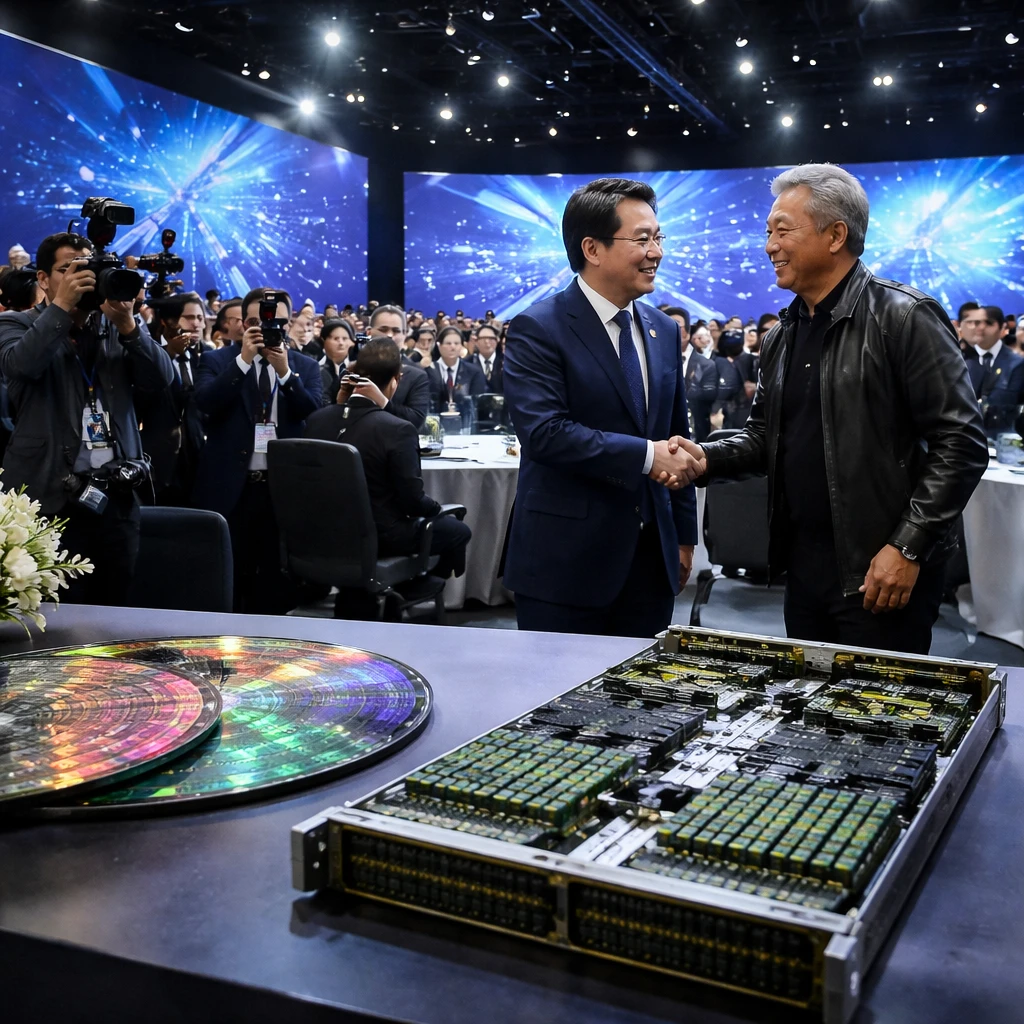
South Korea has rolled out nearly $950 billion in AI-focused commitments that link its leading semiconductor and technology groups with major U.S. AI companies, reflecting an urgent push to expand computing capacity and memory supply for next-generation artificial intelligence systems.
The bulk of the announced activity centers on SK Group and Samsung Electronics. South Korea's presidential Blue House said SK Group signed deals totaling about $750 billion, including a partnership between SK Hynix and Nvidia valued at more than $500 billion. Separately, Samsung Electronics disclosed a memorandum of understanding with Broadcom that could reach up to $200 billion covering memory chips, foundry services and advanced packaging.
Those accords were revealed as part of an AI summit convened by President Lee Jae Myung in San Francisco. At the event, Lee presented what the Blue House called a "San Francisco AI Declaration" that lays out South Korea's plans for technological cooperation with the United States and to open its "dynamic AI ecosystem" to global partners.
"I'd like to present a vision for the future of AI and propose global cooperation to make it happen," Lee said during the summit. The president also held separate meetings with key industry leaders, including Nvidia CEO Jensen Huang, OpenAI CEO Sam Altman, Anthropic CEO Dario Amodei and Broadcom CEO Hock Tan.
Senior figures from South Korea's corporate sector were present as well. The summit included attendance by Samsung Electronics Executive Chairman Jay Y. Lee, SK Group Chairman Chey Tae-won, Hyundai Motor Group Executive Chair Euisun Chung and Naver founder Lee Hae-jin.
Details of the major partnerships
The collaboration announced between Nvidia and SK Group is described as a new AI initiative valued at $500 billion. It spans the deployment of large-scale AI data centers and the joint development of next-generation memory technologies designed for AI training, autonomous AI agents and physical AI applications.
As part of that plan, SK Hynix will enter a long-term partnership with Nvidia to secure next-generation memory supply and jointly advance high-bandwidth memory designs. SK Telecom has committed to build a 2-gigawatt data center that will use Vera Rubin chips in combination with SK Hynix's HBM4 high-bandwidth memory chips. That data center is scheduled to be operational in 2027.
Samsung Electronics said its agreement with Broadcom will involve collaboration on a next-generation AI accelerator that leverages Samsung's high-bandwidth memory technology. Samsung also agreed to provide Broadcom with access to sub-2-nanometer foundry process capabilities and advanced packaging solutions.
Industry demand and supply dynamics
SK Group Chairman Chey Tae-won emphasized that customers developing AI systems are seeking far greater quantities of memory than previously anticipated. He cited recent discussions with Nvidia, Anthropic, OpenAI and Broadcom and warned that projected memory needs may increase.
Chey was quoted saying, "I wouldn't be surprised if, the next time I see (Huang), he'll tell me those figures were too low and say, 'I want more.'" He added that Broadcom's Hock Tan had signaled memory demand could exceed available supply, and that Anthropic was frequently checking on future chip availability as it scales from model development to building computing capacity.
Regarding OpenAI, Chey said the company would require enormous computing power and that SK had been urged to consider supplying chips directly to the ChatGPT maker. On Anthropic, Chey stated the company was building its own "computing power" without elaboration.
An Anthropic spokesperson responded by saying the startup is continuously exploring options and sourcing a variety of chips for a diversified approach to computing. Anthropic's CEO, Dario Amodei, declined to comment on a reported plan to design chips, but confirmed the company had signed supply agreements with Samsung Electronics and SK Hynix without providing additional specifics.
Financial and strategic context
The announced deals are part of broader efforts by South Korea's government and industry to attract foreign capital and secure technological partnerships. The summit and accompanying meetings are intended to catalyze investment in domestic startups and strengthen industrial ties with major U.S. AI players.
President Lee is scheduled to participate in a Silicon Valley gathering that will bring together South Korea's National Pension Service and U.S.-based venture capital firms, with the goal of encouraging further investment into South Korean startups.
These announcements follow state-driven initiatives unveiled earlier by Lee, which outlined three large projects anchored by Samsung Electronics and SK Hynix. Those projects aim to build semiconductor production clusters, physical AI ecosystems and AI data centers, and were presented as part of an industrial strategy that the Blue House said involves more than $576 billion in investment.
Collectively, the recent summit agreements underscore an intensifying focus on securing memory and compute capacity to support a rapidly expanding AI market. The commitments reinforce tighter collaboration between U.S. AI firms seeking to lock in supply and South Korea's semiconductor leaders offering memory, foundry and packaging capabilities.
While many technical and commercial details remain to be finalized, the scale of the announced commitments highlights the central role memory supply and advanced packaging will play as companies scale compute-intensive AI applications.