
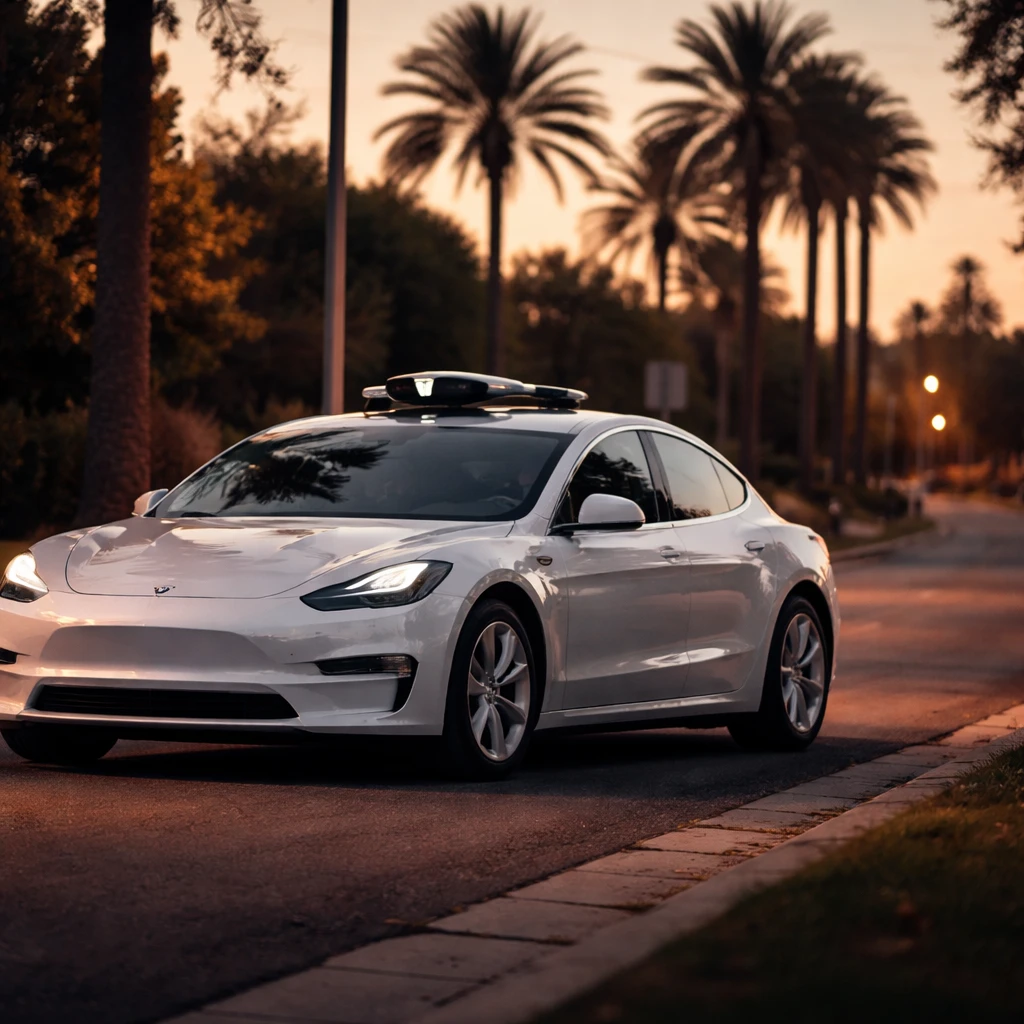
A year after CEO Elon Musk described Tesla’s robotaxi network as poised to grow at a "hyper-exponential rate" and reach half of the U.S. population by the end of 2025, company leaders adopted a markedly more cautious posture on a recent earnings call. Executives fielded questions from analysts about a rollout that has proceeded more slowly than some investors expected.
The company began a small robotaxi pilot in Austin in June 2025 and since then has broadened service to only a handful of additional cities in Texas and Florida. In many cases, availability has been limited to neighborhoods on the outskirts of those metropolitan areas rather than to broad coverage across city centers or entire urban regions.
Tesla reported that paying customers have used its robotaxi service for a total of 2.5 million miles, and that 380,000 of those miles were driven without an in-vehicle safety monitor. Company officials on the call contrasted their deployment approach with the city-by-city expansion used by some competitors and highlighted a number of practical considerations that they say justify a gradual scale-up.
Lars Moravy, Tesla’s vice president of vehicle engineering, said regulatory environments vary from city to city and framed the staged expansion as a response to those differences. "Regulatory situations are different city by city," he said, adding that Tesla is expanding one municipality at a time "to make sure that we’re meeting all of those one at a time."
Vaibhav Taneja, Tesla’s chief financial officer, emphasized operational and software issues that still need fine-tuning. He described obstacles as "different kinks ... not just on the software front, but on the operations front, that we’re trying to tackle," and said the company prefers to "sort these things out in a smaller fleet in a controlled manner" before committing to much larger deployments.
When pressed about fleet size, Wells Fargo analyst Colin Langan asked why Tesla still operates only "in the dozens as opposed to hundreds" of robotaxis and what the specific roadblocks are to scaling the number of vehicles on the ground. Ashok Elluswamy, Tesla’s vice president of AI, defended the strategy, saying even a relatively small number of vehicles can accumulate significant mileage. He described growth in robotaxi miles as "literally exponential," while acknowledging the program is in an early stage of that curve: "Just it’s in the early part of the exponential. That’s why it’s hard for others to comprehend."
Musk reiterated that safety considerations are central to the company’s approach. "We want to grow as fast as possible with robotaxi, without harm to anyone," he said, presenting safety as a constraint on immediate expansion.
In an investor presentation in January, Tesla said it planned to deploy robotaxi service across seven metro areas by the end of June: Dallas, Houston, Phoenix, Miami, Orlando, Tampa and Las Vegas. Until recently, however, Tesla had launched in only three of those cities - Dallas, Houston and Miami - and service in Houston and Miami was restricted to less-trafficked neighborhoods away from downtowns. The company subsequently announced that it was "now in Tampa & Orlando," a move that followed analyst scrutiny about the slow pace of geographic expansion.
Independent measures of autonomous driving activity show a wide gap between Tesla’s reported unsupervised robotaxi miles and totals announced by some competitors. Forrester analyst Paul Miller noted that Tesla’s unsupervised robotaxi mileage remains well below the more than 220 million autonomous miles driven by Waymo through the end of March, highlighting the distance between Tesla’s commercial deployment and that of one established rival.
Some sell-side analysts have begun to reassess assumptions about Tesla’s near-term advantage in the robotaxi segment. Barclays analysts said earlier this month that investors had perceived Tesla’s primary edge as an "ability to scale more rapidly," but that in practice the expansion "has been seen by many investors as somewhat 'slow.'"
Investor expectations about future revenue streams continue to loom large for Tesla’s valuation. Market participants have priced the stock on the premise that robotaxis and Tesla’s Optimus humanoid robots could become major revenue drivers over time. The shares trade at more than 166 times forward earnings estimates - a multiple that the company says is well above those of traditional automakers and large technology firms. The stock has fallen nearly 17% year-to-date as of the most recent close and was trading down about 4% in premarket activity.
Customer experience data from the early expansion rounds has illustrated operational limits. In the weeks after the Dallas and Houston launches, test rides found long wait times and occasional unavailability of vehicles. Those service frictions reflect the operational and logistical constraints that Tesla executives said they are addressing before scaling more broadly.
Context for markets and consumers - The pace at which Tesla scales its robotaxi service affects expectations for the company’s long-term revenue mix and is a factor in how investors value growth prospects tied to autonomous mobility and robotics. For consumers, the limited geographic scope and sporadic availability demonstrate that broad public access to unsupervised robotaxis remains a future development rather than a near-term reality.