
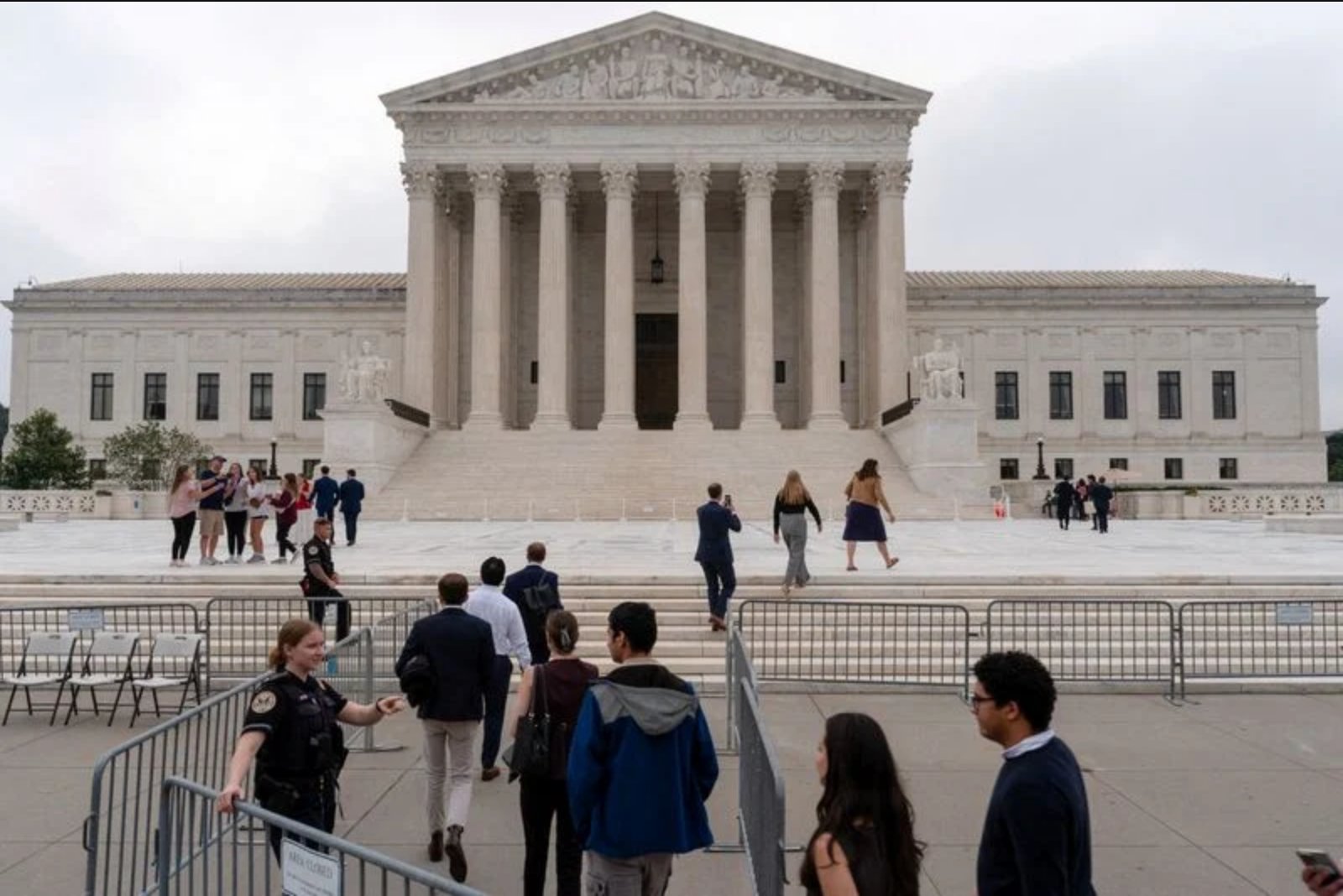
The U.S. Supreme Court on Monday set aside a lower court decision in a legal challenge to the use of a court-authorized "geofence" warrant in an armed robbery prosecution, ordering further review by a lower court. The case involves Okello Chatrie, a Virginia man who has contested the admissibility of evidence obtained through a geofence warrant that contributed to his conviction.
The justices, in a 6-3 ruling, rejected the lower court's conclusion against Chatrie and concluded that a search had occurred. Rather than resolving the constitutional question definitively, the high court sent the matter back to the lower court to undertake additional analysis.
Geofence warrants require third-party companies - in the matter before the justices, that company was Alphabet's Google - to search customer location records for mobile devices that were near a crime scene around the time an offense occurred. Google is not a party to the litigation before the Supreme Court.
At the center of the dispute was whether law enforcement's use of such a warrant to identify possible suspects is consistent with the Fourth Amendment's general requirement that searches be "reasonable." The debate underscores tensions between the Constitution's 18th-century text protecting the right to be secure against unreasonable searches and seizures, and modern digital tools that change how investigations are conducted.
In Chatrie's situation, authorities had exhausted other leads and sought a court-approved geofence warrant after footage showed the robber using a cellphone at a Midlothian, Virginia, credit union. Prosecutors say the investigative method contributed to a sentence of nearly 12 years in prison for Chatrie, who conditionally pleaded guilty in 2022 while continuing to pursue his appeal. He was convicted for brandishing a gun and making off with $195,000.
Investigative practice in geofence cases typically begins with a company returning an anonymized roster of device identifiers located in a specified area and time window. That list is then narrowed in a multi-step investigative process that may culminate in the company providing account holder information to law enforcement, yielding potential suspect leads.
In this case, Google location records placed Chatrie at the crime scene along with 18 other users. Those individuals, including Chatrie, had opted into Google's "location history" feature and were identified as having been within a 150-meter (492-foot) radius of the credit union during a one-hour window surrounding the 2019 robbery. Subsequent searches tied to Chatrie yielded evidence prosecutors described as two "robbery-style demand notes" found in his bedroom, a pistol and nearly $100,000 in cash, with some bills bundled in bands signed by the credit union teller targeted in the robbery.
Arguments presented before the justices in April reflected sharply different views. Chatrie's attorney, Adam Unikowsky, maintained that geofencing produces an overly broad search that exposes large quantities of private information to government scrutiny and lacks the particularity the Fourth Amendment requires. A lawyer for the Justice Department, Eric Feigin, countered that Chatrie's decision to opt in to Google's location history diminished any reasonable expectation that his location data would remain private.
The case also follows a pattern of judicial scrutiny of cellphone-location evidence. The Supreme Court in 2018 imposed limits on law enforcement's ability to obtain cellphone data that pinpoints a suspect's past location. Within the lower courts handling the Chatrie matter, Virginia-based U.S. District Judge Mary Lauck concluded that the geofence warrant used in this investigation violated the Fourth Amendment but nonetheless denied the defendant's request to suppress the evidence. The Richmond-based Fourth U.S. Circuit Court of Appeals affirmed Judge Lauck's ruling.
Separately, the record notes that President Donald Trump's administration defended the investigative technique in the proceedings. The Supreme Court's decision to remand rather than settle the constitutional question leaves open further consideration by the lower court of how geofence warrants align with Fourth Amendment protections.
The remand means the case will return to the lower court for the specific, additional analysis the justices ordered, while Chatrie remains subject to the conditional guilty plea entered in 2022 and the sentence imposed following his conviction.