
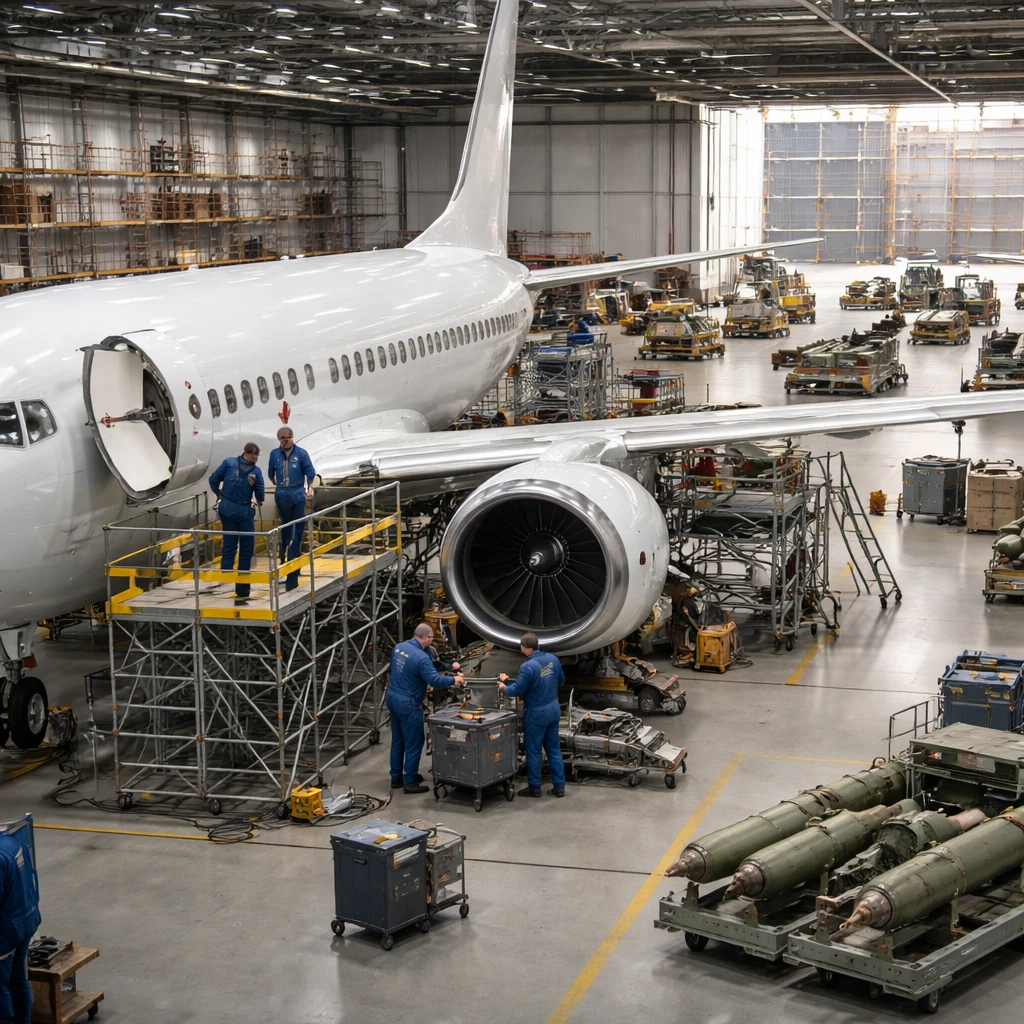
RTX said on Thursday it had increased its full-year 2026 revenue and profit guidance, pointing to enduring demand for commercial aircraft maintenance and a pickup in military systems orders. The company reported a 22% jump in its backlog from a year earlier, reaching $289 billion, comprised of $170 billion in commercial aerospace orders and $119 billion in defense work.
Management attributed the robust maintenance, repair and overhaul (MRO) market to persistent shortages of new commercial aircraft. Those shortages, the company said, stem from supply-chain snags and delayed deliveries that have left airlines operating older fleets for longer and relying on higher-cost maintenance solutions.
Pratt & Whitney, RTX’s engine unit that supplies powerplants for Airbus A320neo-family narrowbodies and for Lockheed Martin’s F-35 fighter, recorded a 16% increase in sales to $8.89 billion. The Raytheon defense business posted an 18% rise in sales to $8.27 billion, driven in part by demand for air and missile defense systems such as Patriot, Standard and AMRAAM missiles.
RTX said defense contractors as a group have been supported by elevated global security spending as the Pentagon and allied governments work to replenish inventories that were drawn down by conflicts in Ukraine, the Middle East and other regions. U.S. President Donald Trump has urged defense firms to boost production and expand factory capacity, and has proposed a fiscal 2027 military budget of $1.5 trillion.
Following these developments, RTX lifted its outlook for adjusted 2026 sales to a range of $95 billion to $96 billion, up from a prior forecast of $92.5 billion to $93.5 billion. Analysts on average are looking for $94.08, according to data compiled by LSEG.
The company also raised its forecast for full-year adjusted earnings to $7.10 to $7.25 per share, from a previous range of $6.70 to $6.90. Wall Street consensus had been $6.92 per share. In the second quarter, RTX reported adjusted earnings of $1.89 per share, compared with $1.56 in the year-ago period.
While the company cited clear demand drivers across commercial MRO and defense procurement, its revised guidance and backlog figures underscore the continuing linkage between constrained aircraft deliveries, airline fleet decisions, and the level of aftermarket activity. In defense, the replenishment of inventories and government-driven production directives remain the immediate sources of order growth.