
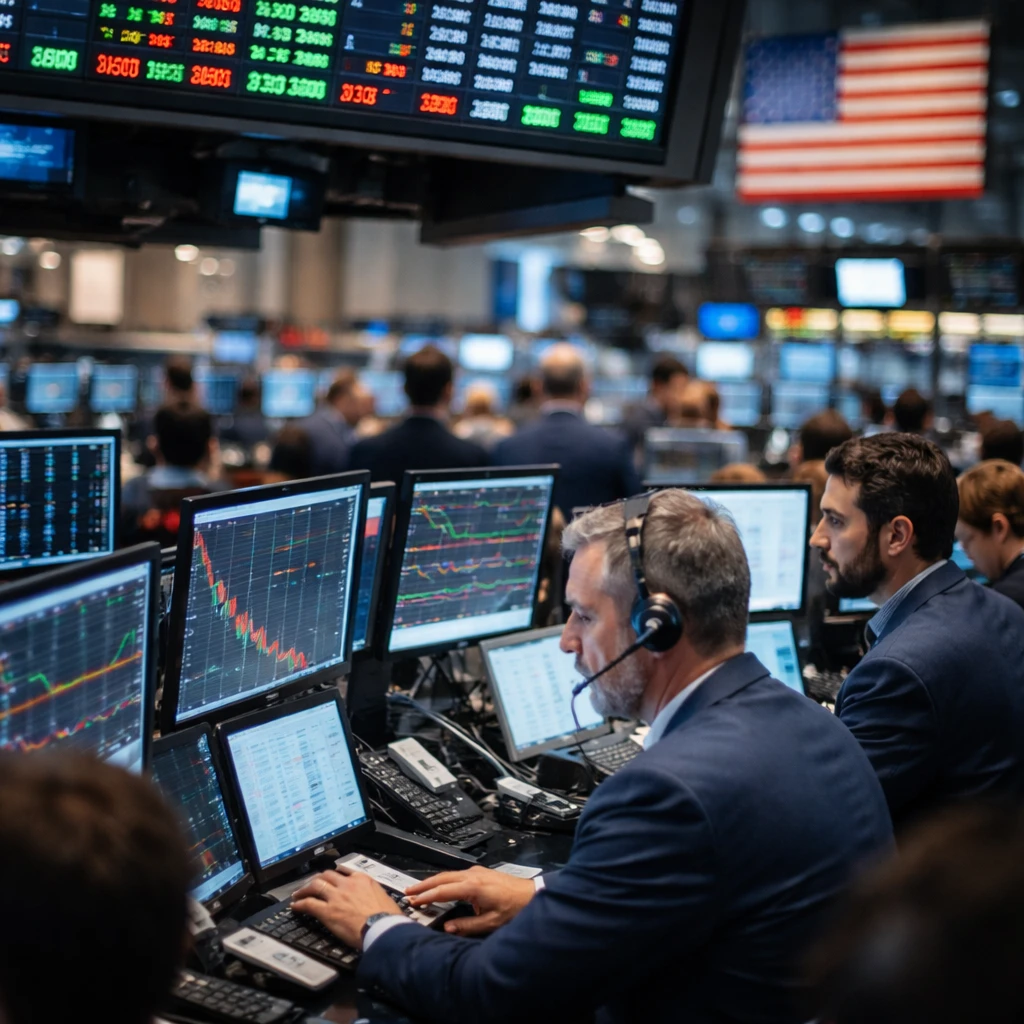
U.S. equity markets ended the week with fresh signs of investor caution as the Nasdaq Composite extended its slide to a fifth consecutive session on Friday, reflecting a continued pullback from higher-beta technology shares.
The tech-heavy Nasdaq slipped 0.24% to close at 25,297.62. The S&P 500 edged down 0.05% to 7,354.02, and the Dow Jones Industrial Average lost 44.51 points, or 0.09%, finishing at 51,876.11.
Over the course of the week, the S&P 500 fell nearly 2% while the Nasdaq declined 4.6%, pressured notably by sharp drops in semiconductor stocks as market participants reassess the timing and scale of AI-related profit growth. The Dow diverged from the broader market trend, rising 0.6% across the same period.
Despite the recent turbulence, the major averages remain positioned to close out a healthy first half of the calendar year when markets wrap up next week. The S&P 500 is up more than 7% year-to-date in 2026, though June has shown heightened volatility across equities.
Investor focus now shifts to a packed calendar. A key data point will be the monthly U.S. jobs report due on Thursday - a release that could materially influence expectations for monetary policy. A stronger-than-forecast payrolls number could reinvigorate bets on additional rate increases, adding to the uncertainty that has been compounded by sharp moves in technology shares. U.S. exchanges will be closed on Friday for the Independence Day holiday.
Minutes from the Federal Reserve’s most recent meeting signaled that policymakers are firmly fixated on lowering inflation, language markets interpreted as more hawkish than anticipated. That readjustment in tone has been reflected in Fed funds futures, which now price in better-than-even odds of a rate increase by the central bank’s September meeting - a notable shift from earlier in the year when many investors were positioned for rate cuts.
Reflecting on the path for policy and markets, Morgan Stanley strategists said: "Our view is that falling energy prices, peaking tariff inflation, and contained services and housing inflation keep the Fed on hold rather than hiking this year. If this stance isrealized, lower real rates would support equities and further fuel the broadening trade." They also cautioned that liquidity dynamics pose a risk: "On the other side, liquidity is tightening as the RMP and Treasury buybacks shrink just as equity supply and the real economy needs more. This is the near-term risk for the indices and popular momentum trades."
The labor market continues to show resilience. Payrolls rose by 172,000 in May, marking the third consecutive month of solid job gains. Economists surveyed by Reuters expect June employment to increase by 110,000. Inflation remains elevated, still well above the Fed’s 2% annual target, which maintains upward pressure on policymakers to act.
Corporate earnings will also command attention next week. Nike is scheduled to report quarterly results on Tuesday, a release market participants will watch for signals about consumer demand and margin trends.
Market strategists provided a mix of longer-term context and tactical positioning as investors weigh the incoming data and the Fed’s posture.
RBC Capital Markets said it completed its monthly update of its 12-month S&P 500 price target, raising it to 8,150 from 7,900. "The story we’re seeing in the numbers broadly is that the stock market deserves to move higher over the next year from a variety of perspectives - subdued sentiment that still has room to climb a wall of worry, earnings tailwinds that offset P/E headwinds in the form of possible interest rate and inflation pressures, a solid GDP backdrop, and a monetary policy backdrop that’s still conducive to further gains," the firm said.
JPMorgan offered a constructive view for the second half of the year, stating: "In terms of global equity outlook, we remain constructive for 2H, are staying with Cyclical trades and look for certain rotations compared to what was an extremely narrow leadership in Q2 - top chart. This is not to say that Mag-7 and SOX are a sell. We believe the recent weakness in the space is largely technical, positioning driven, and will ultimately be bought into. Mag-7 P/E relative is at the cheapest levels in 10 years, with earnings delivering. Having said that, we do not believe AI trade will be the only story in town in 2H, and are looking for a broader market participation."
Evercore ISI emphasized the heightened sensitivity to interest rate path and the potential for market surprises tied to tightening cycles: "With the Fed’s resolute focus on the 2% inflation target, investors believe that there will be a rate hike prior to year end, yet only a fraction of a 2nd hike into 2027 - setting up the markets for a surprise (up, down or both) as prior Hike cycles suggest investors consistently underestimate the length and scope, which averages 333bp over 11 months for 'Soft Landings', 598bp over 17 months for 'Hard Landings'. While investors may 'know' a rate hike is coming, stocks nevertheless tend to selloff 1/3m after the first hike while 6/12m fwd returns skew positive but below average. The 'AI Revolution' hiking cycle of 2026, should it materialize, 'Will Be Different This Time'. Unlike the 1999 hikingcycle where rates rose 175bp in 6 months to pop the Dot.Com bubble, Warsh does not view AI as being an Irrationally Exuberant Bubble."
Morgan Stanley added that earnings strength and commodity moves have helped broaden market participation: "Strong earnings for the median stock, falling crude prices and underperformance of the Hyperscalers and now Semis are driving a broadening in a weaker tape. We remain constructive on Discretionary Goods, Transports and Regional Banks as popular momentum trades come under further pressure."
Next week’s data and corporate releases, combined with the Fed’s evolving communications, will be critical for determining whether the recent pullback in technology and semiconductor stocks is a temporary repricing or the start of a more structural shift in leadership. For now, investors are balancing the resilience of employment and corporate earnings against an increasingly hawkish policy backdrop and dwindling liquidity supports, leaving a narrow path between upside from earnings and downside from tighter financial conditions.