
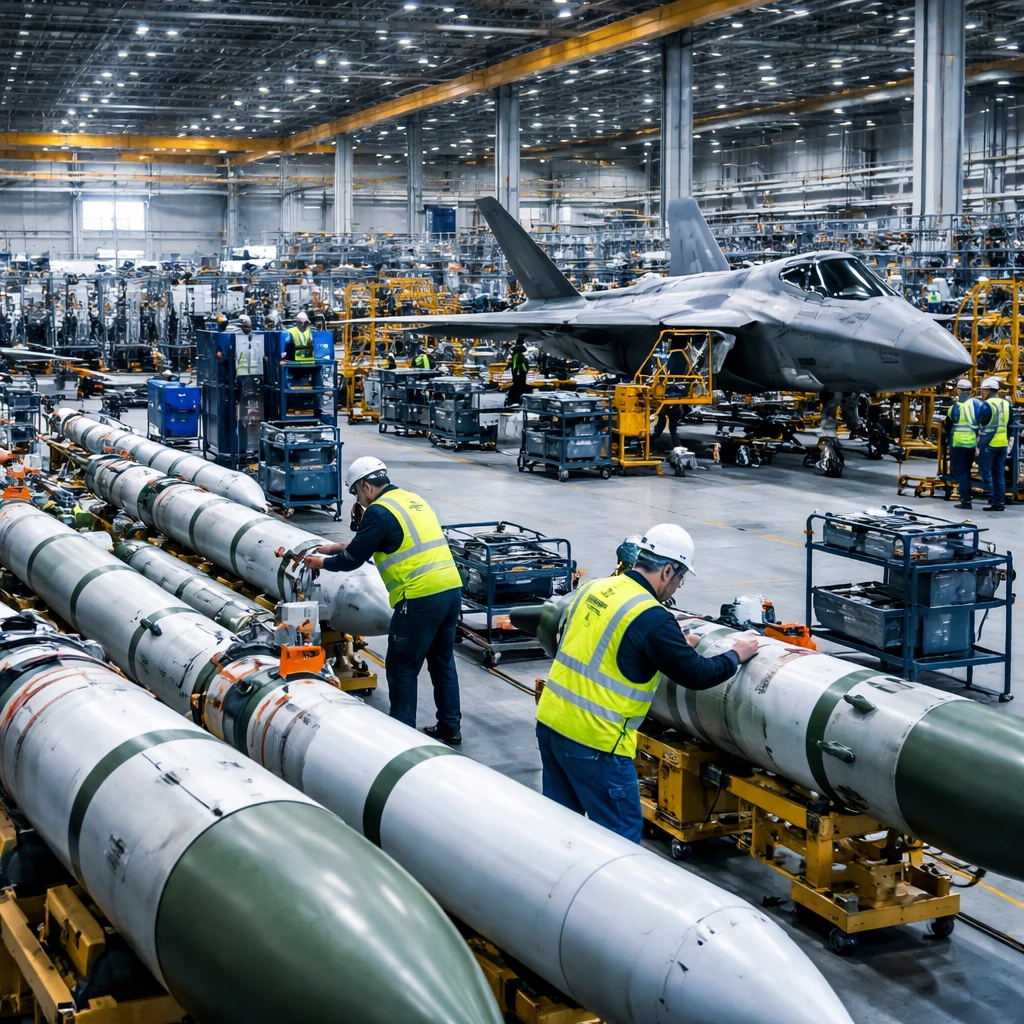
Lockheed Martin said it is increasing its sales and profit targets for 2026 following a quarter marked by rising production of missiles and continued sales of its F-35 fighter. The company cited stronger demand tied to U.S. government efforts to replenish weapons inventories that have been drawn down during multiple recent conflicts.
Shares rose 7% in premarket trading after the update. The company now expects 2026 revenue between $79.75 billion and $81.75 billion, up from its prior guidance range of $77.5 billion to $80 billion. The midpoint of analysts' expectations compiled by LSEG sits at $79.14 billion.
Lockheed also increased its full-year per-share profit outlook to a range of $29.95 to $30.65, versus its earlier projection of $29.35 to $30.25. That revised guidance is above Wall Street's consensus of $29.90.
For the second quarter, the Bethesda, Maryland-based company reported earnings of $7.94 per share, compared with $1.46 per share in the year-ago period. Last year’s results were weighed down by a $1.6 billion charge related to problems in the Aeronautics unit and international helicopter programs in the Sikorsky segment.
Operational drivers in the quarter included a near 20% increase in revenue for Lockheed's missiles and fire control business, which reached $4.1 billion. That growth reflected higher production of PAC-3 and Precision Strike missiles, both of which have been employed in the U.S.-Israeli war on Iran in recent months, according to the company.
The missiles segment also benefited from stepped-up THAAD missile interceptor production following a June contract to expand output. Lockheed signed a $35 billion agreement with the U.S. government to roughly quadruple THAAD production.
Sales in Lockheed's aeronautics segment rose 9%, supported in part by greater production volumes and deliveries of the F-35 stealth fighter. The F-35 remains the Pentagon’s largest acquisition program, with lifetime costs estimated at more than $2 trillion to purchase, operate and sustain the fleet.
Lockheed said its total backlog climbed to $230.4 billion, up 38.3% from $166.5 billion a year earlier. The company noted that demand is expected to remain strong, citing Pentagon data that the U.S. has used more than 50,000 rockets, missiles and rocket-propelled munitions from the start of the Russia-Ukraine conflict in 2022 through the U.S. strike on Iran.
Political pressure has also been a factor. President Donald Trump has publicly urged defense contractors to raise production as ongoing conflicts - including the U.S.-Israeli war on Iran and the prolonged Russia-Ukraine war - have depleted Pentagon inventories.
While Lockheed raised guidance and posted robust quarterly profits, the company’s prior-year charge highlights the potential for program-specific setbacks to affect results. Management’s updated outlook reflects higher volume across missile and aeronautics programs and a sizeable backlog of orders awaiting fulfillment.