
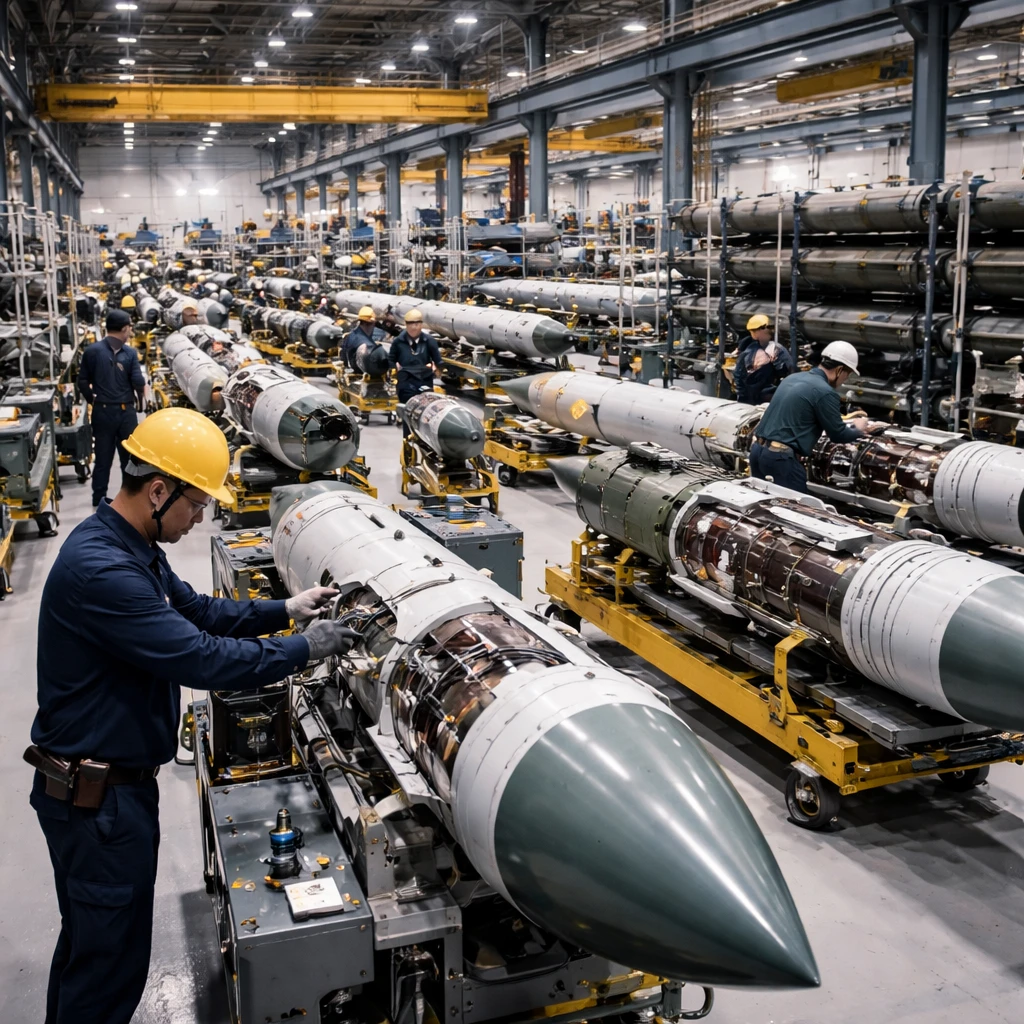
Lockheed Martin and RTX, the two largest U.S. defense contractors, said on Thursday they expect sustained profitability and stronger sales as military inventories are replenished following a wave of global conflicts. Investors responded positively to the outlook, sending Lockheed shares sharply higher and lifting RTX stock.
Company executives attributed the more bullish outlook to heavy usage of munitions and weapons systems across multiple theaters that has eroded existing stockpiles and created elevated demand for production and maintenance.
Market reaction and context
Investors cheered the companies' forward-looking commentary and results, pushing Lockheed Martin shares up 10.6% and RTX shares higher by 7.7% following the announcements. Both firms reported quarterly results that exceeded Wall Street expectations and used the earnings calls to highlight stronger order flows and production ramps.
Drivers of increased demand
U.S. defense officials and political leaders have urged higher production amid what companies described as heavy operational usage of munitions. Company executives noted pressure to accelerate deliveries, and senior management described expanded flexibility from government customers to move faster on production.
The U.S. has expended more than 50,000 rockets, missiles and rocket-propelled munitions since the start of the Russia-Ukraine conflict in 2022 and throughout the U.S. attack on Iran, which began on February 28, according to Pentagon figures disclosed by the companies. That high burn rate has been cited as a key factor driving replenishment programs and contract activity.
Lockheed Martin results and guidance
Lockheed reported that revenue in its missiles and fire control segment rose nearly 20% to $4.1 billion. The gain was attributed to stepped-up production of its PAC-3 and precision strike missiles, both of which have been used in recent operations in Iran. Production of THAAD missile interceptors also rose, following a June contract worth $35 billion to significantly increase output.
The company said its total backlog of orders awaiting production climbed to $230.4 billion, a 38.3% increase from $166.5 billion a year earlier. Lockheed's management signaled active discussions about expanding partnerships, particularly in Europe, to accelerate scaling of production capacity.
Reflecting these trends, Lockheed updated its 2026 revenue guidance to a range of $79.75 billion to $81.75 billion, up from the prior range of $77.5 billion to $80 billion, and above analysts' consensus of $79.14 billion based on LSEG data.
Lockheed's chief executive noted the government has been allowing more flexibility than usual to speed deliveries, and the company's chief financial officer said management was exploring additional partnership opportunities to expand capacity more quickly in response to demand.
RTX performance and outlook
RTX reported a 22% year-over-year increase in backlog to $289 billion, which the company said comprised roughly $170 billion in commercial aerospace orders and $119 billion tied to defense. Demand for aircraft maintenance, repair and overhaul services remained robust as supply-chain disruptions and delivery delays have forced airlines to keep older fleets in service longer.
Sales at Raytheon, RTX's weapons business, rose 18% to $8.27 billion, driven by demand for Patriot, Standard and AMRAAM missile systems. RTX said about half of Raytheon's bookings in the first half of the year, totaling $10 billion, came from international customers, and of that international portion $7 billion originated with European buyers.
RTX raised its 2026 adjusted sales outlook to $95 billion to $96 billion, up from a previous range of $92.5 billion to $93.5 billion, surpassing analyst estimates of $94.08 billion. It also increased its adjusted earnings-per-share forecast to $7.10 to $7.25, from $6.70 to $6.90 previously.
Company executives highlighted that roughly two-thirds of the uplift in annual profit guidance was attributable to Raytheon, with about another 25% coming from Collins, the aerospace components business, according to commentary by an analyst covering the sector.
RTX's chief executive additionally noted potential opportunities emerging in the Middle East and emphasized the company's established customer relationships across both the Middle East and Europe as supportive of future business prospects.
Broader implications for markets and industry
- Defense manufacturing and aerospace services both stand to gain from heightened production and maintenance activity as governments and airlines respond to operational and supply-chain pressures.
- Backlog expansions at major defense contractors signal multi-year demand for missiles, interceptors and related systems, with implications for industrial capacity and supply-chain planning.
Summary
Lockheed Martin and RTX reported stronger-than-expected quarterly results and raised guidance for 2026 on the back of elevated demand to replenish military munitions and sustain aircraft operations. Both companies expanded backlogs and cited international and domestic ordering that supports higher production and services volumes.