
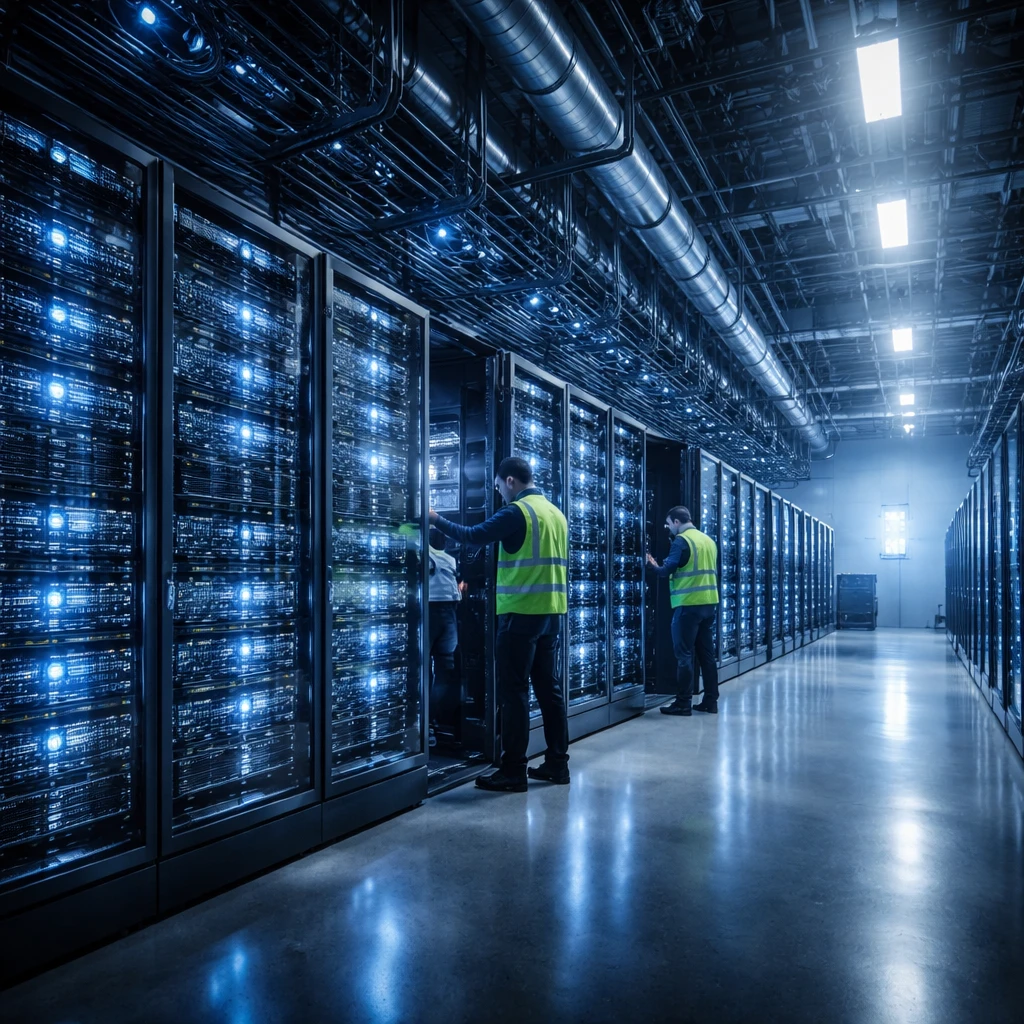
Alphabet’s recent update has practical implications for the neocloud sector: the company lifted its FY26 capex target to $195 billion - $205 billion (from $180 billion - $190 billion) and said it will begin expanding third-party AI compute capacity in Q3. That combination - higher overall spending and explicit outsourcing of inference workloads - points to a tangible demand pipeline for independent cloud operators that specialize in GPU-heavy AI services.
Market moves were uneven. Alphabet shares were trading at $323.69, up 1.89% after earnings, but the most consequential disclosure came from the company’s finance team: its internal data center expansion will not fully satisfy AI inference needs, prompting an outsourcing approach. For neoclouds, that is not an abstract tailwind but a direct commercial opportunity.
CoreWeave: the central, liquid play
CoreWeave (CRWV) is the clearest and most liquid pure-play beneficiary identified by the market. Shares were trading around $74.45, down roughly 8.2% on the day, implying a market capitalization near $44.25 billion and a 52-week range of $63.80 - $153.20.
| Metric | Value | Take |
|---|---|---|
| LTM Revenue | $6.23B | Scaling rapidly |
| Revenue Growth | +130% YoY | The demand proof |
| Gross Margin | 69.4% | Platform-quality economics |
| Net Income Margin | -25.6% | Still burning, but narrowing |
| FCF | -$10.62B | The leverage price tag |
| Debt/Equity | 738.5% | The key risk to own |
| Fair Value Upside | +20.5% ($90.03) | Below intrinsic value |
| Analyst Consensus Upside | +69.5% | Street is bullish |
CoreWeave has been confirmed as a launch partner for Nvidia’s Vera Rubin architecture, technology that the company claims delivers 10x throughput per megawatt versus the prior Blackwell architecture. OpenAI is slated to scale Vera Rubin on CoreWeave infrastructure in Q3, according to public commentary. Separately, private capital is backing the thesis: Galaxy Digital is raising $3.5 billion in junk bonds to finance a CoreWeave data center, with more than $1 billion of projected annual revenue locked in under 15-year lease agreements. Those moves indicate private-credit endorsement of long-term contracted income streams.
Analyst support is building. BofA reiterated a Buy with a $140 price target and raised its FY26 capex estimate to $34 billion while projecting operating margins that exit 4Q26 at 14.6% (up from 1.0% in 1Q26). Truist upgraded to Buy with a $126 target. Baird initiated coverage at Outperform with a $100 target. Rosenblatt offered a more aggressive Buy call and a $250 target. The day’s share-price drop creates a valuation gap versus the $90 fair value mark and $100 - $140 analyst targets; market chatter suggests competition concerns - notably SpaceX - are pressuring the stock rather than a sudden fundamental deterioration.
Nebius: the European, asset-light contender
Nebius Group (NBIS) changed hands near $199.86, down about 9.55% intraday, with a market capitalization roughly $56.58 billion and a 52-week trading range between $50.00 and $299.86.
| LTM Revenue | $877.9M | Early innings vs. CRWV |
| Revenue Growth | +575% YoY | Rapid ramp |
| Gross Margin | 72.1% | Best-in-class economics |
| 6M Return | +111.3% | Already a big mover |
| 1Y Return | +282.9% | The monster run |
| Analyst Upside | +18.9% | More moderate consensus |
| Northland PT | $410 | Aggressive bull case |
Northland’s analysts model Nebius roughly on par with CoreWeave, assuming about a 14% share of a modeled AI-as-a-Service market. Because Nebius operates an asset-light model, it can introduce incremental capacity without incurring the same debt burden that marks CoreWeave’s balance sheet. That structural difference underpins the bull case. The counterpoint is valuation: some fair-value models imply about -20.4% downside from current levels, and the recent 283% one-year gain suggests much of the positive narrative is already priced in.
Speculative tier: QumulusAI and Hyperscale Data
Two smaller, higher-risk names have reported contract wins but face questions about balance-sheet durability. QumulusAI (QMLS) traded near $7.79, off 5% on the session, with a market capitalization near $269 million and a newly announced $32 million Blackwell GPU deal. QumulusAI is down about 79.5% year-to-date.
Hyperscale Data (GPUS) was trading near $0.12, down roughly 1.2%, with a market cap near $60 million. The company has a $1.2 billion 10-year Master Service Agreement plus a Michigan neocloud deal pending. Hyperscale’s shares are down about 85.9% over the past year. The contracts are real revenue signals, but for both names the pressing question is whether their balance sheets can support sustained growth.
Key sector risk: SpaceX pricing and the Pentagon deal
The single largest overhang noted by market participants is the potential for SpaceX to compete aggressively on price if it pursues Pentagon AI compute business with Starship-style cost advantages. That scenario could compress pricing power for incumbent neocloud operators like CoreWeave. BofA’s argument that demand outstrips supply remains the prevailing counterpoint, but the market will be watching any signals from the Pentagon-related procurement process for evidence of how fiercely SpaceX might pursue price-based disruption.
In the near term, the sector looks to be balancing a clear demand signal from Alphabet against concentrated risks around competitor pricing and capital structure. For investors, today’s price action creates differentiated entry points across larger, balance-sheet-heavy operators and smaller, asset-light or speculative names.