
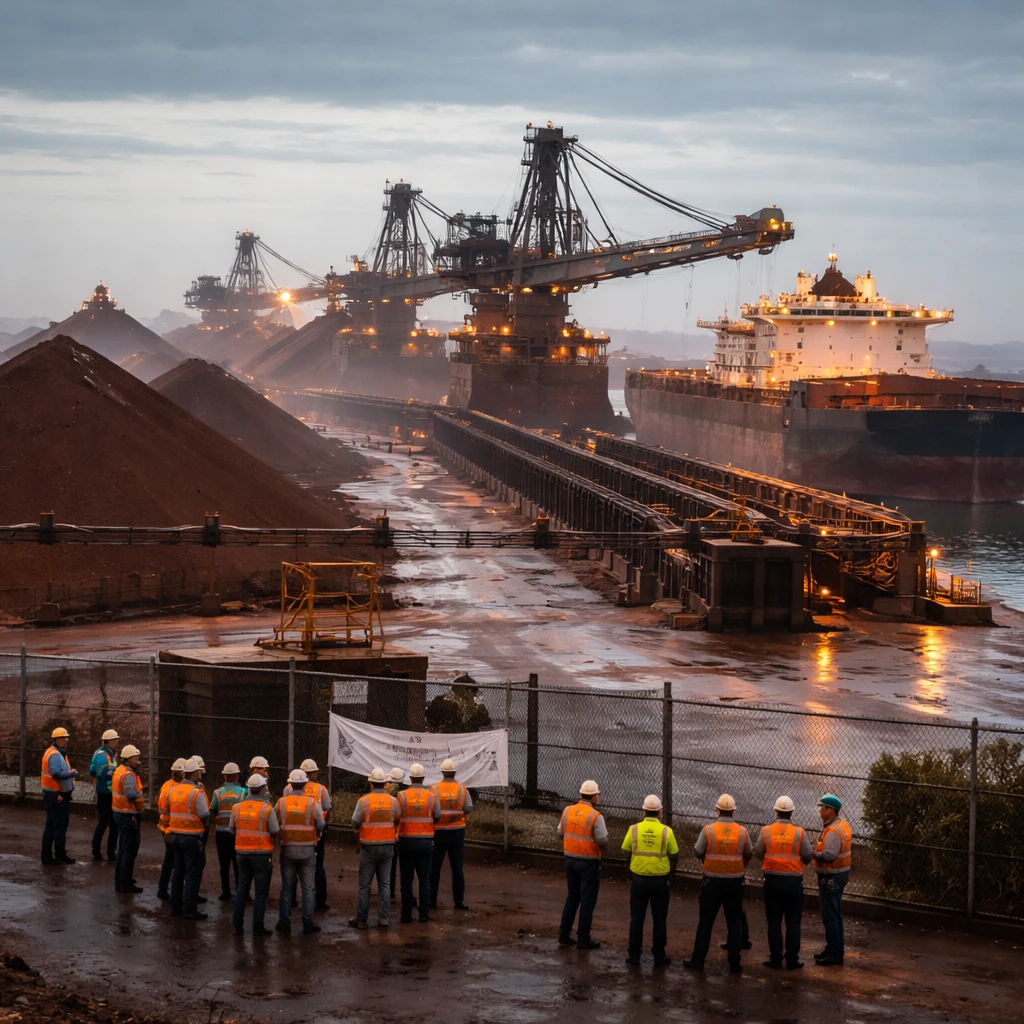
BHP shares fell 2.9% to A$58.795 on Thursday following a quarterly production update that contained both upside and downside elements, and as a labour stoppage at the miner's Port Hedland iron ore export terminal in Western Australia began - the company's first major industrial action in more than two decades.
Approximately 160 to 200 port and maintenance workers have moved to strike after six months of enterprise agreement negotiations reached an impasse. The Combined BHP Ports Unions, which represents four unions at the operation, implemented the stoppage after a final bargaining session on July 14 failed to close the gap on a new four-year workplace agreement. The unions and company are not scheduled to meet again until July 21.
The economic consequences of the disruption are material at a near-term level: Port Hedland handles roughly $80 million of BHP iron ore exports each day, so any interruption to throughput is an immediate hit to daily export value and, by extension, near-term revenue.
Separately, BHP published its Q4 FY2026 production report on Thursday. The document showed West Australian iron ore output rose 7% quarter-on-quarter but fell 3% year-on-year. The report also included a reduction to FY2027 copper production guidance, a development that disappointed some investors who had already been concerned about the company's cost trajectory after the earlier Jansen Stage 2 potash project budget blowout and the related impairment charge.
Despite Thursday's drop, BHP shares have enjoyed substantial gains earlier in the year, trading up nearly 30% so far in 2026 as the company benefited from higher copper and iron ore prices. The stock had also climbed nearly 3% in the immediate run-up to the release of the quarterly production figures.
Context and market reaction
Market participants reacted to the combination of the immediate operational risk posed by the Port Hedland stoppage and the production guidance cut. The strike presents a direct, quantifiable impact on daily export value, while the guidance reduction and previous project cost overruns raise questions about near-term output and capital discipline.
At the time of the report, details on the expected duration of the stoppage were limited to the negotiating timeline, with the next scheduled talks on July 21. Management commentary beyond the published production figures was not included in the report.
Bottom line
BHP's share decline on Thursday reflects investor sensitivity to both operational disruptions and evolving production prospects. The Port Hedland industrial action and the lowered copper outlook combined to offset some of the gains the company has recorded so far in 2026.