
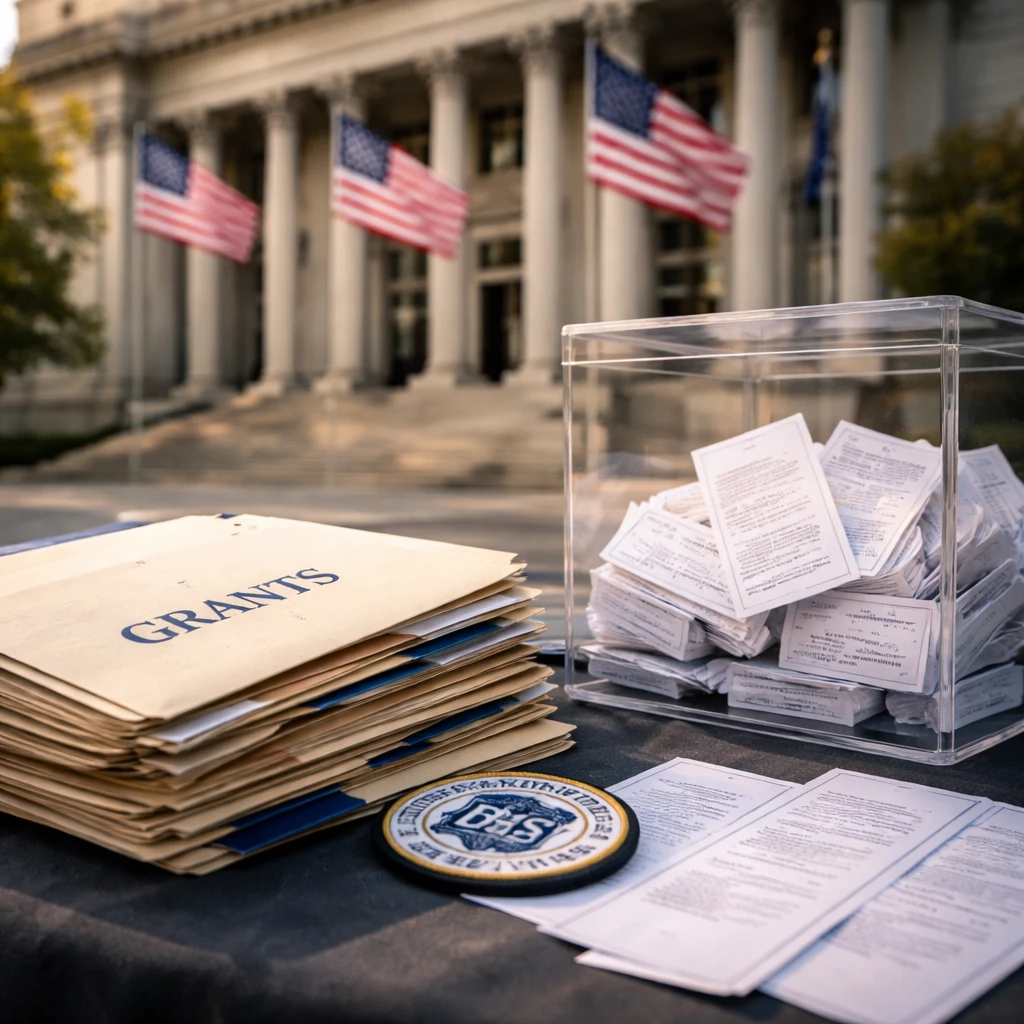
A group composed primarily of Democratic-led states, together with the District of Columbia, filed suit in federal court in Rhode Island seeking to enjoin the Department of Homeland Security from imposing new conditions on disaster-related grant funding tied to election administration practices.
The challenge, brought by 25 states and D.C., contests a policy the administration announced that would make a portion of Federal Emergency Management Agency grant awards contingent on states making specified changes to how they administer elections. The legal filing comes as the country heads into November's midterm elections, when control of Congress is expected to be closely contested.
In public statements announcing the restrictions on more than $1 billion in grant money, DHS described the measures it was urging as "common-sense steps to protect U.S. elections." On July 10, DHS said it would withhold 20% of FEMA grant awards intended to help states prepare for potential terrorist attacks and other threats until states provide plans to adopt voting equipment that accepts hand-marked paper ballots rather than rely on electronic systems that use bar codes and QR codes to tabulate votes.
Alongside a push for hand-marked paper ballot equipment, the administration outlined additional requirements. States would need to conduct manual audits of at least 5% of ballots cast, reconcile the number of voters who participated in each federal election with the number of votes cast, and compare their voter rolls with a DHS database to verify that non-U.S. citizens have not been improperly registered to vote.
The lawsuit, led by Rhode Island, California, Illinois and New Jersey, contends the administration exceeded its legal authority by conditioning disaster preparedness grants on statewide changes to how elections are administered. The complaint points to the Constitution's allocation of primary responsibility for administering federal elections to state governments and asserts that the federal agencies lack power to rewrite state election law.
"Congress never gave DHS or FEMA authority to rewrite state election law," the complaint says.
As part of the arguments in court papers, the states note that they were allocated more than $740 million for the 2026 fiscal year under the relevant grant programs. Under the disputed policy, DHS would withhold 20% of those awards, which the states say amounts to at least $148 million.
The lawsuit also emphasizes that the grant programs at issue have been in place for years and were not originally designed with election security as their primary purpose. The state plaintiffs argue that converting those grants into instruments to influence election administration is beyond the scope intended for DHS and FEMA funding.
DHS and FEMA did not immediately provide comments in response to requests regarding the litigation and the policy.
The administration's actions arrive amid political contention over the extent of voter fraud in U.S. elections. The complaint and related filings highlight that former President Trump and some of his allies have advanced claims of widespread voting fraud, including allegations tied to the 2020 presidential election, which the former president lost. Opponents of the administration's approach - including Democrats and voting rights groups - argue these moves aim to erode public confidence in election administration and could set conditions for contesting midterm results should Republicans fail to retain control of the House or Senate.
Officials in the administration have defended the policy by saying states are not doing enough to guard against voter fraud and votes cast by non-U.S. citizens, and that stronger federal involvement is necessary.
The dispute has been fueled by recent developments in individual states. New Jersey's Democratic governor said on Tuesday that more than 6,000 non-U.S. citizens had been accidentally registered to vote in the state and that nearly 400 of those individuals cast ballots, prompting inquiries from the Justice Department seeking data about the voters involved. At the same time, independent studies and audits have repeatedly found that voter fraud remains rare.
A separate analysis of federal court records released recently found that many criminal cases involving non-U.S. citizen voting trace back to voter confusion, miscommunication with election officials or administrative errors rather than a coordinated campaign of illegal voting.
The Rhode Island federal court will now consider whether to block the administration from applying the funding conditions as states prepare for the upcoming election cycle. The case frames a central legal question about the scope of federal agency power versus the constitutional role states play in running federal elections, while also intersecting with the broader political debate over election integrity and administrative authority.