
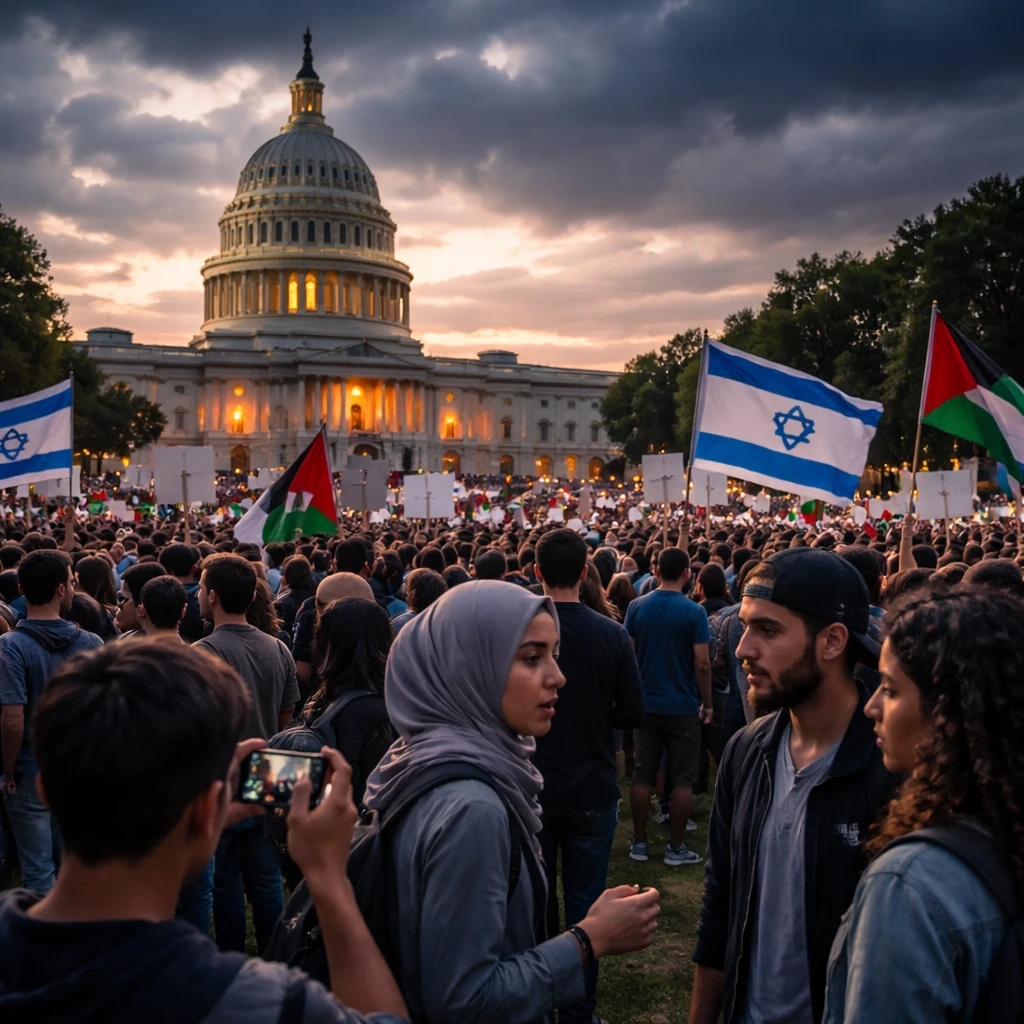
For decades Washington treated support for Israel as a rare point of broad agreement across party lines. That consensus is now fraying within the Democratic Party as the conflict in Gaza, concerns about Israeli leadership and political alignments with U.S. Republicans prompt rising skepticism about long-standing U.S. military assistance.
The pressure is visible on Capitol Hill. In a notable development this month, nearly half of House Democrats voted in favor of an amendment that would have cut off aid to Israel - a measure that previously would likely have been rejected by a commanding bipartisan majority. The amendment failed, but the vote underscores how far Democratic unity on Israel has shifted.
Israel receives $3.8 billion in U.S. military assistance annually and has received additional emergency funding in recent years. Democratic leaders are split over the scope and conditions for that support: some advocate maintaining the status quo, others favor limiting assistance to defensive systems, and a growing number favor a full halt.
House Democratic Leader Hakeem Jeffries and several of his aides opposed the amendment, describing it as too sweeping. Yet prominent Democrats including former Speaker Nancy Pelosi and House Democratic Whip Katherine Clark voted to restrict aid, signaling the depth of internal disagreement.
On the Senate side, Senator Chris Coons of Delaware, the top Democrat on the Senate Foreign Relations Committee, expressed hope that Israel’s elections in October could reopen bipartisan consensus by bringing new leadership. "New governments get to change direction," he told Reuters, adding, "Netanyahu has kept Israel at war for years now, partly to avoid the political consequences of his choices."
Public sentiment mirrors the partisan shift. A June Quinnipiac University poll found that 48% of all voters and 66% of Democrats believe the United States is too supportive of Israel, a substantial increase from the first time the question was asked in 2017 when 16% of voters and 20% of Democrats said the same.
Israel’s ambassador to the United Nations, Danny Danon, acknowledged the debate but emphasized that broad support remains mainstream across many groups. "Yes, there is a vigorous debate, but across broad segments of the parties, support for Israel remains firmly in the mainstream," he said.
The rift will be tested in high-profile Democratic primaries. In Michigan’s Democratic U.S. Senate primary, voters weighed sharply different positions on U.S.-Israel ties in a contest that will determine the November nominee to face Republican Mike Rogers. The contest between progressive Abdul El-Sayed and Representative Haley Stevens has become a barometer of the party’s debate over military aid to Israel.
Stevens recorded a video with AIPAC, a major donor to her campaign, arguing that a close relationship with Israel "yields trade, that yields economic growth and that keeps our freedoms safe." El-Sayed, a former public health official, told Fox News: "The question is whether we want a politics where our money is sent over to Israel to fund genocide and apartheid instead of investing in our own kids."
The allegation of genocide has been raised by a U.N. inquiry and several human rights organizations in connection with the devastation in Gaza; Israel rejects that characterization, saying it is fighting Hamas and taking measures to reduce civilian harm.
Beyond Michigan, Israeli policy shaped outcomes and campaigns in multiple battleground districts. In New York, Florida and Colorado, candidates’ stances on Israel became central campaign issues, contributing to primary defeats for some establishment incumbents.
Conservative and progressive voters have responded in different ways. Jeremy Ben-Ami, president of J Street, a progressive pro-Israel alternative to AIPAC, described intra-party debate as a reaction against both Netanyahu’s right-wing approach and the influence of AIPAC, calling the combination "a toxic brew that really has helped to make Israel, unfortunately, a real wedge issue in the Democratic Party." AIPAC did not respond to requests for comment.
Shibley Telhami, a professor of government and politics at the University of Maryland and a senior non-resident fellow at the Brookings Institution, described the development as a "paradigm shift that sees Israel now as a villain, even a genocidal villain, in a way that was never the case before." He added that while some conservative critics have joined the attacks, the Republican Party is likely to maintain support for Israel as long as evangelical Christians and former President Trump remain aligned behind it.
Several congressional races illustrate how the issue is reshaping electoral math. Outside New York City, Republican Representative Mike Lawler has used Democratic divisions over Israel to target challenger Cait Conley. In southern Florida, moderate Representative Jared Moskowitz, a consistent backer of Israeli aid, faces a primary challenge from democratic socialist Oliver Larkin, who contends Israel has committed genocide in Gaza and supports an immediate halt to U.S. military aid. Polling released in the cycle shows Moskowitz ahead of Larkin by 32 percentage points.
In Colorado, veteran Representative Diana DeGette lost a Democratic primary to Melat Kiros, who has advocated ending wars, including by stopping military aid to Israel. DeGette said she supported restricting aid to defensive weaponry.
Senator Mazie Hirono, who supports a two-state solution and increased humanitarian assistance for Palestinians, voiced a common theme among Democrats who still back Israel’s existence but question its present leadership: "I think the support for Israel’s right to exist, all of that is there. It’s just the (Israeli) leadership we seriously question."
Campus protests and generational differences have amplified the debate within the party. Student activism in 2024 intensified pressure on Democratic officeholders to re-evaluate longstanding positions. At the same time, calls by figures such as New York Mayor Zohran Mamdani for legal accountability for Israeli leaders - including a call for Prime Minister Netanyahu’s arrest over alleged war crimes - have increased tensions between Israeli policy and Democratic constituencies.
Observers say the split has deep roots, tracing back at least a decade to moments of friction between Israel’s leadership and Democratic administrations, and was further inflamed after Israel’s response to the Hamas-led October 7, 2023 attack that killed nearly 1,200 Israelis and foreign nationals and resulted in hundreds taken hostage. Since then, Gaza health authorities report more than 73,000 Palestinians killed, shaping public perceptions and political reactions within the United States.
As the Democratic Party wrestles with its stance, the consequences extend into primary politics and general election strategies, affecting campaigns, donor networks and advocacy groups. Whether the debate will settle after Israel’s elections in October or continue to fuel primary upsets and policy shifts remains an open question within the party. For now, the long-standing bipartisan alignment on Israel has given way to a complex and contested conversation within the Democratic coalition.