
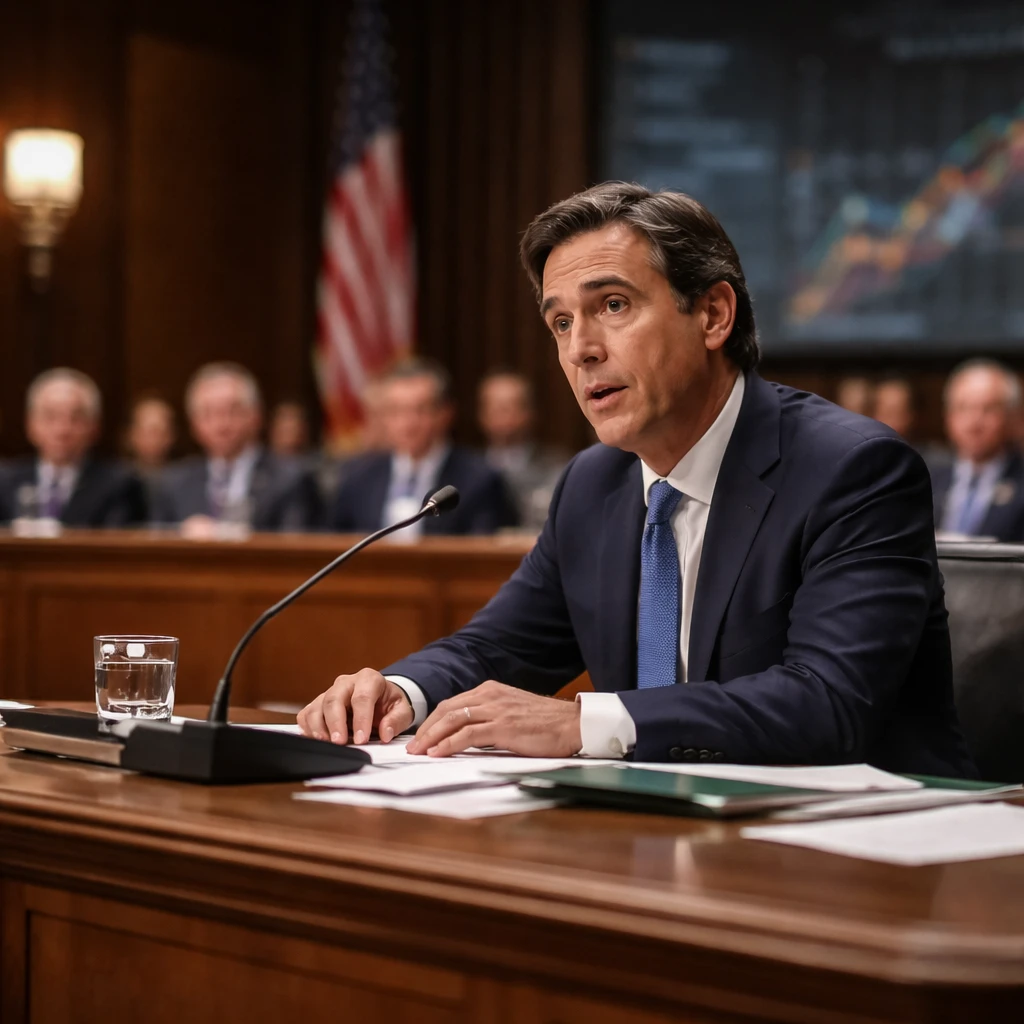
Federal Reserve Chair Kevin Warsh used his second day of testimony to Congress to underline a clear priority: the central bank under his leadership will fix its gaze on the real economy and Main Street, rather than catering to market expectations on Wall Street.
Speaking to the Senate Banking Committee, Warsh rejected the notion that he should be tailoring Fed communications to the needs of market participants. "There are plenty of people on Wall Street who are upset with me already. That I’m somehow not feeding them all the information they’ve got before, if they only had my dot everything would be swell. My message to them is: play the ball, don’t play the Fed," he said, framing his recent choice not to add guidance to the Fed’s updated Summary of Economic Projections as deliberate.
He expanded on that point immediately, stressing the operational discipline he expects from policymakers and market participants. "By that I mean, figure out what’s happening in the real economy, respond to data that’s happening in the real economy, rather than somehow suggest that we’re going to be focused on Wall Street. So you have my commitment to focus on Main Street, because it matters mostly to our dual mandate," Warsh added.
Warsh’s formal testimony arrives at a politically and economically sensitive moment for the Fed. In June, policymakers held the federal funds rate steady at 3.50%-3.75% but signaled an appetite for further tightening later in the year, citing inflation that remains above the central bank’s long-run 2% objective. In public remarks ahead of his testimony, the chair had maintained a hawkish tone consistent with that guidance.
In prepared remarks delivered to lawmakers, Warsh stressed the Fed’s core aim. "The Fed’s number one objective is to get monetary policy right—or as near to it as we possibly can. That is our clear and constant aim, the star we steer by. And if we get policy right—and we will—the inflation surge of the last five years will be a thing of the past," he said, repeating language he used the prior day to the House Financial Services Committee.
Recent inflation releases provided some relief on headline measures, though Warsh cautioned against reading too much into the short-run moves. Data on June consumer and producer prices showed moderation from May: the consumer price index recorded its largest one-month decline since April 2020, and the producer price index fell on a monthly basis for the first time since August last year. Yet Warsh warned these statistics are not flawless indicators of underlying price pressures. "Any central bank would be happy to have the data going in the right direction. My view is that these are imperfect measures of underlying inflation," he told Congress, echoing remarks from his earlier testimony.
Officials and markets noted that much of the June decline in headline inflation stemmed from energy. The fall was driven in part by a more than 20% monthly slump in the global oil benchmark after the U.S. and Iran signed an interim peace deal. At the same time, the testimony noted that oil prices have shown renewed volatility: prices spiked recently amid the biggest escalation in tensions between Washington and Tehran since they signed their agreement, with Brent crude futures up nearly 9% this week alone. Those swings helped explain why the reports offered some breathing room for the Fed in terms of not being forced to raise rates immediately, while leaving uncertainty about the path of inflation.
Warsh devoted a portion of his remarks to the inflationary implications of rapid investment in artificial intelligence. He framed AI as a shock that affects both demand and supply dynamics, saying the demand effects are visible more quickly and are already evident in component prices. "The shock of AI, the supply shock of AI, has an effect on demand and supply ... We see the effect on demand much more quickly ... We see it in the prices of chips that are going up," Warsh said.
On the likely timeframe of any AI-related price effects, the Fed chair offered a guarded projection. "Will it increase measured prices over the course of the next 12 months? I suspect it will be. Whether that’s inflationary or not, that’s up to the Federal Reserve, and we’re going to have something to say about that," he said, indicating the central bank will reassess policy in light of such developments.
Warsh also touched on the valuation dynamics of AI-focused companies. He described the recent surge in investment and valuations as notable, and observed some recent market stress. "The question of these AI companies, certainly the surge in their investment and surge in their valuations is notable. Over the course of last couple of months, we’ve seen the market cap, both of the public companies, and the private companies, under some pressure, but the overall indices, we do seem to see a broadening out," the central bank chief noted.
Those comments come against a market backdrop in which the high-flying AI trade earlier this year helped equities recover from turbulence tied to the Middle East conflict and reach record levels. Since last month, however, concerns that the tech-led rally had become overheated have contributed to a broader market pullback.
Readers can watch the full testimony via the Senate Banking Committee webcast: https://www.banking.senate.gov/hearings/07/08/2026/the-semiannual-monetary-policy-report-to-the-congress.
As Warsh reiterated to Congress, the Fed intends to calibrate policy to the evolving data backdrop - prioritizing the real economy and the institution’s dual mandate while remaining attentive to emerging price pressures, including those tied to AI-driven demand for technology components.