
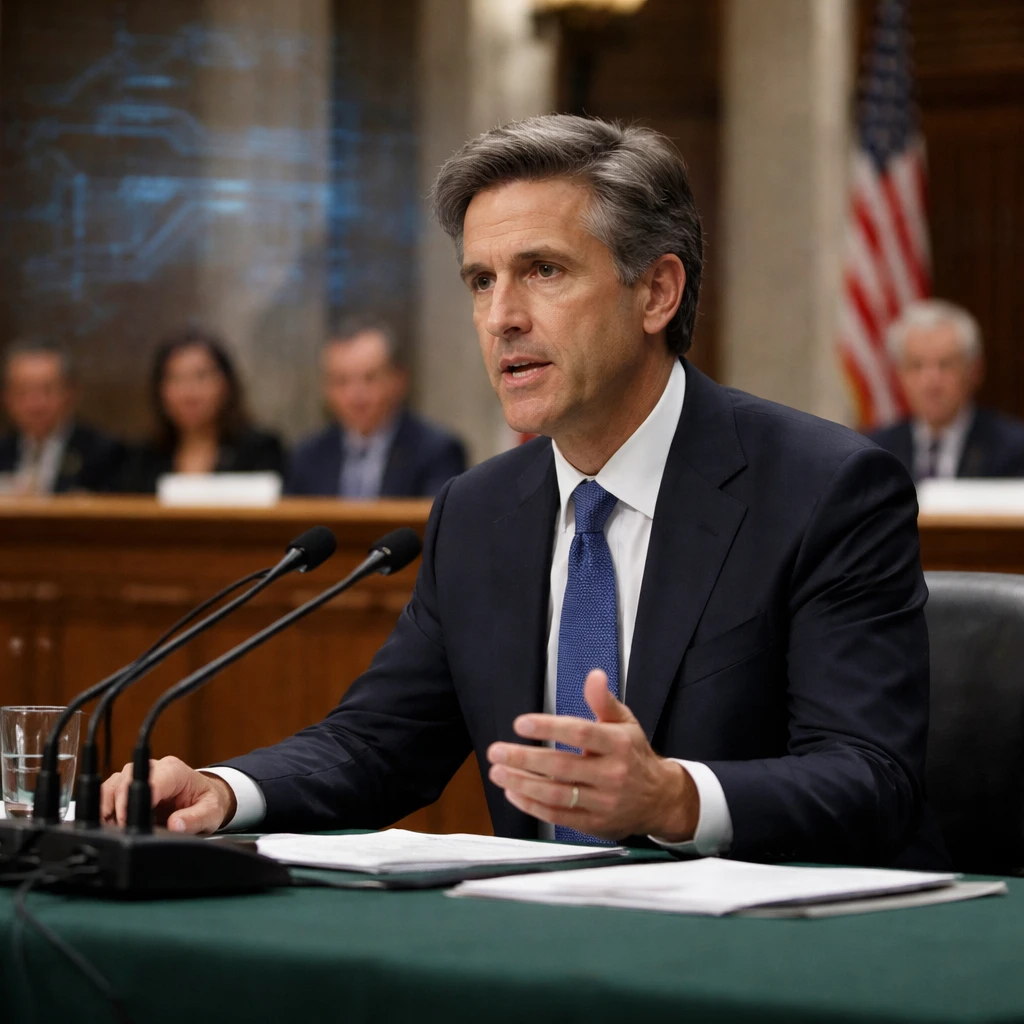
Federal Reserve Chairman Kevin Warsh told lawmakers at a Senate Banking Committee hearing that investment driven by artificial intelligence is contributing to higher prices, but he does not view those one-time price changes as inevitably inflationary. Warsh said the Federal Reserve will assess whether the recent price moves evolve into broader inflationary trends.
"I don’t view a one-time change in prices as necessarily being inflationary because I think there’s a supply response; in that way this is different from a foreign conflict and what it might do, which tends to reduce the supply side of the economy," Warsh told the committee. He cautioned that prices could rise over the coming 12 months, and said the question of whether such increases become inflationary hinges on how the Federal Reserve responds.
Warsh outlined his view that artificial intelligence will generate employment both in the near term and over the long term, while acknowledging potential disruption in the medium term. He told senators he cannot promise there will be no short-term disruption to jobs or offer comfort regarding immediate labor-market outcomes.
"I don’t view a one-time change in prices as necessarily being inflationary because I think there’s a supply response; in that way this is different from a foreign conflict and what it might do, which tends to reduce the supply side of the economy,"
On wages, Warsh said they have been growing at a reasonable pace, but he described the timing of when wage growth will come more from productivity gains as a "puzzle." He emphasized that the surge in prices linked to AI investment is real, while pointing to robust business capital spending as a significant contributor to gross domestic product - a pattern he expects to continue.
Warsh emphasized the central bank's role in judging whether observed price movements transition into sustained inflation. He stressed that supply-side responses set the AI-driven price changes apart from supply-reducing shocks such as a foreign conflict, and reiterated that Fed policy decisions will be central to the inflation outcome.
Key points
- AI-related investment is driving measurable price increases, but the Fed does not automatically treat one-time price moves as inflationary.
- Artificial intelligence is expected to create jobs in the short and long term, though medium-term employment effects may be disruptive.
- Business capital investment is contributing materially to GDP, and Warsh expects that trend to persist.
Risks and uncertainties
- Whether AI-driven price increases become inflationary depends on future Federal Reserve actions - markets and financial sectors are exposed to that policy uncertainty.
- Medium-term disruption to employment is possible, posing risks to labor-intensive sectors and consumer demand dynamics.
- The timing of a shift toward wage growth driven by productivity gains is uncertain, creating ambiguity for wage-sensitive sectors and household income projections.