
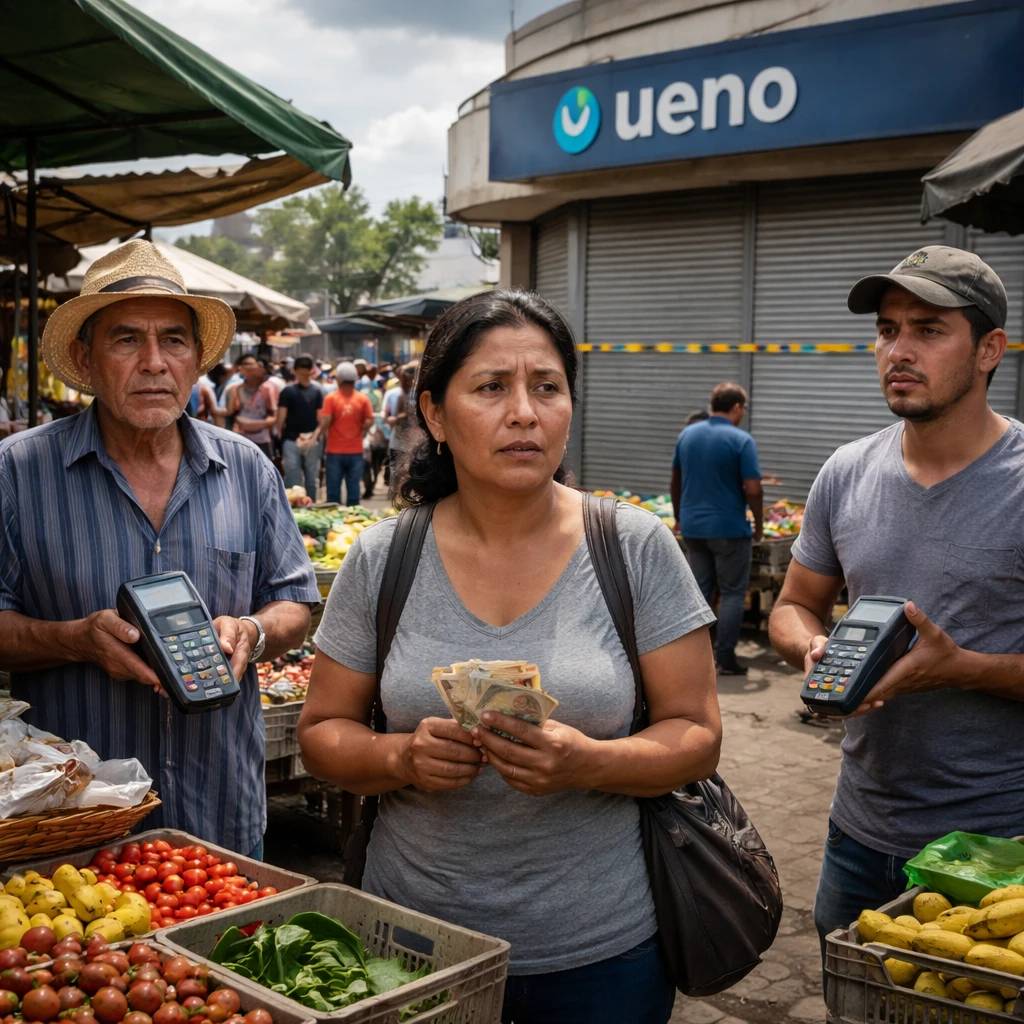
ASUNCION - The sudden collapse of Paraguayan digital bank ueno has upended the daily commerce of Asuncion's Mercado 4, a sprawling market where thousands of vendors previously embraced the bank's green point-of-sale terminals to process payments and transfers. For many stallholders, ueno had been their first experience with formal banking, offering a streamlined account-opening process and cashback incentives that brought street vendors and micro-entrepreneurs into the financial system. But that progress unraveled last week when Paraguay's central bank placed ueno into resolution over solvency concerns, freezing millions of accounts and triggering the country's biggest political crisis in more than a decade.
At Mercado 4, the usual bustle has faded as sellers scramble for alternatives. Some are turning to other banks, while others are reverting to cash - a risky move that leaves them vulnerable to crime. Many are still waiting to recover their funds. 'Most have lost a lot of money. They're really affected,' said Elvia Quiroz, a 60-year-old clothing seller who has worked at the market for over three decades. Ueno had branded itself as Paraguay's 'undisputed leader in financial inclusion,' in a country where informal employment accounted for 60% of the workforce last year. 'We got used to transfers. People did business that way,' Quiroz said. 'Suddenly this happened and everything fell apart.'
The bank's collapse on November 3 left roughly 3 million customers across Paraguay temporarily unable to access their accounts, while authorities work to reimburse depositors and transfer customers to other banks. A local merchants' association estimated that around 80% of Mercado 4 vendors used ueno. Hilaria Escurra, a 48-year-old fruit vendor, said she was still waiting for her money and felt it would be difficult to trust banks again. 'This is a blow to all Paraguayans,' she said. 'This crisis that came with the bank's closure devastated us.' Like several others at the market, Escurra blamed the recently ousted President Santiago Peña for the crisis. Peña had business ties to the group behind ueno and tapped ueno's former president, Carlos Carvallo, to lead the central bank. Last week Peña was impeached and removed from office. Prosecutors later charged both Peña and Carvallo with breach of trust and administration for personal gain. They have denied wrongdoing. Peña 'left all of us bankrupt,' Escurra said.
For Leonardo Ojeda, president of the Mercado 4 Merchants Association, ueno had transformed the way business was done at the market in a remarkably short time. Ueno only launched in 2021 and obtained its banking license in 2023. 'The economy moved in an incredible way because it made it easier to open accounts,' Ojeda said. 'It made it easier to deposit money outside banking hours.' Vendors came to rely on ueno even though some were nervous about its swift rise from a niche fintech to major financial player in less than five years, he said. Both opposition and ruling party lawmakers raised their own concerns, chief among them worries about the significant public funds being managed by ueno and an alleged lack of oversight by regulators. The central bank ultimately intervened after concluding ueno did not have enough capital to cover the risks associated with loans it had made to companies with which it was connected.
Paraguay's new President Pedro Alliana, who took office last week, said on Tuesday that 95% of ueno depositors had been reimbursed through the country's deposit guarantee fund, and the rest would be completed by Wednesday. Prosecutors have charged 35 people so far in connection with the bank's collapse, but Paraguayans are still waiting to find out the full story of ueno's rise and fall. 'There aren't good options anymore: either you get robbed on the street or you get robbed by the bank. There's no escaping it,' said Ojeda.