
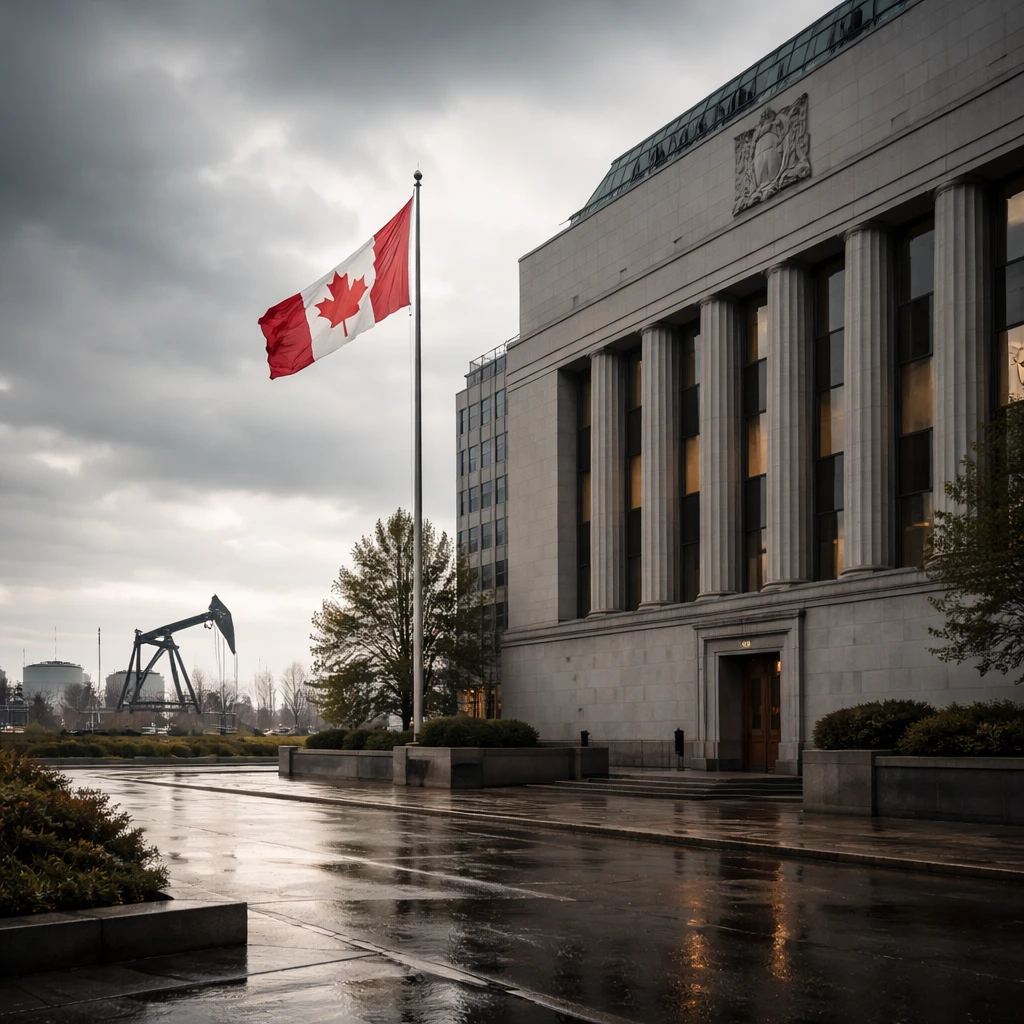
The Bank of Canada left its key interest rate unchanged at 2.25% on Wednesday, marking a continuation of a pause that has now stretched across five successive meetings as officials assess conflicting signals from the domestic economy and global energy markets.
That decision met market expectations, but the central bank's accompanying statement highlighted a mounting policy challenge. Policymakers pointed to heightened uncertainty tied to potential shifts in U.S. trade policy and the ongoing conflict in the Middle East - developments that, they cautioned, could ultimately compel the bank to tighten or loosen policy to maintain price stability.
Domestic economic data have shown signs of strain. First-quarter gross domestic product contracted by 0.1%, business capital spending remained subdued, and housing market activity weakened. Trade flows also painted a mixed picture, with exports falling while imports rose as firms rebuilt inventories.
At the same time, inflation has surprised on the upside relative to earlier expectations. Consumer price inflation measured 2.8% in April, influenced mainly by higher oil prices and the waning of a year-ago impact from the consumer carbon tax in annual comparisons. The Bank of Canada said global oil prices are running roughly $10 per barrel above the assumptions set out in its April Monetary Policy Report - a gap expected to keep headline inflation near the 3% area in the coming months.
Governor Tiff Macklem said the bank is prepared to look through the short-term effect of elevated energy costs on inflation, but he made clear that officials are determined not to allow those pressures to become embedded across the broader economy. In prepared remarks he said: "Economic weakness combined with rising inflation is a dilemma for monetary policy."
While some measures of core inflation have moved closer to 2%, the central bank signalled vigilance. Officials said they will watch closely for evidence that higher energy costs are starting to feed into a broader set of consumer prices.
The statement outlined a range of potential policy responses tied to evolving risks. Macklem noted that the emergence of significant new trade restrictions from the United States could prompt the bank to consider deeper rate cuts to support growth. Conversely, a sustained period of high energy prices accompanied by wider inflation pressures could necessitate a series of rate increases. The bank emphasized its intent to remain nimble as economic conditions change.
The outcome for interest rates therefore appears increasingly uncertain, shaped by the interplay between domestic weakness and externally driven inflationary forces - particularly in energy markets. For now, policymakers have opted to hold steady at 2.25% and monitor how these crosscurrents evolve before making further adjustments.
Key takeaways:
- The policy rate remains at 2.25% after a fifth consecutive hold.
- Growth indicators show weakness - Q1 GDP fell 0.1%, investment is subdued, and housing activity has cooled.
- Inflation rose to 2.8% in April, largely driven by higher oil prices and comparison effects from the consumer carbon tax.