
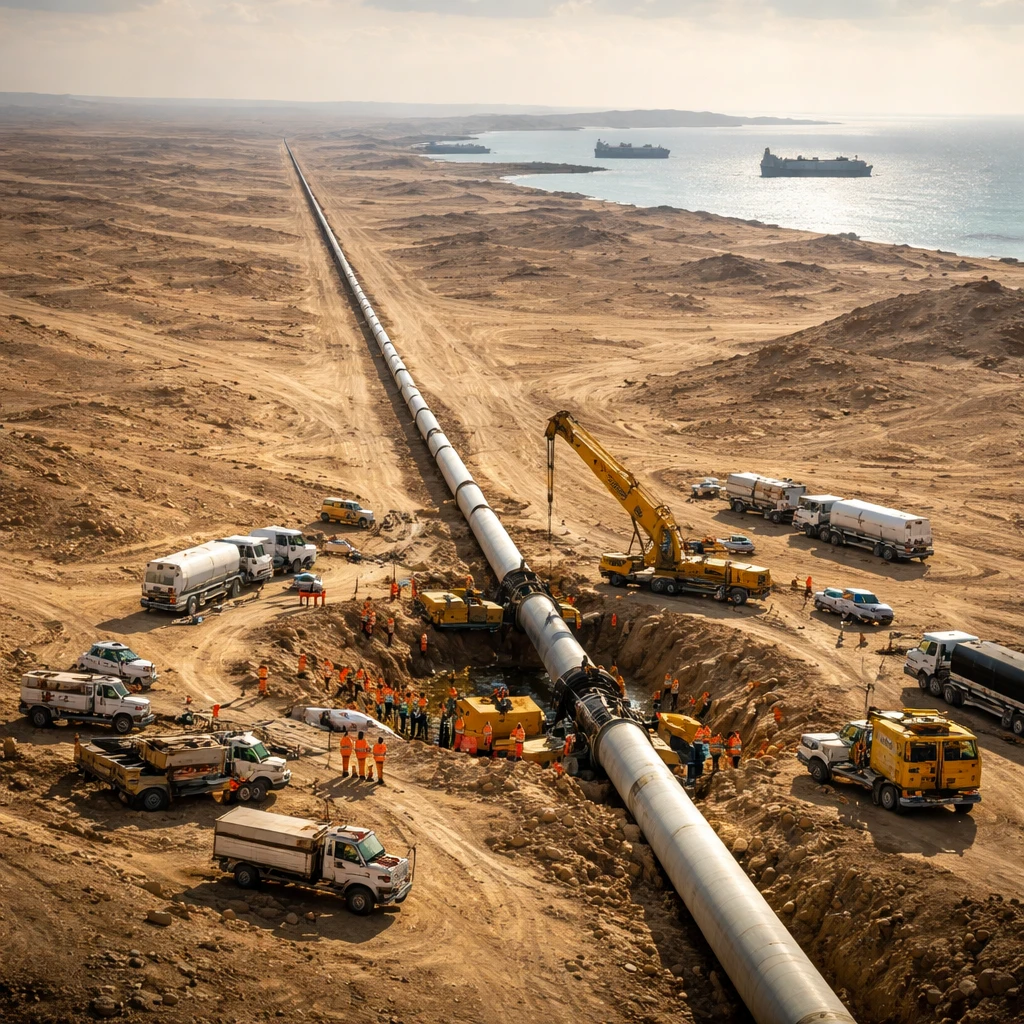
Saudi Aramco is working to bypass a damaged stretch of its 1,200-km East-West Pipeline and expects to restore roughly half of the pipeline's capacity within days, while targeting a full return to service in about six weeks, a person familiar with the situation told Bloomberg.
The pipeline was carrying between 4 and 5 million barrels per day before last week’s drone attacks forced a shutdown, a throughput level that represents roughly 4% to 5% of global oil supply, according to Reuters. The market reaction to the disruption has been most visible in Brent crude, which traded near $105 on Wednesday.
The East-West Pipeline has become a central export route for Saudi oil since the Strait of Hormuz was severely disrupted following the U.S.-Israeli military campaign against Iran that began on February 28, 2026. With that sea lane largely closed, the pipeline provided the kingdom’s principal route to move crude to Red Sea loading points at Yanbu and from there into global markets. The pipeline’s shutdown last Friday prompted traders to estimate that Yanbu held only five to seven days of export inventory before Saudi Arabia’s ability to supply world markets would be seriously constrained.
Saudi officials have blamed the attack on drones operated by Iranian-backed militias in Iraq. The Associated Press reported that repairs to a major pumping facility could take three to five weeks, with the possibility of partial operations during that period - a timeline broadly consistent with the Bloomberg account.
With the pipeline offline, Saudi Arabia is reportedly accelerating prompt crude sales that bypass the Strait of Hormuz, shifting volumes through alternative channels. It remains uncertain whether those sales and routing changes will materially offset the capacity lost to the damaged pipeline while repairs are underway. The precise volume the bypass will carry has not been disclosed; the description of "about half capacity" implies a flow in the range of 2 to 2.5 million barrels per day, given the pipeline’s pre-attack throughput.
A successful partial restart within days would reduce the most immediate near-term supply risk and could put downward pressure on Brent prices that have risen sharply since the disruption. The situation retains notable uncertainty while repairs proceed and alternative routing is tested.
Summary
Aramco aims to re-establish roughly half the East-West Pipeline's flow within days via a bypass, with a full restoration targeted in approximately six weeks. The pipeline had been handling 4-5 million barrels per day before drone attacks forced a shutdown. The outage has tightened near-term supply prospects and pushed Brent crude higher. Repair estimates for a key pumping facility range from three to five weeks, and Saudi crude sales routed outside the Strait of Hormuz are being increased as a potential offset.
Key points
- Aramco plans a temporary bypass to restore about half of the 1,200-km East-West Pipeline's capacity within days; full restoration is expected in about six weeks.
- The pipeline transported 4-5 million barrels per day before the attack, equal to approximately 4% to 5% of global oil supply; Brent crude traded near $105 on Wednesday.
- Shutdown left Yanbu with an estimated five to seven days of export inventory; Saudi Arabia is increasing prompt crude sales routed outside the Strait of Hormuz as an alternative.
Risks and uncertainties
- Unclear offset from rerouting - It is uncertain whether prompt sales and alternative shipping routes will make up the capacity lost to the damaged pipeline, creating ongoing supply risk for oil markets.
- Repair timeline variability - Reports indicate repairs to a major pumping facility could take three to five weeks, while Aramco’s broader timeline targets roughly six weeks for full restoration; partial operations may be possible during repairs.
- Price volatility - A partial restart could ease near-term tightness and affect Brent prices, but the market remains vulnerable to further volatility until flows normalize.
Sectors affected
- Oil and energy markets, including producers and refiners.
- Shipping and logistics related to crude exports through Red Sea terminals.
- Global commodities markets sensitive to crude supply disruptions.