
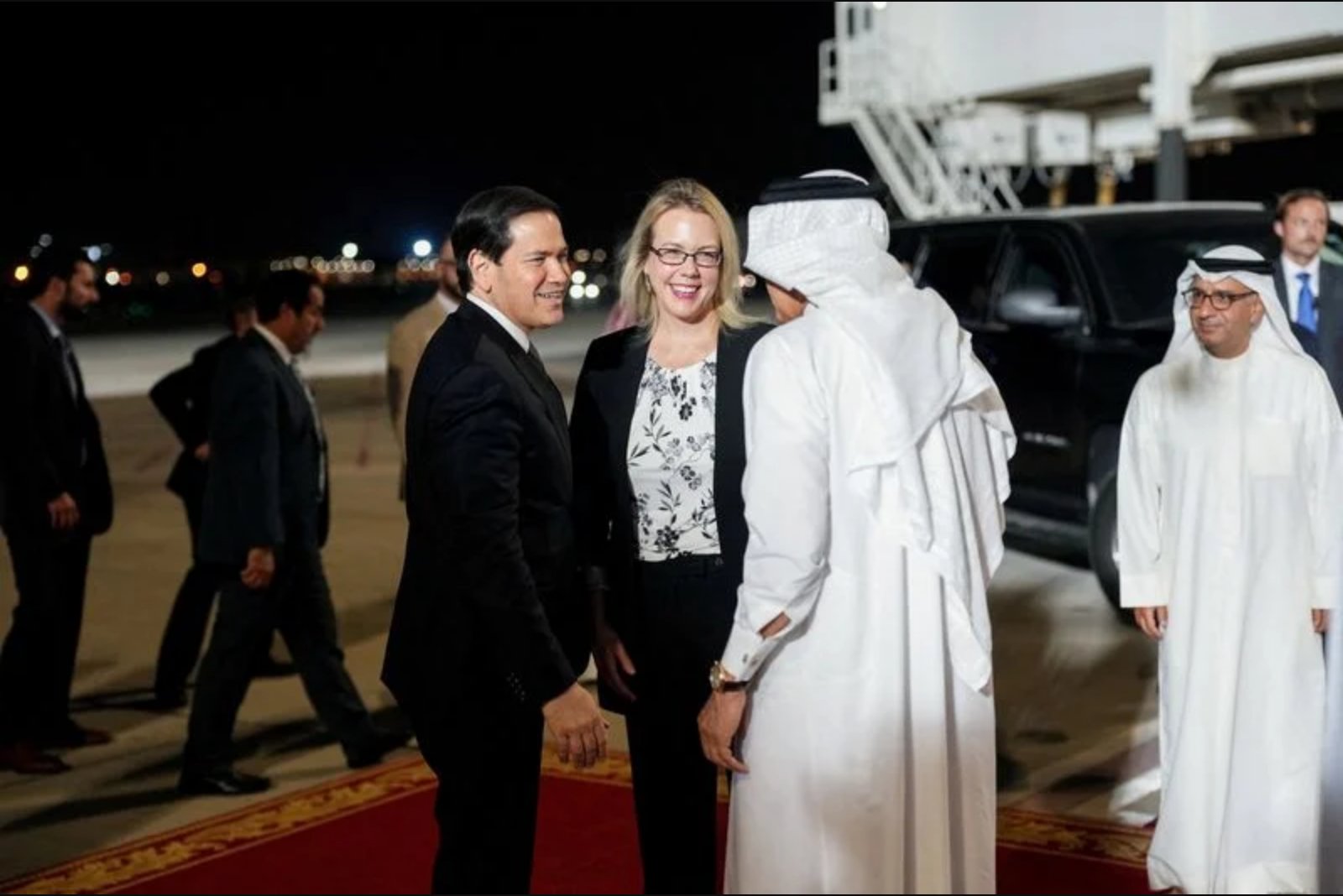
Manama, Bahrain - U.S. Secretary of State Marco Rubio arrived in Bahrain on Wednesday night for the final leg of a three-day diplomatic tour of Gulf states aimed at rallying regional support for a preliminary U.S.-Iran framework agreement.
Rubio’s itinerary brings him to Manama, the capital that hosts the U.S. Navy’s Fifth Fleet headquarters, where he is scheduled to meet Bahraini officials and representatives of the Gulf Cooperation Council - the six-member group of Sunni monarchies that includes Saudi Arabia, Qatar, Oman, the United Arab Emirates and Kuwait.
The trip follows earlier stops in the United Arab Emirates and Kuwait. At those meetings, Rubio sought to calm concerns among Gulf leaders who fear that elements of the proposed deal could disproportionately benefit Tehran and shift the region’s security dynamics and the flow of oil. He emphasized U.S. commitments to allied security, telling reporters in Kuwait: "We’re not going to do anything that undermines the security of our allies, our longstanding allies in the region."
The visit is the first senior-level U.S. diplomatic mission to the oil-producing Gulf since the U.S.-Iran framework agreement was announced last week as a step toward ending the conflict between the two countries. The framework emerged after a first round of talks in Switzerland concluded on Monday.
Tensions remain over competing public accounts of what the negotiations produced. U.S. President Donald Trump said on Tuesday that Iran had agreed to nuclear inspections into "infinity," a description Tehran has denied, saying it did not accept such a concession in discussions. These divergent statements have created questions about the stability and clarity of the tentative peace accord.
In addition to inspection arrangements, Washington and Tehran have offered conflicting descriptions of other sensitive elements, including any financial inducements for Iran, arrangements for control of the Strait of Hormuz, and matters connected to Israel’s separate war in Lebanon.
All six GCC states are strategic partners of the United States. They provided varying degrees of logistical assistance to Washington during the conflict and were themselves targeted by Iranian airstrikes. Their position forms the backbone of American security planning in the Middle East; any shift in their security relationships with the United States could materially affect U.S. military posture in the region.
Provisions within the draft U.S.-Iran agreement that have drawn particular scrutiny include an absence of curbs on Iran’s ballistic missile program, the inclusion of a proposed $300 billion reconstruction fund, and clauses that critics say could expand Tehran’s regional footprint and influence over vital oil shipping lanes.
Rubio has stated he will not be asking Gulf partners to contribute to any reconstruction fund during this tour, even though the memorandum of understanding with Iran suggests regional states could at least partly shoulder the expense.
Some U.S. Gulf allies have privately expressed disappointment with the interim deal, which they fear might pave the way for Washington to normalize ties with Iran - a predominantly Shi’ite country that many Sunni-led GCC governments regard as a principal adversary. Bahrain itself presents a domestic dimension to that concern: the Sunni monarchy rules over a Shi’ite majority population and officials worry that a financially emboldened Tehran could fuel unrest at home.
Contextual note: The discussions and disagreements described here are those publicly disclosed by the involved parties following the first round of talks in Switzerland and the subsequent statements from U.S. and Iranian officials.