
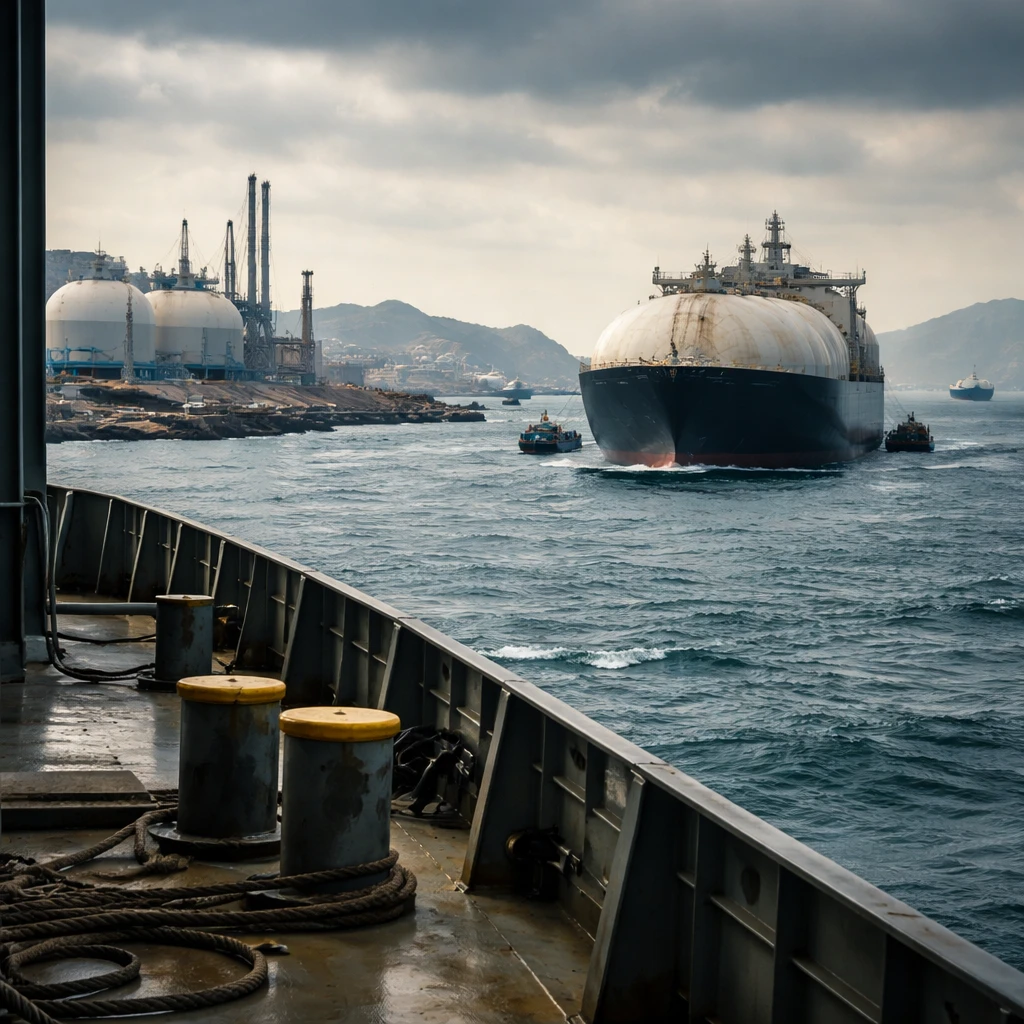
Goldman Sachs has raised its short-term outlook for European gas prices, citing a slower recovery in Persian Gulf LNG exports than previously expected amid ongoing disruptions to shipping through the Strait of Hormuz.
Analyst Samantha Dart now assumes Persian Gulf LNG flows will normalize in October, moved back from an earlier July assumption. The delay is attributed to continued shipping interruptions in the Strait of Hormuz, a strategic maritime chokepoint that handles roughly one-fifth of the world’s petroleum consumption and 20% of global LNG exports.
The bank quantifies the impact on the balance-of-summer global LNG supply at 16 million tonnes per annum, equivalent to about 4% of supply. Goldman Sachs estimates this shortfall will leave Northwest European gas storage near 67% full by the end of October - the conventional start of winter - down from a prior estimate of 74%.
Assuming average seasonal temperatures, the firm projects storage will fall to 28% full by late March, the end of winter. Those storage paths underpin the bank’s decision to raise its Dutch TTF price forecasts for the balance of the third quarter and for the fourth quarter of 2026 to 60 and 53 euros per megawatt-hour, respectively. Previous forecasts for those periods were 41 and 40 euros per megawatt-hour. Goldman Sachs also lifted its full-year 2027 TTF forecast to 31 euros per megawatt-hour from 30 euros.
On the risk profile, Goldman's analyst noted that upside risks dominate the near-term outlook and reiterated a recommendation that gas users hedge against possible winter price spikes. Dart emphasized the sensitivity of winter balances, saying: "With our estimated tightness in winter gas balances in Europe leaving little room for error, we expect that, for the remainder of this summer, TTF will price very close to the 65 EUR/MWh threshold." The bank links that threshold to a level that it believes would discourage Asian LNG demand.
The analysis lays out conditional scenarios. Under a gradual normalization of Middle East energy exports through 2027, Goldman Sachs estimates TTF would need to move above 100 euros per megawatt-hour to adequately curb Asian demand. Conversely, a quicker-than-expected resumption of Hormuz flows could push prices back toward roughly 40 euros per megawatt-hour, a level the bank associates with the coal-to-gas switching threshold.
Looking beyond the immediate horizon, Goldman Sachs retained a bearish stance on TTF for 2028 and 2029, forecasting 19 and 16 euros per megawatt-hour, respectively. The bank qualified that outlook by noting it depends on the Strait of Hormuz being fully open for shipping.
Goldman Sachs also pointed to potential downside sources for European price risk, including new U.S. LNG export capacity and possible higher coal and renewable generation in Asia. These factors are identified as further elements that could relieve upward pressure on European gas prices if they materialize.
Implications for market participants
The bank’s revisions highlight a compressed margin for error in European winter gas balances and reinforce the firm’s recommendation that gas consumers consider hedging strategies in the near term. The raised TTF forecasts for the remainder of 2026 and for 2027 reflect the direct pricing consequences Goldman Sachs expects from the current disruption to Persian Gulf LNG exports and the resulting impact on Northwest European storage levels.