
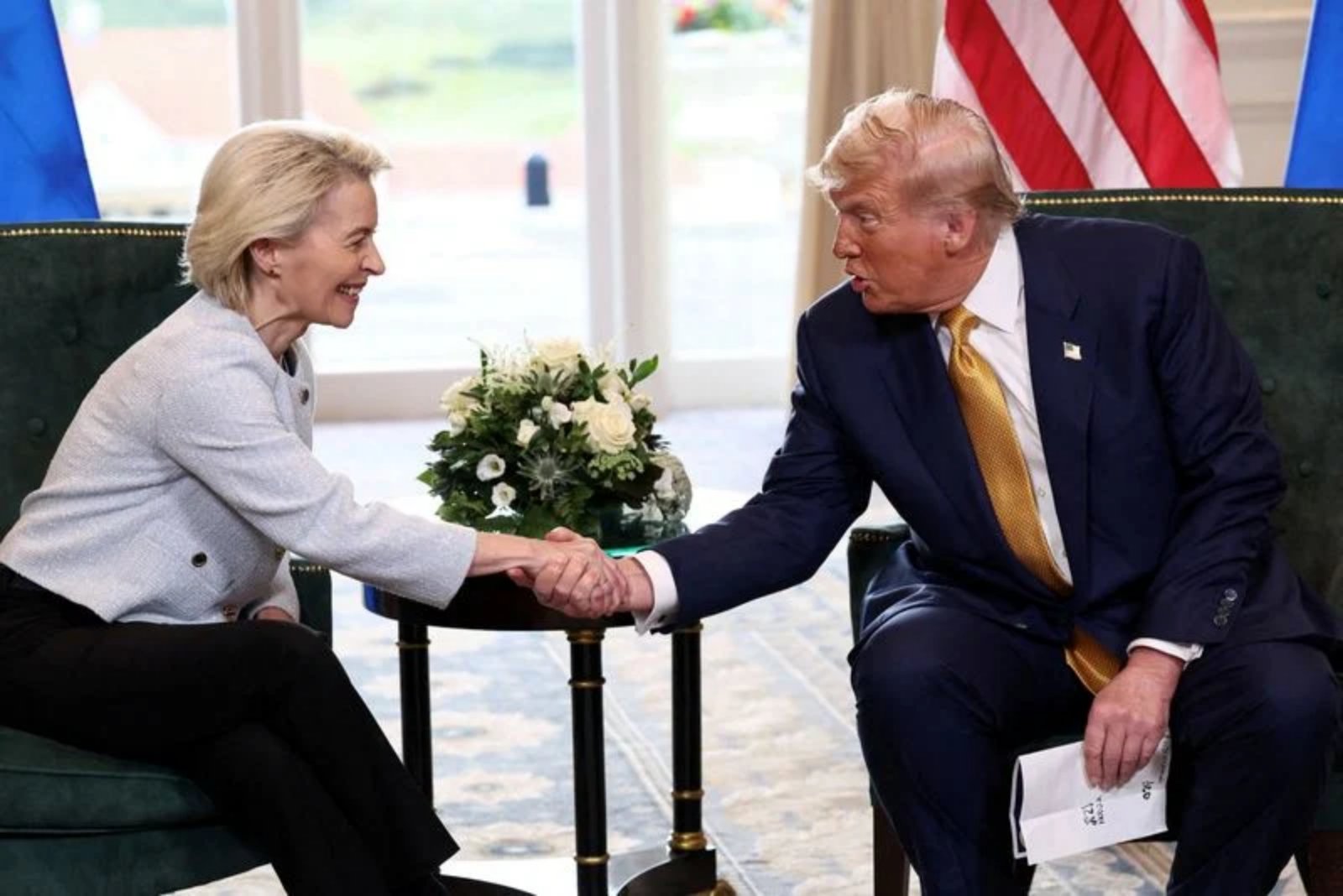
BRUSSELS - The European Union is on the verge of putting into law the import-duty rollbacks it agreed with U.S. President Donald Trump nearly 11 months earlier at the Turnberry golf course in Scotland, a move that aims to head off a renewed tariff confrontation between the two trading blocs. Legislators in the European Parliament are due to vote on the implementing legislation on Tuesday, with a clear majority expected to approve the package that pairs the elimination of EU duties on some U.S. imports with broadly 15% U.S. tariffs.
President Trump had warned of "much higher" tariffs unless the EU acted promptly, adding pressure to finalise the arrangement.
Industry reaction and preparations
European industry bodies have urged lawmakers to ratify the agreement, saying it would stabilise annual transatlantic trade valued at $2 trillion for businesses operating across the Atlantic. European carmakers in particular, hit hard by tariffs, have already begun retooling production plans on the assumption the Turnberry terms will stand.
Volvo Cars, which currently produces the majority of its U.S.-bound vehicles in Europe, plans to shift production of some of its top-selling XC60 SUVs to its South Carolina facility later this year. The company also intends to begin manufacturing a new hybrid model at that plant by the end of the decade.
Fifteen trade associations representing EU automakers as well as textile, cosmetics and food and drink producers said backing the Turnberry deal would bring predictability for firms dependent on deep transatlantic supply chains. At the same time, those groups warned that agreeing the deal would not end negotiations, describing the pact as "not the end of the conversation."
Pending U.S. tariff measures and unresolved tariffs over aircraft dispute
A central test for the durability of the Turnberry arrangement is whether the new U.S. tariffs scheduled to take effect on July 24 will precisely match the 15% level set out in the accord. The two sides must also decide whether to continue refraining from reimposing mutual tariffs related to a long-standing dispute over aircraft subsidies, where measures on $11.5 billion of goods are currently frozen. A five-year suspension of those aircraft-related tariffs is due to expire on July 11.
U.S. Trade Representative Jamieson Greer said the United States will adhere to the deal. But Bernd Lange, chair of the European Parliament’s trade committee, expressed scepticism about how predictable U.S. action will be, noting: "The decision is in the White House by the president and therefore nobody knows what will really happen."
Recent threats by President Trump to impose 100% tariffs on French wine were cited as an example of developments that could unravel the Turnberry commitments, prompting Lange to say the European Union should be ready to suspend parts of the deal if necessary. The EU also retains the option to re-activate countermeasures covering €93 billion ($108 billion) of U.S. goods, measures that are currently suspended until August 6.
Broader disagreements - tariffs are only part of the picture
Beyond headline tariff numbers, Washington and Brussels face a range of other outstanding issues and divergent priorities. The United States has pressed the EU to address non-tariff barriers and regulatory approaches, including U.S. objections to the EU’s proposed carbon border adjustment mechanism and rules that require firms to demonstrate commodity imports are not sourced from recently deforested land or to audit supply chains for human rights or environmental harms.
In response, the EU has eased some regulatory provisions and extended compliance deadlines. Nevertheless, some corporate actors remain strongly opposed to parts of the EU agenda. The text records that Exxon Mobil Corp has urged the EU to abandon its corporate sustainability law and has raised its complaints with President Trump.
From the EU’s perspective, the United States applies tariffs above the 15% threshold to products that incorporate metal, such as washing machines, wind turbines and motorcycles. The Turnberry deal was followed by a U.S. expansion of the list of so-called metal derivatives a month later, although some items have since been removed. EU legislation allows the European Commission to suspend tariff reductions on U.S. steel or aluminium products unless all U.S. tariffs are brought back to the 15% level by the end of the year.
Manufacturers of cutlery and catering equipment in the EU warned that elevated U.S. metal-related levies could push them out of the U.S. market or squeeze already thin margins.
Spirits, steel quotas and the lingering spectre of Section 232
The EU has also pushed for a replacement of 50% U.S. tariffs on steel and aluminium with tariff-free quotas and seeks a wider list of products eligible for duty-free treatment. Wine and spirits producers across Europe are keen to secure exemptions or first-mover status; U.S. spirits makers have reportedly supported reciprocal tariff elimination, pointing to a period of strong bilateral growth when a zero-for-zero tariff regime had been in place.
The Turnberry deal could still be undermined by lingering uncertainty over "Section 232" investigations, the U.S. mechanism that allows tariffs on grounds of national security. The article records that one immediate risk has receded: the possibility of President Trump unilaterally imposing new tariffs without formal process, such as the January threat over Greenland. But after a U.S. Supreme Court decision struck down global tariffs introduced previously, the U.S. administration now must conduct a formal investigation before levying new duties.
On that point Ignacio Garcia Bercero, senior fellow at think tank Bruegel, said: "There might be other tools the United States finds to make threats for political reasons, but I don’t think tariffs are going to be that instrument, because it is no longer available."
Outlook and remaining timelines
The immediate sequence of dates provides the framework for whether this phase of tariff détente will hold: the aircraft tariff suspension runs until July 11; new U.S. tariffs are due to take effect from July 24; and the EU’s suspended countermeasures on €93 billion of U.S. goods remain inactive until August 6. How closely Washington’s measures adhere to the 15% benchmark in the Turnberry agreement will be decisive, and so will bilateral progress on non-tariff regulatory issues.
Until those questions are resolved, corporate planning, particularly in the automotive and metal-using manufacturing sectors, will continue to adapt under a degree of policy uncertainty.
($1 = 0.8614 euros)