
Markets opened under pressure Thursday as traders reassessed the payoff from the massive capital investment sweeping the technology sector. In premarket action Meta Platforms was indicated down roughly 10% to a level near $526.50, a figure just above its 52-week low of $520.26, signaling investor skepticism over whether the company's large-scale AI spending is producing returns commensurate with its size.
Other names tied to the AI cycle also showed signs of stress. Credit-default swaps tied to NVIDIA have been rising sharply, drawing attention in credit markets. Palantir was indicated down about 0.87% to $121.93 in premarket trading on Thursday. Oracle’s equity has come under heavy selling pressure while its credit-default swaps have also become a focus for investors worried about the leverage the company has taken on to expand cloud and AI data-center capacity.
Debt and the data-center premise
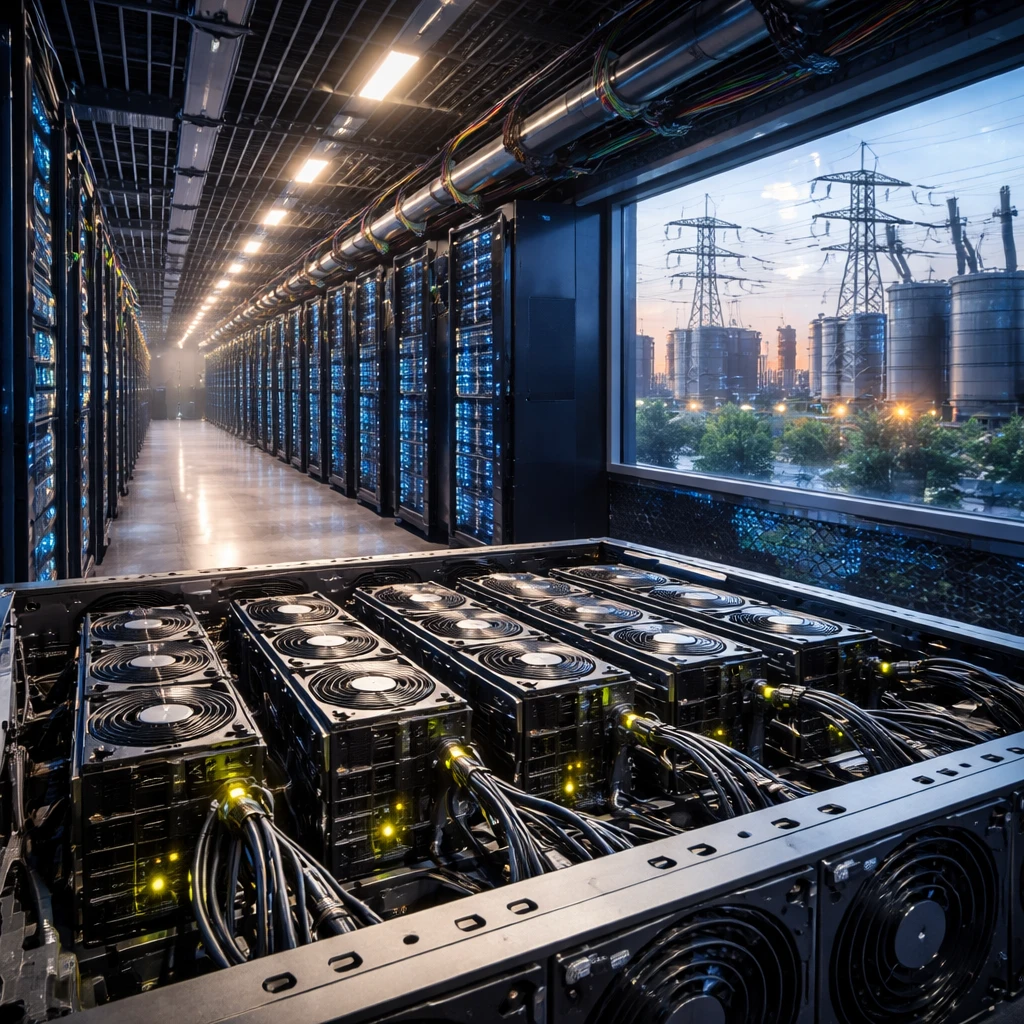
Oracle has financed much of its data-center expansion with bond issuances, and its long-term debt load has climbed markedly in recent years as it competes for market share against hyperscalers. That leveraged posture is vulnerable to a slower-than-expected AI revenue ramp. Across the industry, the pricing of data-center debt rests on an implicit assumption: AI workloads will be deployed quickly and densely enough to utilize capacity. When that forecast is questioned, credit spreads widen and equity valuations can compress at the same time.
This pattern is not unique to Oracle. A range of companies have issued billions in corporate bonds to fund land purchases, power agreements, and hardware procurement. Those are fixed obligations that do not shrink if enterprise AI adoption moves more slowly than anticipated, creating a potential imbalance between fixed capital commitments and uncertain revenue timing.
Markets broaden the repricing
The selloff permeated markets beyond individual stocks. South Korean shares slid more than 9% on Thursday amid fears that AI-related spending will disappoint, a move concentrated in chip-related names. At the same time, intraday price action displayed mixed signals: a cluster of tickers showed divergent moves, with Oracle up 5.07%, NVIDIA up 1.12%, Meta down 9.37%, AIQ up 2.45%, KOMP up 1.11%, and Palantir down 0.65% in different snapshots of trading.
The central question increasingly being asked by market participants is not merely how much has been spent, but what exactly has been built. The answer that emerges from company filings and investor conversations is that much of the activity has gone into the infrastructure that enables AI - the data intake, normalization, storage, and large-scale processing - rather than the consumer-facing agents that many observers expected would be the immediate payoff.
Where the data comes from
Crucially, the information these facilities are designed to process is not mainly chat transcripts or viral consumer queries. Instead it is an unceasing stream of real-world signals: location pings from mobile devices, food-delivery order records, RFID reads from warehouses and logistics hubs, license-plate scans captured by traffic cameras, flight-tracking feeds, and thousands of other data streams produced continuously by modern commerce and monitoring systems. The resulting capital cycle has spilled outward from GPUs and server racks into the power infrastructure that supports these facilities.
As one example of how the AI investment cycle has reached beyond traditional tech players, a recent SEC filing by renewable energy firm Greenbacker Renewable Energy explicitly cites "rising data center demand" and "lack of power" as central strategic positioning pillars. That underscores how power capacity and its financing have become integral to the broader AI buildout.
Output versus input - the transparency problem
A deeper concern for investors is the paucity of public evidence about the actual quality of AI agents being trained on all of this capital-intensive infrastructure. Companies are competing to acquire land, secure power contracts, and buy GPU clusters, yet disclosures about the capabilities, reliability, or independent verification of the resulting AI systems are limited. Capital expenditures are visible and measurable; the performance of the AI agents and assistants that are expected to monetize that investment is far less transparent.
Hundreds of billions in annual capital spending flow into data centers, power capacity, and chips, yet in many enterprise deployments the assistants and agents promoted by companies remain early-stage in scope, with narrow reliability and little systematic evidence of their quality. For investors, that opacity is becoming more difficult to dismiss. The input side of the AI value chain - the physical assets and energy commitments - is large and evident. The output side - demonstrable, widely applicable, high-quality agents - is not being shown with the same transparency.
NVIDIA at the center of a circular-financing concern
NVIDIA occupies a pivotal role in this debate. The company’s credit-default swaps have risen in response to concern among some analysts that a circular financing dynamic may be at work: AI companies borrow to purchase NVIDIA chips, and the valuation and demand for those chips in part hinge on continued investment by the same buyers. NVIDIA last traded at $190.01 on Wednesday, off more than 3.5% on the day, though premarket Thursday showed a partial recovery to roughly $193.93.
NVIDIA is scheduled to release fiscal second-quarter 2027 results on August 26. That earnings report will represent a major opportunity for management to address whether data-center revenue growth is accelerating, plateauing, or showing other trends that would validate or challenge the narratives that have underpinned the sector’s valuation following two years of heavy capital deployment.
Palantir and the data-aggregation story
Palantir offers another perspective. The company’s core competency has long been integrating and analyzing large, institutional data sets for government and enterprise clients, a business case that predates the current AI investment cycle. If the recent buildout is effectively erecting a substrate for institutional data aggregation rather than directly producing consumer-facing conveniences, Palantir’s longstanding focus on large-scale data integration may look prescient.
Street analysts continue to place value on that framing. Oppenheimer recently reiterated an Outperform rating on Palantir ahead of the company’s impending earnings report. Palantir shares closed Wednesday at $123.00.
Portfolio implications and investor behavior
Investors seeking to limit exposure amid AI-related ETF volatility have found some comfort in broader product structures. Analysis by a market research tool cited KOMP and AIQ as offering relatively lower risk in AI ETF selloffs, a reflection of the preference for diversified, less concentrated exposure rather than single-name investments during periods of high uncertainty.
What differentiates the present moment from prior cycles of AI skepticism is the scope of the reassessment. Meta’s sizable premarket decline, if sustained into the regular session, would bring the stock toward a retest of its 52-week low. Coupled with the sharp move in South Korean chip equities, rising CDS levels tied to NVIDIA and Oracle, and wider concern about data-center leverage, market scrutiny has expanded beyond individual balance sheets to the foundational assumptions of the AI investment thesis.
Whether earnings reports and upcoming disclosures will reassure investors that data-center revenue growth can sustain valuations is an open question that market participants will be watching closely. NVIDIA’s August earnings call in particular is likely to be treated as a stress test of whether the sector’s underlying revenue trends justify the scale of recent capital deployment.
Note on reporting limitations
Some market indicators cited in this article reflect intraday or premarket levels that can change rapidly as trading commences and new corporate disclosures are released. Where specific intraday prices and percentage moves are cited, they represent snapshots from premarket or prior-session trading referenced within company reporting and market data released ahead of the regular session.