
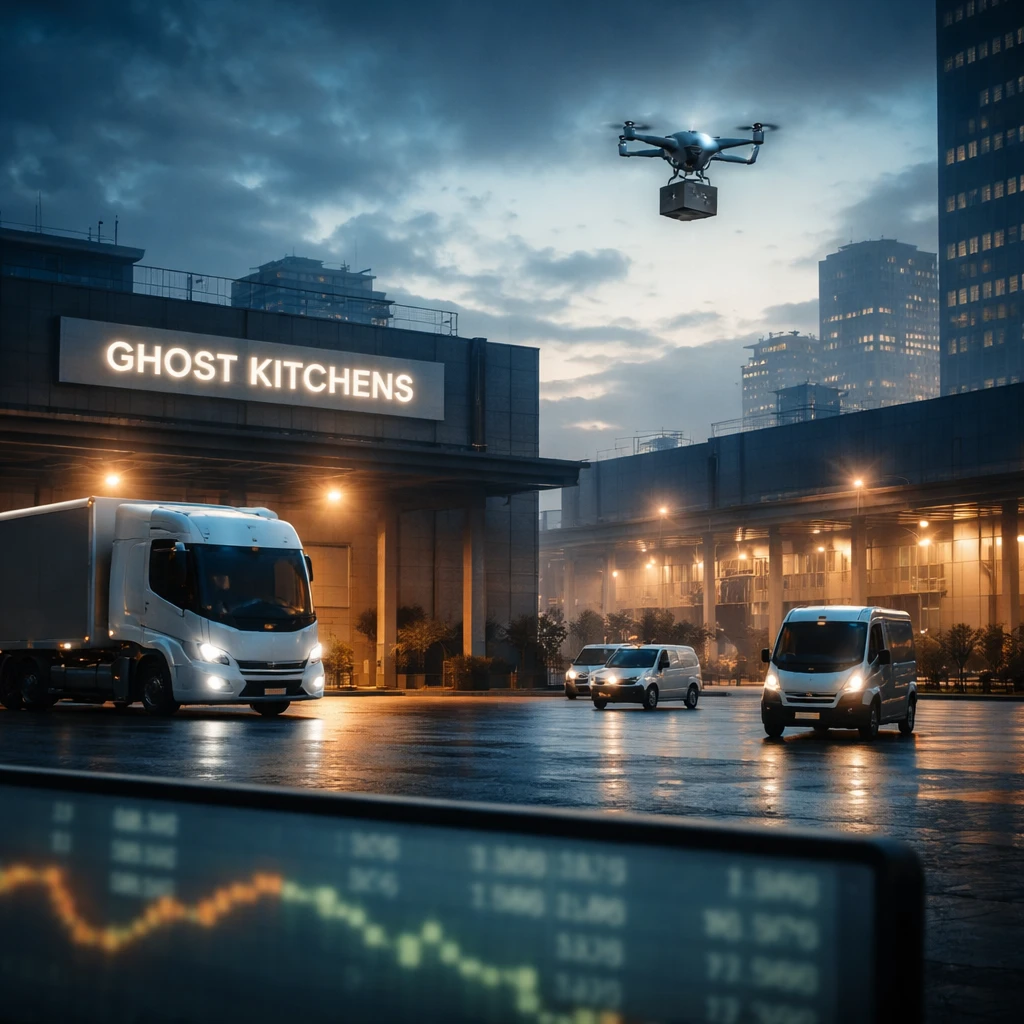
Overview
Travis Kalanick’s Atoms business has drawn market attention after closing a $1.7 billion financing package. The fundraising, while not launching a direct consumer food-delivery platform, has elements that could reshape the physical infrastructure of food logistics. The fact that Uber is listed as an equity partner in the round has particularly heightened investor focus on DoorDash as it approaches second-quarter earnings on Aug 5.
What Atoms comprises
Atoms is structured as a holding company for industrial AI plays across three divisions:
- Atoms Food - the rebranded CloudKitchens business, focused on ghost kitchen real estate and related infrastructure.
- Atoms Transport - which includes Pronto, acquired in March 2026, and concentrates on autonomous trucking and transport AI.
- Atoms Mining - a newly announced industrial AI vertical.
The capital raise was led by Andreessen Horowitz, with Ben Horowitz joining Atoms’ board. Equity investors listed in the round include Bain Capital, Fifth Wall, and Uber. Major banks participated on the debt side, with Bank of America, Goldman Sachs, JPMorgan, Wells Fargo, and Barclays among the lenders.
Why investors are watching
On the surface, CloudKitchens as a landlord of ghost kitchens does not directly displace a marketplace like DoorDash. The more salient competitive vector is the possibility of vertical integration: combining Atoms Transport with Atoms Food could enable a single operator to own both the preparation facilities and autonomous logistics that deliver food from kitchen to consumer door. That configuration would bypass the traditional gig-economy delivery model DoorDash relies on.
Uber’s presence on the cap table is particularly notable to market participants. DoorDash’s largest competitor has chosen to back Kalanick’s infrastructure play rather than invest solely in marketplace features. Market observers interpret that as a signal the industry may be moving toward ownership of the physical AI layer underpinning food logistics rather than only competing on the consumer-facing marketplace.
DoorDash’s current position
DoorDash is not passive. The company is pursuing its own infrastructure and automation initiatives. On July 29, DoorDash received FAA Part 135 certification for its in-house drone program, DoorDash Air, making it one of eight national operators to hold that designation. DoorDash reported that pilot locations experienced an approximately 30% increase in order volumes during the nine weeks after launch.
On July 15 DoorDash introduced the dd-cli tool, which enables AI agents to place DoorDash orders autonomously. The company positions this as part of building infrastructure for an agentic AI economy.
Market context and valuation
DoorDash shares are trading at $193.53, with a market capitalization of $84.3 billion. The stock’s 52-week range is $143.30 to $285.50. Year-to-date the shares are down 15.76%, while they have staged a recent one-week bounce of 14.00%. Over the past 12 months, DoorDash is down 21.96%.
Bull-versus-bear snapshot
- Atoms Food (CloudKitchens) - Bull: a real estate landlord model that does not itself operate a delivery marketplace. Bear: could be evolved into a vertically integrated delivery competitor.
- Uber backing Atoms - Bull: may suggest competitors are focused on infrastructure ownership rather than direct marketplace competition. Bear: could mean a key rival has hedged its exposure by aligning with a potential infrastructure owner.
- DoorDash drone certification - Bull: an autonomous delivery moat in development. Bear: program remains pre-commercial with no specified timeline for broad rollout.
- Valuation and analyst views - Bull: a roughly 22% year-over-year decline in the share price lowers entry risk. Bear: Aug 5 earnings are expected to show a year-over-year EPS decline, a nearer-term concern. Broker notes include Wedbush at Neutral with a $205 target and Wells Fargo trimming its target to $199; insiders have sold about $24 million in stock.
Near-term priorities for investors
Although Atoms’ $1.7 billion war chest and its autonomous transport capability present a material medium-term development to monitor, the more immediate event for DoorDash shareholders is the upcoming Aug 5 earnings release. Wall Street consensus expects a year-over-year EPS decline, and that near-term performance will likely drive trading reactions more than a strategic threat that may not fully materialize until 2027 or 2028.
Conclusion
Atoms should be treated as a medium-term competitive watch item rather than an immediate market alarm. CloudKitchens by itself has not been a marketplace disrupter, but when paired with an autonomous transport arm and backed by $1.7 billion in financing and a high-profile investor like Uber, the potential for a vertically integrated food-to-door operator warrants careful monitoring. For the time being, investors should prioritize DoorDash’s Aug 5 earnings and the company’s near-term path on margins and EPS.
Company snapshot
- DoorDash Inc (DASH): Trading at $193.53 (Market Cap: $84.3B)
- 52-Week Range: $143.30 - $285.50
- YTD: -15.76%
- 1W: +14.00% (recent bounce)
- 12-month change: -21.96%