
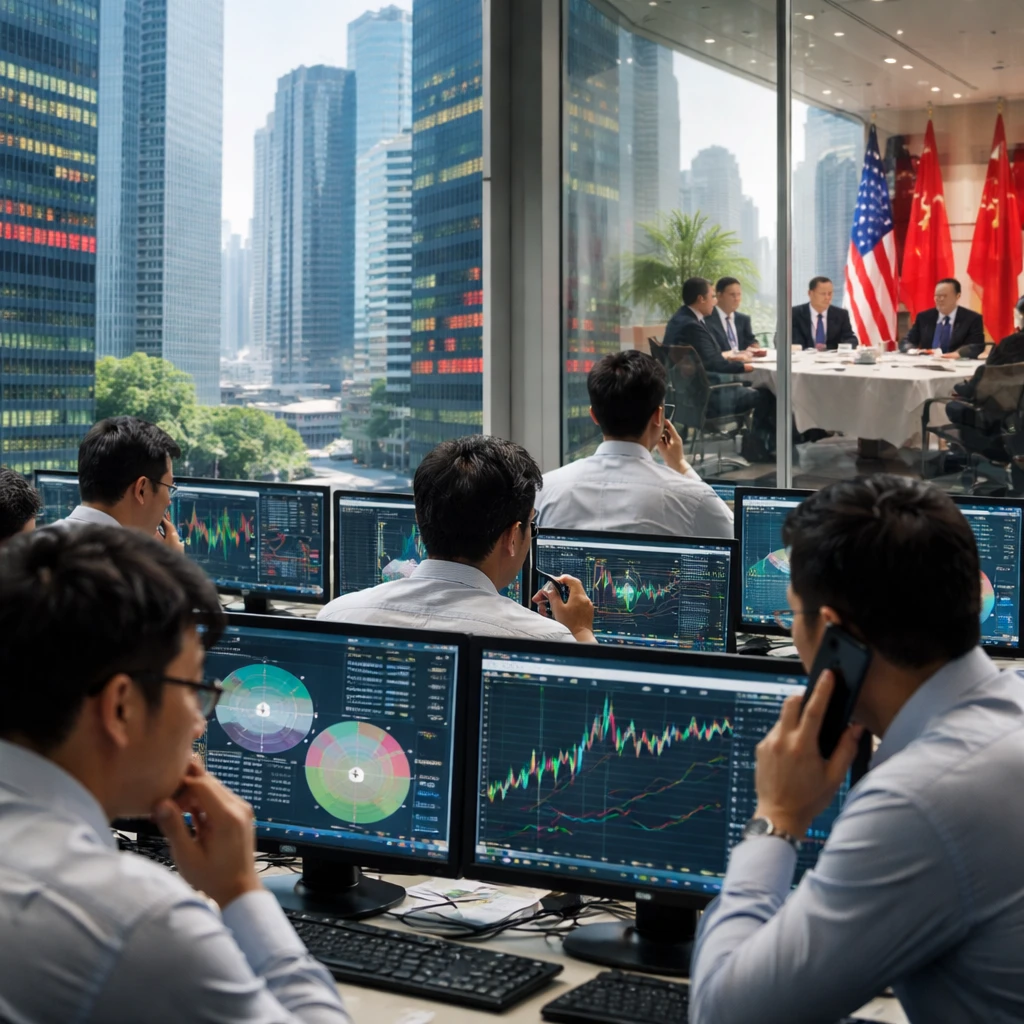
Asian equities largely moved lower on Friday, reversing some of the prior session's gains as enthusiasm around chip sales to China cooled and attention stayed focused on an ongoing summit in Beijing. Market participants sought clarity on whether U.S. officials had signaled a loosening of export restrictions for semiconductor products to Chinese buyers. At the same time, major Chinese equity benchmarks remained close to the multi-year highs they reached earlier in the week while traders awaited further bilateral talks.
Chip sector under pressure
South Korea's KOSPI recorded the steepest drop in the region, tumbling 3.5% amid sharp declines among the country's leading chipmakers. The sell-off in semiconductor-related stocks spilled over to other Asian chip suppliers. Japan's Tokyo Electron Ltd. (TYO:8035) and Advantest Corp. (TYO:6857) each lost ground, with declines ranging from roughly 1% to as much as 6% across the group.
The acceleration of selling followed comments from U.S. Trade Representative Jamieson Greer, who told Bloomberg that recent talks did not include detailed discussion of chip export controls, and that the decision on whether to purchase U.S. chips was for Beijing to make. Those remarks undercut a report from Thursday that suggested NVIDIA Corporation (NASDAQ:NVDA) had been permitted to sell its H200 processor to 10 Chinese firms. That earlier report had helped power a rally in semiconductor stocks, although it also noted that no actual sales had been completed.
In overnight trade, S&P 500 futures eased about 0.2% in Asian session trading, signaling that gains in global equities connected to semiconductor optimism could be at risk of reversing.
China steadies as talks continue
China's Shanghai Shenzhen CSI 300 and the Shanghai Composite each finished the session little changed, holding near the 4-1/2 year and 11-year highs they reached earlier in the week. Investors were watching additional meetings between U.S. President Donald Trump and Chinese President Xi Jinping scheduled later on Friday after the two met on Thursday and suggested the possibility of improving ties between the world's largest economies.
President Trump told Fox News in an interview that China had agreed to buy U.S. oil and to increase purchases of Boeing aircraft. Meanwhile, China's foreign ministry said the two leaders had reached consensus on several items, though it provided few concrete details.
Broader regional moves and macro influences
Outside China, markets varied but were generally lower. Japan's Nikkei 225 slid 1.6%, while the TOPIX eased 0.3% after data showed Japan's producer price index for April topped expectations. The report attributed much of the upside to higher oil and chemical prices linked to the Iran conflict, pointing to broader inflationary pressures that could prompt the Bank of Japan to consider raising interest rates.
Hong Kong's Hang Seng index declined 1.0%, pressured by local technology shares, and Singapore's Straits Times slipped about 0.1%. Australia's S&P/ASX 200 traded flat, and India's Nifty 50 rose roughly 0.4% in early trade.
Market takeaway
The session highlighted two interlocking themes for Asian markets: sensitivity to developments in U.S.-China relations - especially as they pertain to advanced technology exports - and the impact of localized macro data on regional equity performance. While talk of potential approvals for chip sales to China sparked a rally earlier in the week, follow-up comments clarifying what was and was not discussed in bilateral meetings removed some of that momentum, leaving chip stocks vulnerable to a pullback.
Key points
- Chipmaking stocks cooled after U.S. trade official Jamieson Greer said chip export controls were not discussed in detail during recent talks - impacting semiconductor and broader tech sectors.
- China's main indexes remained near multi-year highs as markets awaited further Trump-Xi discussions and sought more detail on any bilateral agreements.
- Regional divergences emerged as Japan faced inflation-driven pressure that could influence the Bank of Japan's policy outlook, affecting financial and industrial sectors.
Risks and uncertainties
- Unclear outcome of U.S.-China discussions on semiconductor exports - this ambiguity poses risk to technology and semiconductor equities.
- Limited public detail on agreements from Trump-Xi meetings - markets may remain sensitive to headline risk until substantive terms are disclosed, affecting China-focused assets.
- Rising producer prices in Japan driven by oil and chemical costs - this inflationary pressure could prompt central bank action, creating volatility in Japanese equities and bond markets.
No additional disclosure provided.