
Economy May 14, 2026 07:26 AM

U.S. and China Agree on AI Best-Practices Framework as Trump Meets Xi in Beijing

Treasury Secretary Bessent says talks were possible because the United States maintains a lead in AI; semiconductor controls and chip-sale deliberations remain unresolved

By Jordan Park

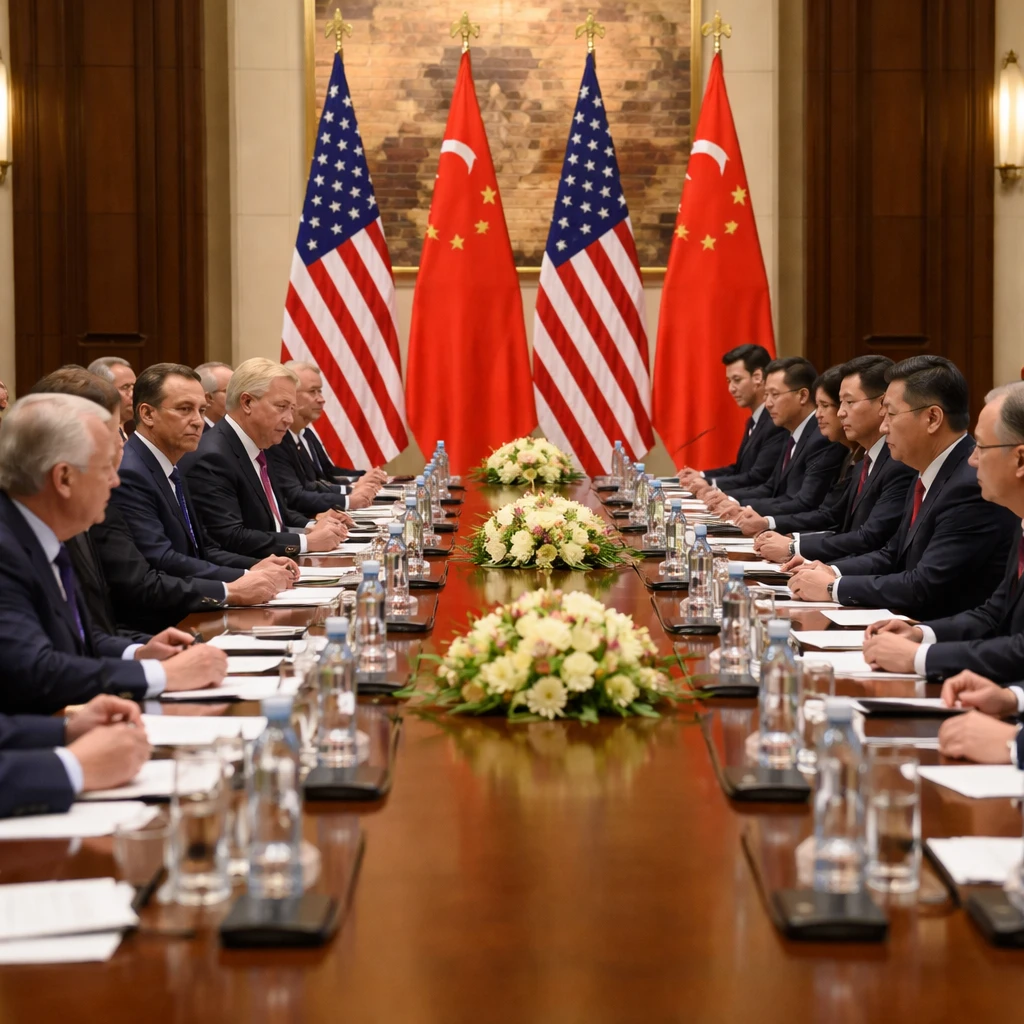
The United States and China announced a protocol setting out best practices for artificial intelligence as President Donald Trump met Chinese President Xi Jinping in Beijing for a two-day summit. U.S. Treasury Secretary Scott Bessent said Washington is able to have substantive AI discussions with Beijing because the United States is ahead in AI capabilities, and he signaled expectations of significant advances in upcoming large language model releases. Semiconductor export restrictions and reports of recent chip sale approvals to Chinese firms continue to draw scrutiny.

U.S. and China Agree on AI Best-Practices Framework as Trump Meets Xi in Beijing

Key Points

  • The United States and China unveiled a protocol on AI best practices during President Trump's two-day summit with President Xi in Beijing - a move framed as establishing safeguards against non-state access to powerful AI models.
  • Treasury Secretary Scott Bessent said substantive talks were possible because the United States currently leads in AI capabilities and expects a major advancement in upcoming large language model releases from Alphabet's Gemini and OpenAI.
  • U.S. restrictions on advanced semiconductor sales to China, mainly affecting Nvidia products, remain a central policy tool; reports of possible sales of Nvidia's H200 AI chips to major Chinese firms have prompted significant internal deliberation.

Leaders from the United States and China disclosed a protocol on Thursday that outlines best-practice approaches to artificial intelligence, announced as President Donald Trump conducted a two-day summit with Chinese President Xi Jinping in Beijing.

U.S. Treasury Secretary Scott Bessent described the development of the framework in remarks to CNBC on Thursday, emphasizing that Washington and Beijing - characterized as the two AI superpowers - are initiating structured discussions about how to prevent non-state actors from acquiring powerful AI models.

"The two AI superpowers are gonna start talking. We're gonna set up a protocol in terms of how do we go forward with best practices for AI to make sure non-state actors don't get a hold of these models," Bessent said.

Bessent elaborated on why these conversations were taking place, attributing them to the United States' current lead in AI capabilities. "The reason we are able to have wholesome discussions with the Chinese on AI is because we are in the lead," he said. "I do not think we would be having the same discussions if they were this far ahead of us."

On the technological front, Bessent said he expected a pronounced jump in capability in forthcoming large language model releases from Alphabet's Gemini and OpenAI, describing the anticipated updates as a step-function change.

Policy measures remain a central feature of the U.S. approach. Washington has imposed restrictions on the sale of advanced semiconductors to China - measures focused largely on chips from Nvidia - with the intent of limiting the pace of China's AI development. Nvidia's chief executive, Jensen Huang, joined President Trump's delegation to China as a late addition to the trip.

When asked about media reports that the U.S. had cleared sales of Nvidia's H200 AI chips to several large Chinese technology companies, Bessent acknowledged that the issue involved extensive discussion and negotiation. He described the matter as subject to "a lot of back and forth," without offering further detail on approvals or specific recipients.


Diplomatic dynamics beyond AI were also on display. Trump and Xi concluded their first major meeting of the week at 12 p.m. local time on Thursday. In Beijing's official readout, Xi stressed that Taiwan is the most important issue for bilateral relations and cautioned against mishandling the matter; Beijing asserts that Taiwan is part of its territory.

Bessent indicated that President Trump would provide additional comments on Taiwan in the days following the meeting.

The visit marks the first time a sitting U.S. president has traveled to China since 2017. The summit is scheduled to conclude on Friday.

Ahead of the Trump-Xi encounter, Bessent held a meeting on Wednesday in South Korea with Chinese Vice Premier He Lifeng.

Risks

  • Uncertainty over semiconductor export decisions - reports of possible H200 chip sales to Chinese firms have generated extensive internal discussion, creating ambiguity for technology and semiconductor markets.
  • Heightened focus on Taiwan in Beijing's public statement introduces geopolitical risk that could affect diplomatic and economic relations between the United States and China, with potential spillovers for markets linked to cross-border trade and supply chains.
  • Potential misuse of advanced AI models by non-state actors remains a stated concern motivating the protocol, representing a risk for sectors reliant on secure AI development and deployment.

More from Economy

Merz Opposes EU-Wide Borrowing, Calls for Deep Economic Overhaul May 14, 2026 Venezuela launches broad debt-restructuring effort after U.S. sanctions are eased May 14, 2026 Polestar CEO: Rising Pump Prices Shift Buyer Priorities Toward EVs May 14, 2026 Yardeni: Fed Rate Cut in 2026 Now Unlikely as Inflation and Labor Strengthen May 14, 2026 OPEC+ to Stage Monthly Output Restorations Through September as Gulf Exports Remain Blocked May 14, 2026