
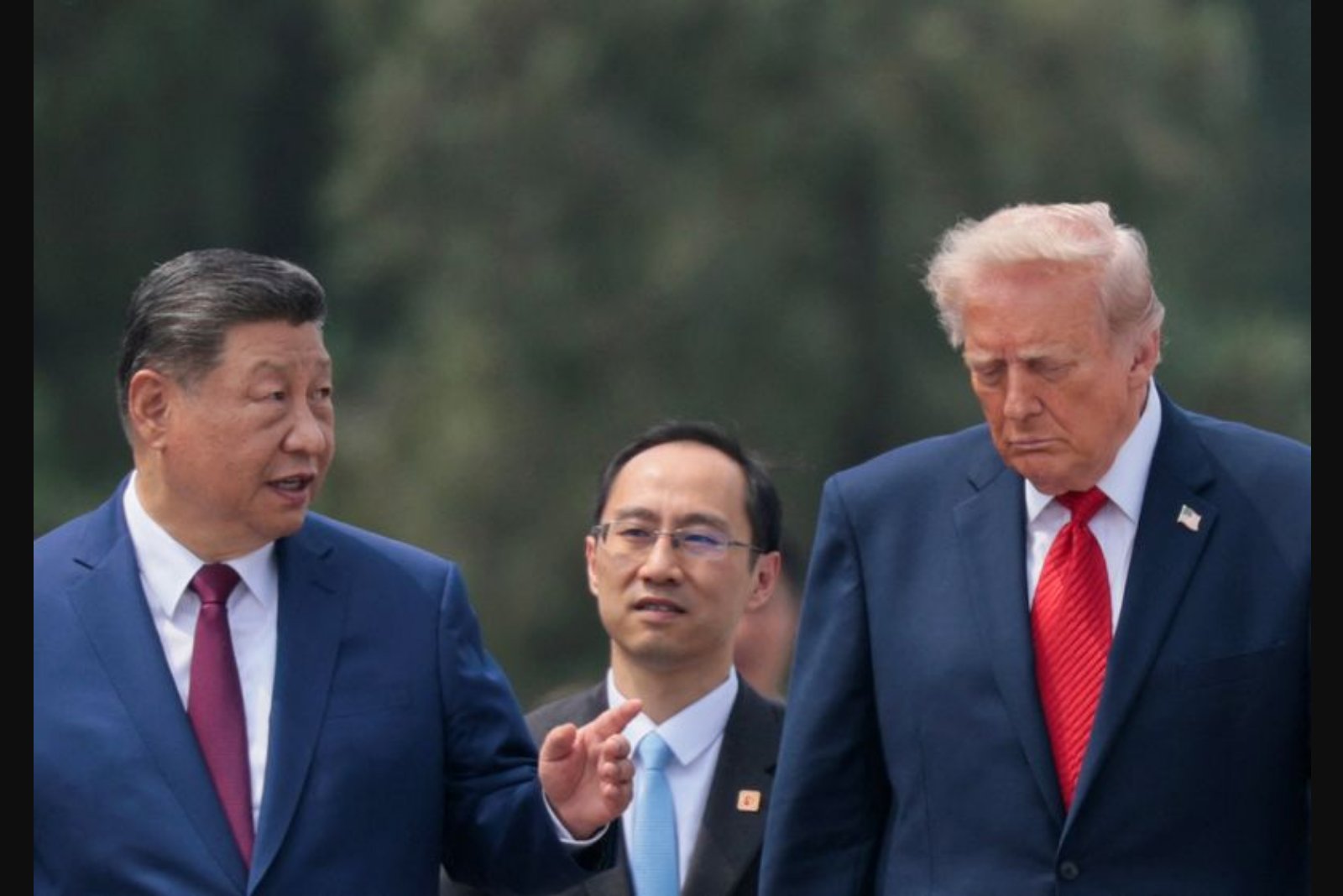
U.S. officials raised the prospect that China could increase purchases of American energy after Presidents Donald Trump and Xi Jinping met in Beijing on Thursday for a summit that exceeded two hours.
In a White House readout published after the meeting, Xi is reported to have expressed interest in buying more U.S. oil as a measure to reduce China's dependence on shipments transiting the Strait of Hormuz. The readout characterized the summit as lasting more than two hours.
Shortly after the White House summary, U.S. Treasury Secretary Scott Bessent told CNBC that the two sides had discussed Beijing buying more energy, saying production from Alaska would be a "natural" fit for China.
Chinese state media summaries of the session made no mention of energy purchases. China’s foreign ministry did not respond to a request for comment on the White House readout or the comments by the U.S. Treasury Secretary.
Thursday marked the first day of a two-day summit that Chinese state media said would chart a new direction for bilateral relations. Within those discussions, purchases of U.S. energy and agricultural products have been discussed publicly as potential components of an agreement, though no specific deal terms have been released.
Context on recent U.S.-China oil flows
China has not imported any U.S. oil since May 2025, a stoppage tied to a 20% tariff that was imposed during the trade war. The removal of that tariff would likely be a prerequisite for any substantial resumption of U.S. oil shipments to China.
Even at their peak, U.S. supplies have represented a small share of China’s crude imports. Imports of U.S. oil peaked at about 395,000 barrels per day (bpd) in 2020, roughly just under 4% of China’s total crude imports. By 2024, before Donald Trump returned to office, U.S. oil imports into China had fallen to about 193,000 bpd, with a value of approximately $6 billion.
The chairman of state-owned oil major CNPC, which maintains long-term contracts with U.S. liquefied natural gas producers, was expected to attend a banquet in Beijing for the U.S. delegation on Thursday.
Officials are also expected to press ahead with discussions around a trade mechanism for non-sensitive goods this week, with each side potentially identifying up to $30 billion worth of goods on which tariff reductions could be applied. No concrete details of such tariff reductions or product lists have been disclosed.
Key points
- China may consider buying more U.S. energy following a lengthy Trump-Xi meeting - a White House readout and U.S. Treasury comments signaled the possibility.
- China has not imported U.S. oil since May 2025 due to a 20% tariff; reversing that tariff would likely be necessary for large-scale oil resumption.
- Talks around a trade mechanism for non-sensitive goods could involve roughly $30 billion of goods per side for tariff reduction, but specific terms are not yet public.
Sectors likely to be affected - Energy (crude oil and LNG), agriculture, and trade-sensitive manufacturing sectors.
Risks and uncertainties
- Absence of agreement on tariff removal - the 20% tariff on U.S. oil remains in place and would probably need to be lifted before meaningful resumption of U.S. crude exports to China.
- Lack of corroboration from Chinese authorities - Chinese state media summaries did not include mention of energy purchases and the foreign ministry did not respond to requests for comment, leaving outcomes uncertain.
- Unspecified deal terms - while tariff reductions on non-sensitive goods and increased purchases have been flagged, no concrete details or timelines have been released.
While the White House and a senior U.S. official indicated energy purchases were discussed, the overall picture remains one of potential rather than concluded agreement. Observers and market participants will be watching for any formal announcements or changes in tariff policy that could enable renewed flows of U.S. crude and liquefied natural gas to China.