
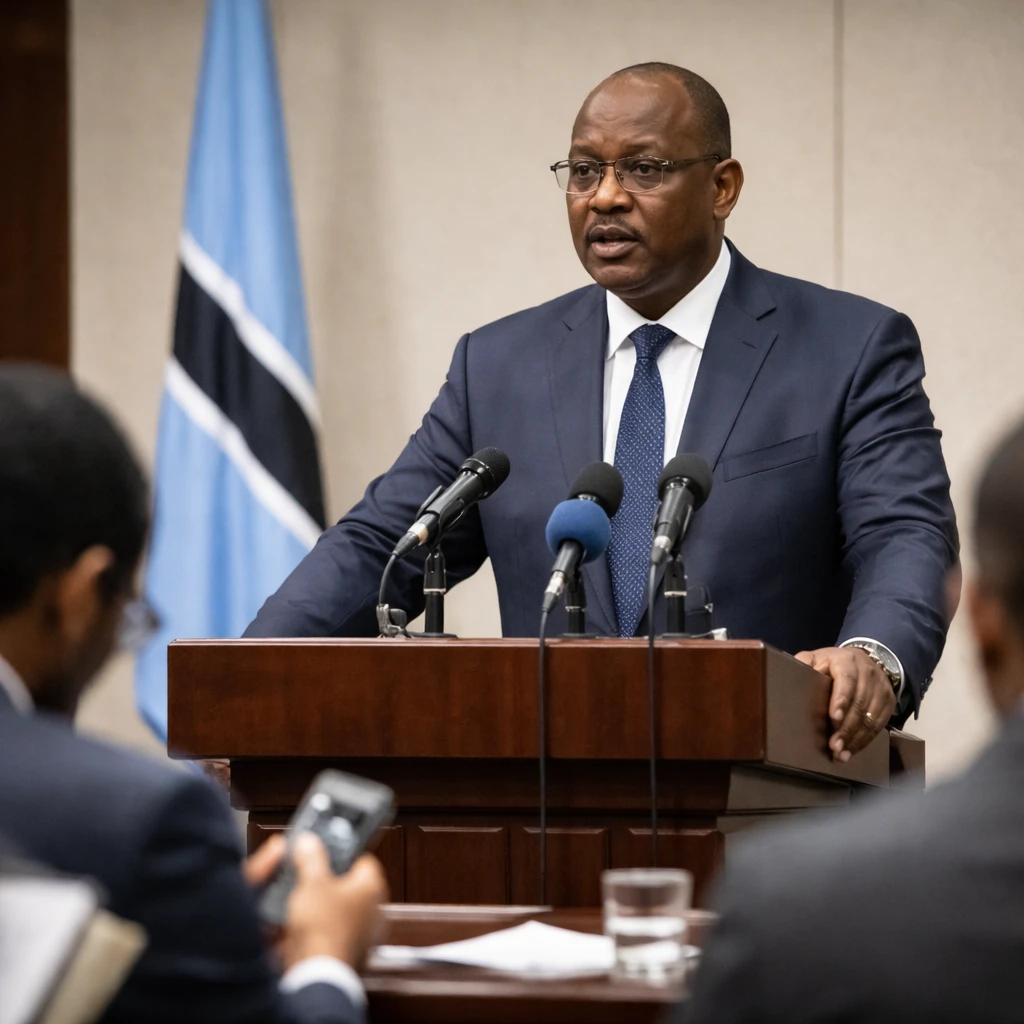
Botswana's central bank announced a two percentage point increase to its key policy rate on Thursday, moving the rate from 3.5% to 5.5%. The decision makes the bank the first in Africa to raise rates following the global energy shock linked to the Iran war.
Governor Lesego Moseki presented the decision at a briefing in Gaborone and set out the committee's view on near-term price pressures. He said the monetary policy committee - the MPC - expects inflation to move above the upper bound of the central bank's 3% to 6% target range in the second quarter.
In his remarks, Governor Moseki emphasized the immediate drivers of the expected inflation increase. "The MPC expects inflation to increase significantly in the short term and breach the upper band of the objective range of 3% to 6% in the second quarter due to the recent increases in fuel prices, public transport fares and medical aid premiums," he said.
The central bank set out its medium-term projection for the price level, forecasting that inflation will average 8.7% in 2026 before moderating to 5.6% in 2027. The bank's path assumes that some of the recent price shocks will unwind over time, but officials cautioned that upside risks remain.
Moseki noted that inflation could outpace those projections if second-round effects from fuel and administered prices continue to feed through the economy. He pointed specifically to electricity and transport fares as administered prices that could amplify inflationary pressures if their pass-through persists.
Context and implications:
- The rate change is a direct response to the global energy shock associated with the Iran war, which the central bank identified as a catalyst for higher fuel costs.
- The policy move follows the monetary policy committee's assessment that short-term inflation will exceed the central bank's stated objective range.
- Official projections indicate elevated inflation in 2026 with a return toward the target range by 2027, though the bank highlighted the potential for further upward deviations if administered price increases continue to transmit across the economy.
The central bank's statement and forecasts provide a baseline for how policymakers see the near-term inflationary environment and how those expectations shaped the choice to tighten policy now rather than wait. The bank has explicitly linked its decision to recent rises in fuel, transport and medical aid costs and warned that secondary price effects could push inflation beyond the projected path.