
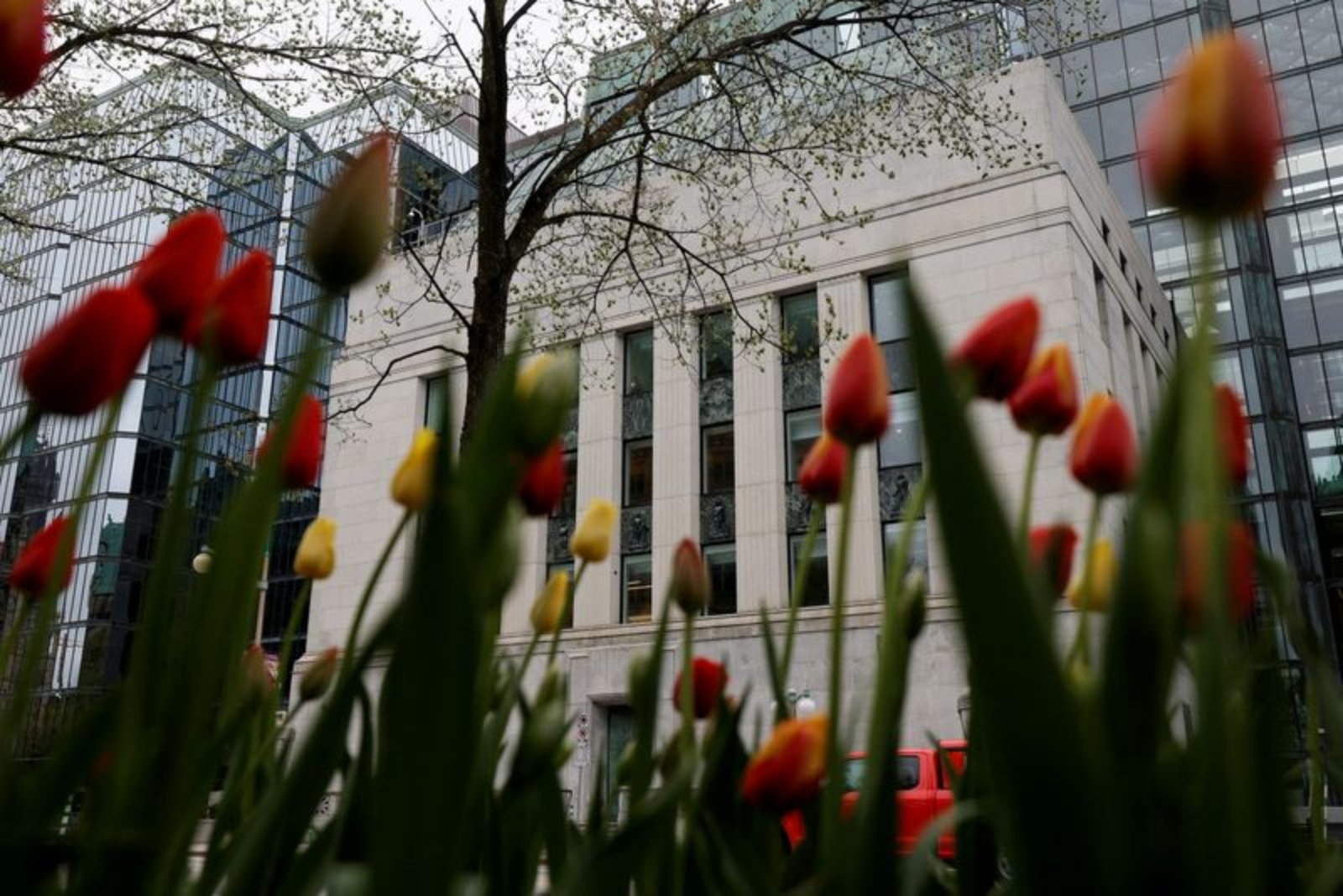
OTTAWA, April 29 - The Bank of Canada held its key policy rate steady on Wednesday and said that, assuming its economic projections are borne out, any future changes to the rate would likely be limited. Governor Tiff Macklem, however, flagged that continued strength in oil prices and other external uncertainties could force the central bank to act more decisively.
Presenting the institution's quarterly monetary policy report, Macklem stressed the conditional nature of the bank's outlook. "If the economy evolves broadly in line with the base case, changes in the policy rate can be expected to be small," he said, underscoring that the bank's plans hinge on its current forecast.
Still, Macklem was unusually explicit about a potential alternative path. Citing uncertainty tied to the Middle East war and U.S. tariffs, he warned that rising crude prices could translate into a broader inflation problem for Canada - a development that might require multiple rate increases in succession. "If oil prices continue to increase, and particularly if they remain elevated, the risk that higher energy prices become ongoing generalized inflation increases," he said. "If this starts to happen, monetary policy will have more work to do - there may be a need for consecutive increases in the policy rate."
The bank described the overall effect of the conflict in the Middle East on Canada as modest on balance. While higher oil prices provide a boost to export revenues for the country, they also place pressure on businesses and household budgets through increased energy costs.
The central bank's latest forecasts show an expected uptick in headline inflation for April, with inflation projected to rise to about 3% from 2.4% in March, before averaging roughly 2.3% for the year. The bank also nudged up its medium-term growth outlook, raising its 2026 gross domestic product growth forecast to 1.2% from the 1.1% it published in January.
In constructing its baseline, the bank said it is assuming U.S. tariffs remain unchanged and that the price of crude will fall to $75 a barrel by mid-2027. Those assumptions are central to the bank's projection that inflation will return to its 2% target by early next year, a timetable the rate-setting team continues to monitor closely.
Macklem noted that, to date, there is little sign that higher oil prices have broadly spilled over into prices for other goods and services. "So far, there is little evidence that higher oil prices have fed through to other goods and services prices more broadly," he said. He added that while near-term inflation expectations have increased amid higher energy and food costs, longer-term expectations remain anchored.
Wednesday's report marked the central bank's first set of projections since the Iran war began on February 28, an event that pushed up crude and gasoline prices and heightened concerns about persistent inflationary pressures across the economy.
Macklem listed several external factors that will shape future policy choices: the fate of the United States-Mexico-Canada free trade agreement, developments in the Middle East, the impact of U.S. tariffs, and secondary effects stemming from higher crude prices.
Views among economists and analysts diverge over the net effect of higher oil on the Canadian economy, which is a net exporter of crude. The issue is consequential for sectors sensitive to energy prices - including energy producers, transportation, and consumers - and informs fiscal and monetary planning.
Separately, a fiscal update presented on Tuesday by Prime Minister Mark Carney's government indicated that nominal GDP is expected to rise this year.
Impacted sectors and takeaways
- Energy - higher crude prices boost export revenues but risk feeding into broader inflation.
- Households and businesses - elevated fuel and food costs put pressure on budgets and operating expenses.
- Financial markets - central bank signals of potential consecutive hikes could affect interest-rate sensitive assets and borrowing costs.