
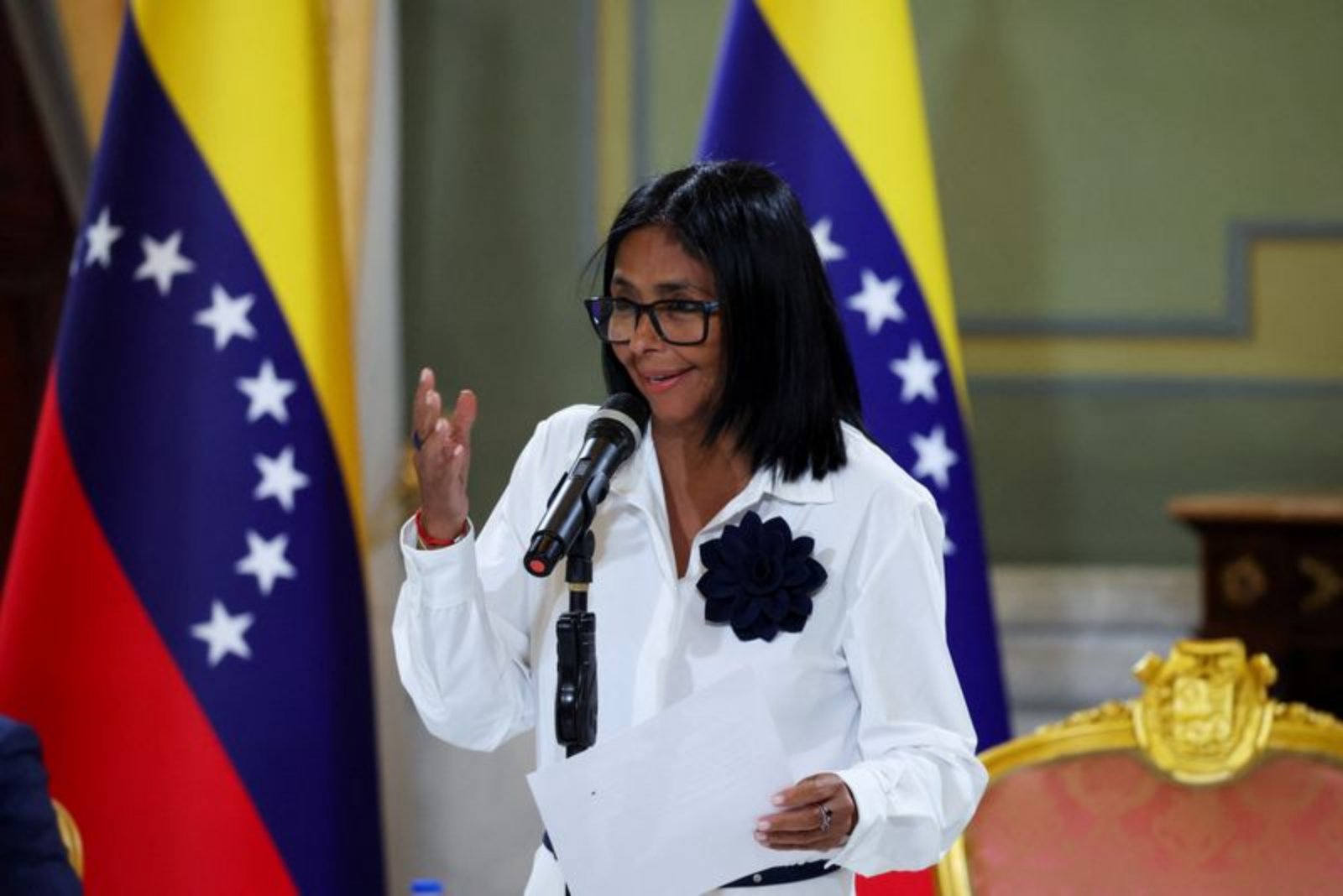
Venezuela's acting president, Delcy Rodriguez, announced on Thursday that the monthly minimum income for workers will be increased to $240, and that pensions will be raised to an equivalent of $70. The pension increase represents a 40% rise, Rodriguez said, though she acknowledged that the boost is insufficient to fully meet retirees' needs.
Her remarks came during a government-organized march calling for an end to U.S. sanctions. Speaking at the event, Rodriguez said protests by some employees demanding higher wages were understandable. "When I see workers protesting, I think, 'They're right.' We want better wages for workers. We want to fully restore what wages are meant to represent. Of course. This is then the first step toward being able to guarantee the purchasing power of workers across the country," she said.
Rodriguez did not specify how much of the newly announced $240 monthly income would be delivered as base salary versus how much would be paid as bonuses. The distinction matters because the monthly minimum wage in Venezuela has, in recent periods, been equivalent to only a few cents when converted into U.S. dollars. Governments have supplemented base pay with bonuses that officials have previously said brought total monthly incomes up to $190 for some workers.
On pensions, Rodriguez said: "I also want to report that our elderly - our grandfathers and grandmothers, those who have been hit the hardest - will receive a pension equivalent to $70, which represents a 40% increase. It is not enough. It is not enough." She added that additional measures for the elderly would be examined.
The last official increase to base salary and the public sector pay scale occurred in March 2022. Since then, steep depreciation of the bolivar has raised the local currency cost of government-paid bonuses, which economist firms in Caracas estimate pushed bonus payments to about $400 million in April, up from roughly $250 million in December.
Worker unrest has intensified in recent months. Protests by employees across education, healthcare and public services have become more frequent, even as the government receives hundreds of millions from oil deals with the United States, which officials say have boosted state coffers. In some states, supporters of the ruling party reported that certain bonuses were no longer being paid after the capture of President Nicolas Maduro and his wife by U.S. forces in January, a development that local party backers said contributed to grievances and instances of defection from the socialist party.
Annual inflation stood at 649% in March, according to central bank figures cited by officials. The public sector employs more than 3 million people, while pension beneficiaries number around 5 million, by government counts. A planned union march in Caracas on Thursday that would have pressured for higher salaries was blocked from mobilizing by a heavy police presence and by crowds attending the government-led demonstration.
The measures announced by Rodriguez represent an attempt to address mounting social pressure and to partially restore wages and pensions. She framed the raise as a first step toward regaining purchasing power for workers nationwide, while leaving key details about the composition of the $240 income package unresolved.