
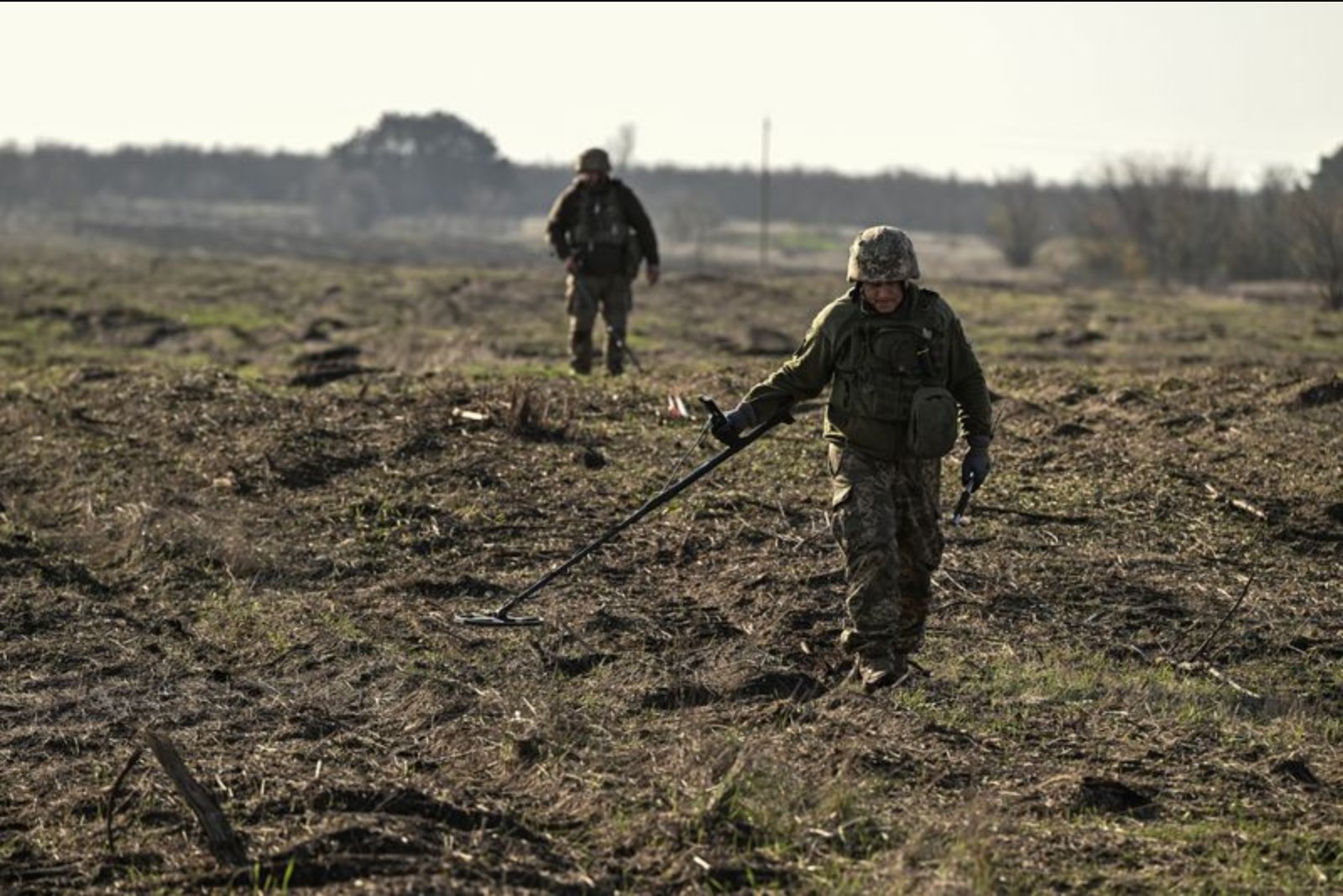
Near the village of Myrotske in central Ukraine, a group of deminers advances methodically through woods and fields, sweeping metal detectors in sync as they search for buried explosives. The teams are working to remove mines and unexploded ordnance left behind after Russian forces occupied the area about 40 km (25 miles) northwest of Kyiv early in the invasion four years ago.
Large tracts of Ukrainian land remain contaminated after years of fighting. Olena Shustova, media manager for the demining charity HALO Trust, said the country is now "the most heavily mined country in the world" and that "Ukraine will not be demined in less than 10 years." HALO began operations in the Myrotske area after a nearby Ukrainian serviceman stepped on an anti-personnel mine while collecting firewood two years ago, an incident that highlighted continuing dangers even when front lines move elsewhere.
HALO Trust, which describes itself as the world’s largest international mine action organisation, employs 1,350 nationals in Ukraine. State-run Demine Ukraine estimates that more than 132,000 square kilometres - an area comparable to Greece or the U.S. state of Mississippi - remain contaminated, while nearly 42,000 sq km have been rendered safe to date.
Given the scale of contamination, demining organisations are combining human effort with technological tools. HALO has introduced artificial intelligence into its workflow to analyse high-resolution drone imagery of affected zones and to train systems to recognise explosive remnants. The organisation reports that these methods have reached around 70% accuracy so far. Shustova noted that while the overall process may stretch across decades, these technological advances are helping to accelerate it.
At a separate demining site north of Kyiv, technology and human oversight come together in a very visible way. A remote operator named Oleksandr Liatsevych sits inside a portable steel cage with reinforced windows. Wearing virtual reality glasses and using a joystick, he controls a customised excavator positioned several metres away. The machine digs into earth that may contain unexploded ordnance and processes material through a specialised grinder that destroys hazardous items.
Liatsevych, a 39-year-old former civil servant and farmer from Huliaipole on the frontline between Ukrainian and Russian forces, said the transition to operating machinery remotely was initially challenging. "The difference between driving from a cabin and driving a remote joystick is big," he said, adding that a lack of childhood experience with computer games made the learning curve steeper.
Alongside these automated and remote systems, manual deminers continue traditional clearance work. In nearby woods, deminer Olha Kava crouches, outfitted in protective vest and visor, as she probes the ground for a suspected anti-personnel mine. Kava, a former travel agent and mother-of-three, joined demining after friends enlisted in the armed forces following the full-scale invasion. She acknowledged fear but said it "motivates you to do your job correctly and responsibly."
The combined use of remote-operated excavators, drones and AI is part of a broader shift in which automation and new technologies are changing how contaminated landscapes are cleared. Unmanned machines can cover larger areas with reduced risk to personnel, while AI can prioritise sites for manual or mechanical intervention by flagging likely locations of explosive remnants in imagery.
Despite these gains, the operational challenge remains immense. The large contaminated footprint, the continuing need for manual verification and the human cost when accidents occur underline why demining work in Ukraine will remain a long-term endeavour.
Context and next steps
Organisations running clearance operations will likely continue to refine AI tools and expand use of unmanned machinery to improve speed and safety. At the same time, large-scale manual demining and verification will remain necessary in many areas where technology cannot yet replace careful ground work.