
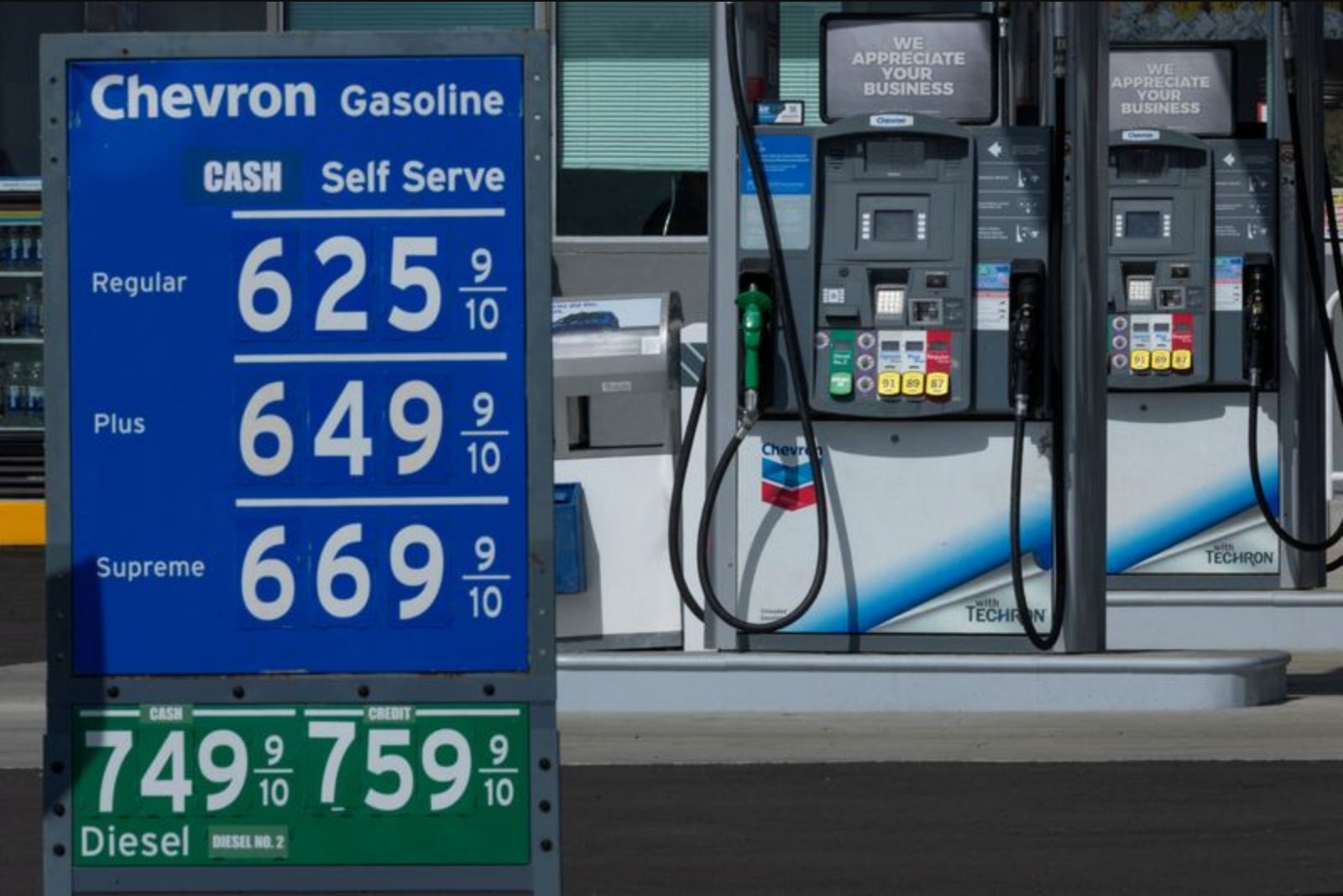
Summary: Motorists in California encountered gasoline prices above $6 a gallon on Thursday, the steepest regional level in roughly two years. The surge, tied in the article’s reporting to disruptions stemming from the Iran conflict, has constrained supplies, hit California particularly hard because of its regulatory and tax structure, and intensified political debate with a key gubernatorial primary weeks away.
Gasoline in California climbed to an average of $6.01 a gallon on Thursday, the highest price in the state since October 2023 and the top level nationwide, according to GasBuddy data. The U.S. national average reached $4.34 a gallon on the same day, marking the highest nationwide reading since July 2022.
The spike in pump prices has coincided with a broader disruption to global oil supplies linked to the Iran conflict, which the article reports has "closed the Strait of Hormuz and bottled up nearly a fifth of global oil flows." That supply shock, together with California’s high taxes, strict emissions standards and reliance on imported petroleum, has produced what many motorists and analysts in the state view as acute price pain.
Supply dynamics and trade flows
California’s geographical and regulatory position makes it particularly sensitive to international supply movements. The state depends heavily on imports from Asia to meet domestic fuel needs, and the reduction in available crude for Asian refiners has prompted production cuts and export restrictions there, leaving less refined product available to ship to the U.S. West Coast.
At the same time, international buyers pressed by shortages have purchased crude and refined fuel from the U.S. Gulf Coast, pushing benchmark oil prices higher and contributing to increased fuel prices across the United States. U.S. gasoline exports rose in March to 834,000 barrels per day, the highest level since November, with at least two cargos sent to Asia, Kpler data showed. In California, fuel stockpiles reached record lows in April.
Imports into California have also shifted sharply. Gasoline imports to the state fell after reaching a record 195,000 barrels per day in the week beginning April 13, dropping to less than 75,000 barrels per day in the most recent week cited by Kpler.
Denton Cinquegrana, chief oil analyst at Dow Jones Energy, summarized the state’s exposure by saying, "California is arguably the state most impacted by the Strait of Hormuz in the United States, which has been largely insulated from the events."
Economic effects and inflationary pressure
The surge in fuel costs has fed into domestic inflation measures. The article notes that higher fuel prices contributed in March to the largest annual rise in inflation in nearly three years, and analysts expect pressure on consumers to deepen as the Iran-linked disruptions persist into the U.S. peak summer travel season, which typically stretches from around Memorial Day in late May through Labor Day in September.
Political fallout
Fuel costs have become a political flashpoint. With California’s gubernatorial primary roughly one month away, candidates debated whether to scrap the state’s $0.61-per-gallon gas tax, the highest in the nation. At the national level, high gas prices are expected to influence voter sentiment ahead of congressional midterm elections in November, when the article says President Donald Trump’s Republicans will be working to hold onto control of Congress.
Public opinion polling cited in the article showed three out of four Americans said the Trump administration bore responsibility for the recent rise in gas prices, according to an April Reuters/Ipsos poll, and a majority of respondents expected gas prices to worsen over the next year.
California Governor Gavin Newsom, a frequent critic of President Trump, attributed the higher pump prices to the Iran conflict in a press release quoted in the article: "Every American who fills up their tank this week, buys groceries, or books a flight is paying Donald Trump’s Iran war tax." His remarks followed criticism from Trump that Newsom-backed energy policies helped lead to refinery closures in the state, increasing reliance on imports.
The California Energy Commission had previously sought to reassure motorists by saying the state’s ability to import fuel from Asia would shield consumers against spikes, but the current supply disruption has exposed that reliance as a vulnerability.
Household and small-business impacts
The rise in prices is being felt at the pump. Miguel Angel Cruz, who operates a landscaping business, described how his outlays have risen: he said he used to fill his truck for $50 but now that same fill runs about $80. At a Carlsbad service station while he spoke, the pump tally for slightly more than 13 gallons moved past $80 and landed at $85.75.
"I cannot drive any less," Cruz said, explaining the operational constraints of his work. He added: "Every time we get a new president in the White House, they say this year is gonna be better. But nothing’s changed. It’s the same story, except now it’s worse because of the war in Iran."
Other motorists report similar stress. Amanda Martinez, a video editor who recently relocated to California from Texas, said she did not think gas in California should cost as much as it does. "I cannot afford this gas," Martinez said. She indicated that if prices climb further she would consider commuting less, asking her employer about remote work or a gas card, and is weighing the prospect of buying an electric vehicle since her office is about 20 miles from home.
Route 66 centennial and travel plans
The gasoline price spike comes as motorists mark the 100th anniversary of U.S. Route 66, the cross-country highway that stretches about 2,400 miles between Chicago and Los Angeles. The U.S. government’s Route 66 Centennial Commission and independent motorists have organized events to commemorate the route, often nicknamed "The Mother Road." According to an AAA survey cited in the article, about 41% of Americans planned to visit at least parts of Route 66 during the 2026 centennial celebration.
Route 66 remains a popular choice for summer road trips, and the article highlights concerns that higher fuel costs will weigh on travel plans and consumer budgets during the peak vacation months.
Market signals and refining capacity
The article notes the closure of two California refineries in recent years that together supplied about 20% of the state’s motor fuel needs. That loss of domestic refining capacity has increased California’s dependence on imports. While the Energy Commission had earlier suggested import capability could mitigate outages, current global supply strains have undercut that contingency.
Analysts and market observers are watching both crude and refined product flows closely as the situation develops. The convergence of constrained supply, elevated international demand for U.S. product, and domestic policy complexities has created a pronounced squeeze on gasoline availability and affordability in California.
Outlook and final observations
The article lays out a picture of constrained international supply and shifting trade flows that have combined with state-level factors to push gasoline prices in California above $6 a gallon. The situation has become a politically charged issue as a state primary approaches and as national political actors prepare for midterm elections. For consumers and small businesses that rely on regular driving, the higher pump prices are already adding to household costs and business operating expenses, and the prospect of a sustained disruption into the summer travel season is likely to keep gasoline near the center of economic and political attention.