
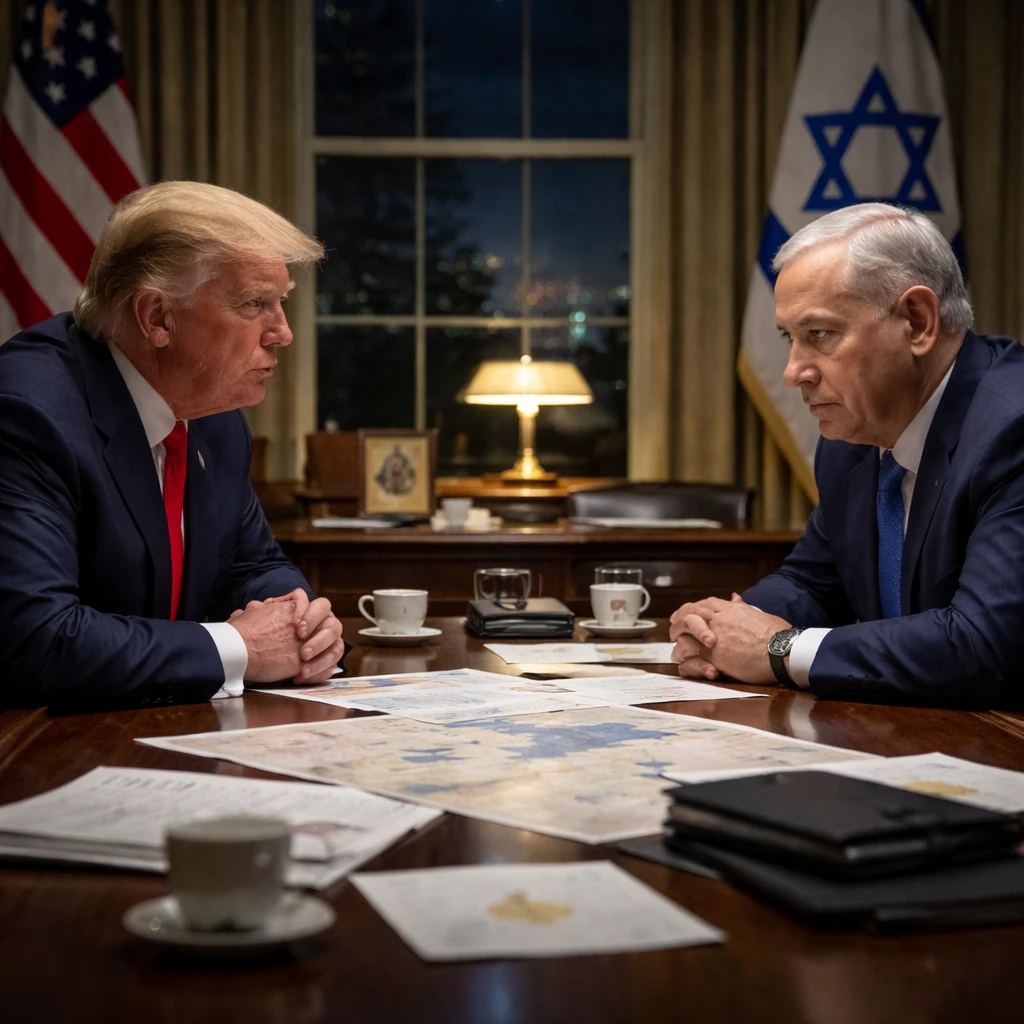
WASHINGTON, July 29 - U.S. President Donald Trump and Israeli Prime Minister Benjamin Netanyahu examined the full spectrum of strategies to try to curb Iran's nuclear efforts during a meeting at the White House, a senior Israeli official told reporters on Wednesday.
The official said the discussion covered three distinct options in detail: pursuing a negotiated agreement, maintaining and increasing a blockade together with economic pressures, and carrying out a large-scale military strike. The official stressed that Netanyahu did not present an Israeli preference for an attack to President Trump.
"In the end, it’s his decision," the official said, referring to Trump. The official added that all three options - "A deal, continuing the blockade and economic pressures, and a massive strike" - were discussed at length.
The Israeli official also pointed to indications that Iran's clerical leadership may be feeling domestic strain, citing rising inflation and growing public frustration. At the same time, officials are weighing the potential consequences for the global economy and for oil markets as part of their deliberations.
Market moves were evident on Wednesday, when oil prices experienced one of their sharpest daily rises since the conflict intensified on February 28, linked in the official's account to a joint aerial campaign by Israeli and U.S. forces in Iran. Tehran has responded with strikes against Israel and Gulf states.
The official noted that Israel did not participate in a recent two-week U.S. bombing campaign this month that prompted Iranian strikes on U.S. bases, though Israel has warned it would respond forcefully if it were attacked.
Separately on Wednesday, the United States and Saudi Arabia conducted strikes against Iran-backed paramilitary targets in Iraq. President Trump, who had briefly halted air strikes, declared he would "beat the fucking shit" out of Iran for firing on U.S. troops.
Iran confirmed overnight that it fired on U.S. bases in Jordan and engaged vessels in the Strait of Hormuz. It also rejected an Omani proposal to jointly manage transit through the strait.
Summary
- Trump and Netanyahu reviewed diplomacy, economic pressure and military action as options toward Iran.
- Netanyahu did not press for an attack; the Israeli official framed the final choice as Trump's.
- Officials noted domestic unrest in Iran and factored in effects on the global economy and oil markets.
Key points
- Three options were discussed: a negotiated deal, escalation of economic measures and blockade, and a large-scale strike.
- Recent military activities, including a joint Israeli-U.S. aerial campaign and retaliatory strikes, have coincided with sharp oil price movements.
- Regional actions involved strikes on Iran-backed groups in Iraq and Iranian fire on U.S. bases and shipping in the Strait of Hormuz.
Risks and uncertainties
- Further military escalation could amplify volatility in oil markets and broader global economic effects.
- Continued attacks on shipping and bases raise uncertainty for maritime operations through the Strait of Hormuz.
- Domestic instability in Iran, reflected in inflation and public frustration, could lead to unpredictable policy responses.