
Overview
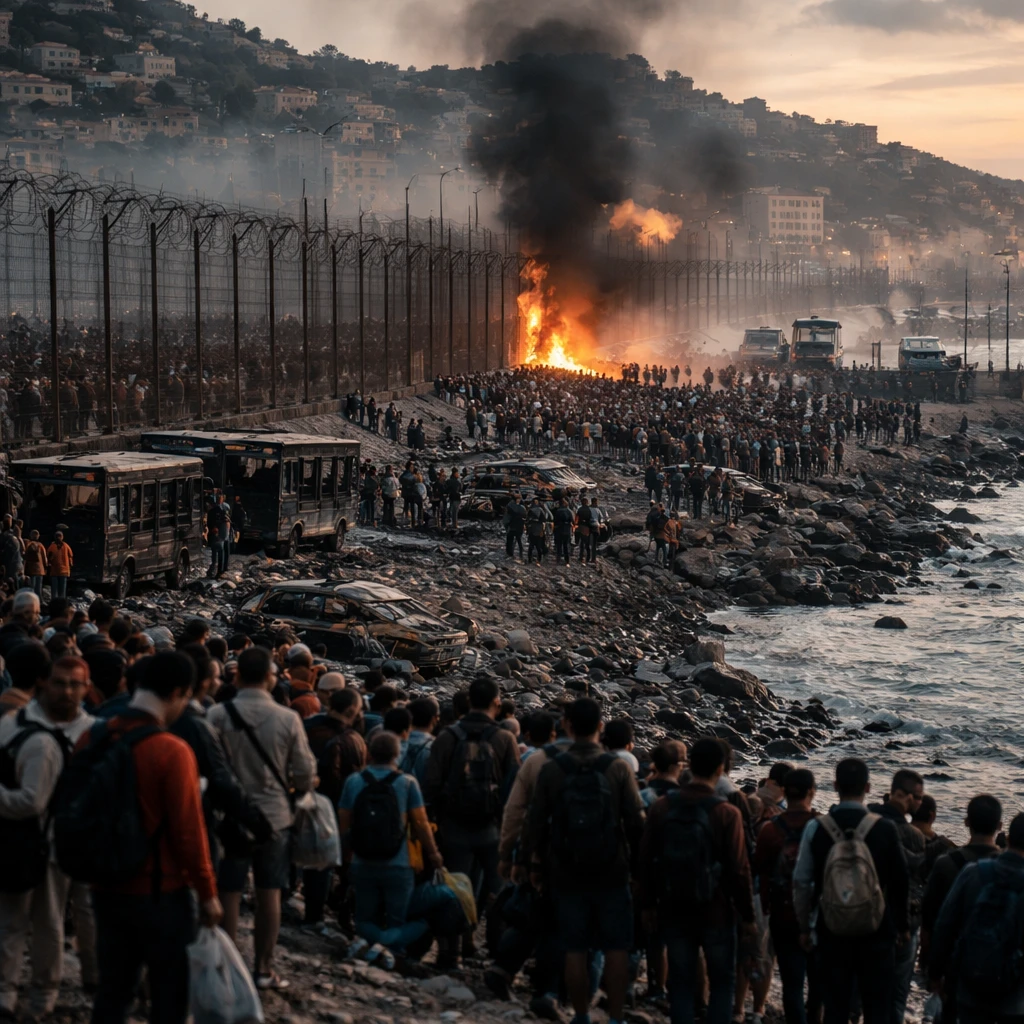
Spanish and Moroccan authorities strengthened security along the fence encircling Ceuta on Friday after an unprecedented mass movement of people arrived by both land and sea in the space of 24 hours. Officials reported at least 19 bodies recovered from the water amid the surge. Spanish national security officials initially posted an estimate that more than 49,000 people had crossed the border illegally in that 24-hour period, citing the Interior Ministry; that estimate was later removed from the department website without explanation.
Scale and immediate response
The crossing overwhelmed the normally small Spanish enclave - a narrow Mediterranean spit under Spanish administration on the Moroccan coast - and prompted rapid security responses on both sides of the border. Spanish authorities signaled an intention to remove people who entered illegally as quickly as possible, while also noting that a recent court ruling imposes limits on the use of special immediate-expulsion procedures known as 'border rejections' for people intercepted at sea bound for Ceuta or Melilla.
Prime Minister Pedro Sanchez was scheduled to visit Ceuta on Friday accompanied by Interior Minister Fernando Grande-Marlaska. Authorities across Spain and Morocco reinforced physical barriers and increased deployments at access points into the enclave. On the Moroccan side, security forces used water cannon trucks and pushed back groups attempting to cross, and a reinforced deployment in the town of Fnideq prevented most attempts despite thousands gathering there overnight.
Visual evidence on the Moroccan approach to the gates showed signs of violent clashes with the crowds: the charred shell of a bus and seven burned cars were visible near the scene.
Human dimension
Those involved in the attempt to reach Ceuta included women and children from Morocco and from sub-Saharan African countries further south. Some people tried to find alternate routes along the coast when the main crossings were blocked, and a portion prepared to swim to reach the enclave.
One man identified only as Brahim, 32, said he had traveled from Tangier and aimed to pass through the gate but found it effectively closed. "I was late," he said.
Spain's Guardia Civil police association AUGC posted on the social platform X that there had been too few police deployed to monitor the fence during the surge on Thursday, and that this lack of manpower made it impossible to stop the mass crossing at the time.
Legal and political constraints
Spanish officials noted that the government reacted immediately to the surge and that it intended to return migrants eventually, while observing both judicial rulings and the rights of migrants. Territorial Policy Minister Angel Victor Torres suggested one contributing factor may have been a recent Supreme Court ruling clarifying that migrants intercepted at sea while trying to reach Ceuta or Melilla cannot be summarily returned under the special rules.
That legal context complicates the use of rapid-expulsion measures and shapes how authorities in Ceuta and in broader Spanish jurisdictions can process and remove people who arrived without authorization.
European reactions and tensions
The mass crossing reverberated across Europe and exposed divisions among EU partners. France announced that it had instructed authorities to increase checks at its border with Spain, although the statement did not spell out operational measures. Italy's government, led by a right-wing prime minister, said it was prepared to adopt extraordinary measures to defend borders and public safety, including threatening suspension of Spain's participation in the Schengen open-border arrangement.
Finland's interior minister, also aligned with parties on the right, publicly praised the Italian suggestion and said the EU should consider following Italy's lead. Political figures in France and Italy used the incident to press for stricter movement controls within the Schengen Area.
Italian Foreign Minister Antonio Tajani criticized Spain's recent approach to regularizing irregular immigrants and argued the images from Ceuta illustrated that granting citizenship to hundreds of thousands of irregular migrants was wrong and encouraged trafficking. Spain's Foreign Minister Jose Manuel Albares called Tajani's comments "inappropriate" and said Spain expected solidarity rather than partisan rhetoric; Albares said he would summon Italy's ambassador to convey that protest.
Far-right politician Marine Le Pen, campaigning in France, said she would restrict Schengen free movement to European nationals if she were elected, and called on France to strengthen its border controls in the wake of the Ceuta events.
Operational picture on the ground
On the Moroccan side in Fnideq, thousands moved toward the border overnight despite heightened security that prevented most from crossing. Small groups kept moving along the coast searching for gaps in the reinforced perimeter, and some prepared to swim. Moroccan authorities deployed water cannon and pushed back attempts at the gates.
Spanish authorities face the dual challenge of managing the immediate return of people who entered without authorization while operating within judicial limits on summary expulsions. Ceuta and Melilla, Spain's two autonomous cities on the Moroccan coast, constitute the European Union's only land borders with Africa. Each city has a population of around 85,000 and both periodically see surges in attempted crossings; officials said the scale seen this week was without precedent.
Broader political context cited by officials
Spanish government officials framed migration as a sensitive political issue across Europe, especially in the decade following the 2015 migration crisis. Spain's national leadership said that, while it remains firm on preventing illegal crossings, immigrants also contribute to the economy and that recent measures, including a mass amnesty that enabled hundreds of thousands to seek citizenship over the past year, reflect that perspective.
Key points
- More than 49,000 people were initially estimated to have crossed into Ceuta illegally within 24 hours, and at least 19 bodies were recovered from the water - this resulted in a large-scale security reinforcement on both sides of the border.
- European partners responded with increased border checks and political pressure; Italy threatened extraordinary measures including potential suspension of Schengen arrangements with Spain, raising cross-border tension.
- Legal constraints from a recent Supreme Court ruling limit the use of immediate expulsions at sea, shaping how Spanish authorities can process returns and complicating operational responses.
Risks and uncertainties
- Judicial limitations on "border rejection" rules increase uncertainty for rapid deportation operations - this affects border security and public-sector immigration enforcement resources.
- Political fallout among EU partners - stepped-up checks and threats to suspend Schengen arrangements could disrupt cross-border travel and trade, affecting transportation and tourism sectors in Spain and neighboring EU countries.
- Operational capacity constraints at the fence and processing centers - claims of insufficient police deployment during the surge point to risks in manpower planning and border infrastructure readiness, affecting government security budgets and logistics suppliers.
Conclusion
The mass arrival at Ceuta has exposed limits in both governance and infrastructure at a sensitive external EU border. Authorities on both sides have responded with reinforced security, and Spain has signaled it will move to expel people who entered illegally while complying with judicial protections. The incident has rippled across European capitals, triggering intensified checks and heated political exchanges that could influence future cooperation on border management within the EU.