
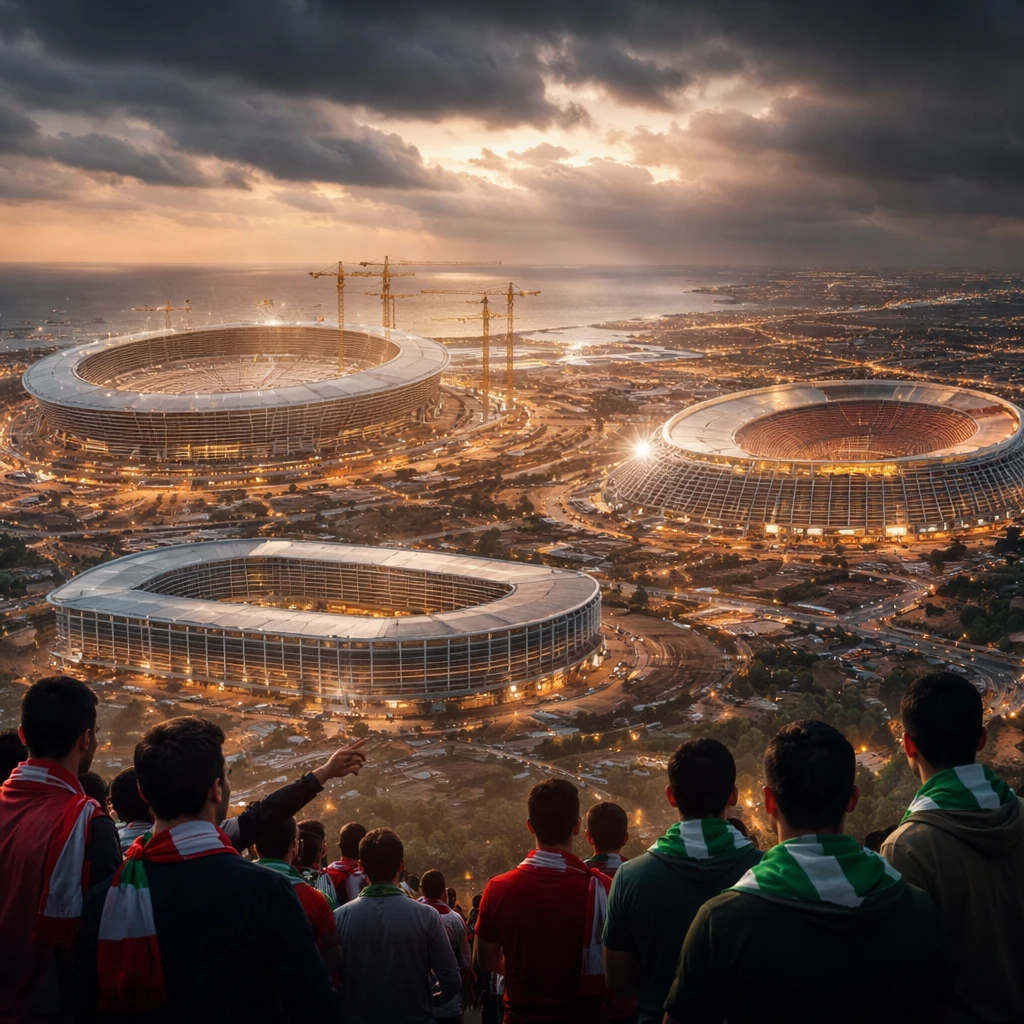
When Spain signed on as a co-host of the 2030 World Cup, many inside the country’s football and tourism circles assumed the tournament’s final would be played on Spanish soil. Spain’s credentials - repeated success as world champions and its status as a top global destination for visitors - made it appear the natural setting for the pinnacle of the competition. Those assumptions have been shaken as Morocco, a later entrant to the joint bid, has aggressively positioned itself to host the final.
What was initially treated in some Spanish quarters as a foregone conclusion has become a fraught contest. The battle for the final is now concentrated on three proposed venues: Real Madrid’s Santiago Bernabeu, Barcelona’s Camp Nou and Morocco’s under-construction Hassan II stadium near Casablanca. Each option carries its own advantages, but the dynamic among them is influenced as much by politics and alliances as by stadium capacities and infrastructure.
The competing bids and the stadium question
Morocco’s strategy is built around the Hassan II stadium, a project named after its former king and planned to seat 115,000 spectators, which would make it the largest soccer arena in the world. The Moroccan Football Federation has rallied behind the stadium as a focal point for delivering the final. Supporters point to Morocco’s rise as a footballing nation, including its standing inside the top five of FIFA’s world rankings, as a sporting justification for hosting the match.
Spain’s offer is split between two of the country’s most iconic club arenas. Barcelona’s Camp Nou, following a projected $2 billion refurbishment, is expected to have a capacity of 105,000 by the 2028-2029 season. Real Madrid’s Bernabeu, meanwhile, will hold about 84,000 after a $1.5 billion modernization. For Spain, presenting two world-renowned stadiums gives it multiple options, but that multiplicity has also exposed internal tensions.
Political and institutional fault lines
The competition over the final has not been confined to stadiums and engineering plans; it has become entangled with broader political and institutional dynamics. Within Spain, prominent figures have publicly warned of consequences if the final is not awarded to the country. Alberto Núñez Feijóo, the leading candidate to become prime minister after a recent election, stated Spain should pull out of hosting the tournament if it is not granted the final.
Other influential voices in Spanish football have echoed those fears. Javier Tebas, head of LaLiga, and José Luis Martínez-Almeida, the conservative mayor of Madrid, have also expressed concern - Almeida saying he was not optimistic about Spain’s prospects given what he perceived as a lack of matching ambition from the Spanish government.
Inside the Spanish football federation (RFEF), the situation has been complicated by the timing of the bid and internal instability. The bid was assembled during a period when the RFEF was dealing with fallout from a scandal involving its former president, which, according to RFEF sources, was not a conducive environment for forging a unified plan on a multi-party project of this magnitude. The federation’s secretary general, Alvaro de Miguel, has pushed back against suggestions of division, arguing that presenting two viable Spanish venues actually improved the country’s chances against Morocco’s single option.
Morocco’s unified front and strategic advantages
By contrast, Morocco’s campaign appears united and concentrated. The Moroccan Football Association, with strong institutional backing, has emphasized the Hassan II stadium as a national project. Moroccan supporters and officials have framed the push for the final as not only a sporting objective but also an investment in regional development and infrastructure.
Morocco’s approach is being presented as transformative for Casablanca and its surrounding region. Moroccan FA President Fouzi Lekjaa has stated that the Hassan II stadium is expected to be completed in early 2028. The government has signaled significant public investment ambitions: according to IMF figures cited in discussions, Morocco plans to spend about $19 billion from 2024 to 2030 on airports, stadiums, hotels, a high-speed rail network and linked transport infrastructure, including a train station and highway to connect the stadium with Casablanca 45 km away.
Proponents argue that hosting the final in Morocco would catalyze wider infrastructure and economic development in North Africa. One source involved in Moroccan discussions suggested the final should go to the stadium with the highest capacity - and to an African country - saying it would be awkward and send the wrong message to Africa if the final were awarded to a non-African country with a smaller stadium.
FIFA politics and the Infantino factor
The decision over the final’s venue is being shaped not only by the merits of the two bids but also by internal politics at FIFA. FIFA President Gianni Infantino has faced scrutiny for a proposal to sell a 20% stake in the World Cup and has been engaged in a power struggle with UEFA. Observers and Spanish critics have suggested that Infantino’s relationship with Morocco could influence the outcome. Morocco’s football association has been described as one of Infantino’s staunch supporters, and he has reportedly spent extended periods at FIFA’s regional headquarters in Rabat since the controversy over the selloff plan.
Javier Tebas has publicly asserted that Infantino would favor Morocco because of Morocco’s backing of his reelection bid, and he went so far as to say that if Infantino remains in office Spain’s chances of securing the final would be negligible or non-existent. Infantino is the front-runner for reelection at FIFA’s upcoming congress, which will be held in Morocco.
Countervailing influences also exist. Real Madrid President Florentino Perez is noted as having a close relationship with Infantino and could potentially advocate for Spain’s case. The RFEF’s Alvaro de Miguel has argued that FIFA’s governance being under scrutiny could benefit Spain, expecting the final to be awarded to what he described as the tournament’s "natural" candidate. FIFA itself has said it does not have a standard procedure for selecting a venue and that decisions will follow consultations with host cities, countries and governments.
Infrastructure, hospitality and technical assessments
Concrete measures of readiness vary across the bids. The FIFA technical report evaluated Casablanca’s accommodation offering for the general public at 3.1 compared with a rating of 5 for Spain. Casablanca’s hotel capacity and broader hospitality offering will be areas identified for development if Morocco’s bid for the final advances.
Spanish officials note Madrid’s experience in managing high-pressure matches, citing examples such as the 2018 Copa Libertadores final which was relocated to Madrid due to fan violence in South America. They have also pointed to challenges faced in Rabat during the 2025 Africa Cup of Nations final, where a penalty decision led to the Senegalese coach ordering his players off the pitch, confrontations among players ensued and there were disruptions including theft of equipment by ball boys.
Capacity also features prominently in the debate. Supporters of the Moroccan bid stress the Hassan II stadium’s 115,000-seat capacity, while Spanish backers highlight the Camp Nou’s planned 105,000 capacity following renovation and the Bernabeu’s 84,000 seats after its refurbishment. De Miguel has argued that if size matters, the Camp Nou would be able to match Morocco’s capacity ambitions by the late 2020s.
Economic stakes and sectoral implications
Beyond national pride and sporting prestige, the decision over the final carries meaningful economic implications. The selection of a final venue affects sectors including tourism, hospitality, transportation, construction and event services. A World Cup final comes with short-term spending from visiting supporters and long-term implications for brand positioning, city marketing and infrastructure utilization.
For Morocco, organizers present the World Cup as an opportunity to accelerate transport projects and urban development around Casablanca. The cited IMF plan to invest $19 billion through 2030 outlines a broad program of investment that would touch construction firms, hotel developers, rail operators and airport authorities.
Spain, with its more mature tourism and hotel market, argues it already has the capacity and experience to accommodate the influx of visitors that a final would draw. However, internal disunity on which Spanish city should host the match has created a political complication that affects the country’s external negotiating posture.
Voices from the pitch and the crowd
Public sentiment in Morocco appears enthusiastic. Fan Bilal Jouhari in Rabat emphasized Morocco’s footballing merit, noting the national team’s high FIFA ranking and arguing that Morocco deserves a shot at the final. "Those who threaten to walk out if FIFA chooses Morocco as the final’s host are just like those who abandon the game because they don’t like the referee’s decisions," he said, comparing detractors to fans who quit in protest over refereeing.
Outside observers of major tournaments argue that bids often prevail where the host country stands to gain substantial development and legacy benefits. Ricardo Trade, who has held senior operational roles at global sporting events, said Spain should have resolved which city would host the final as part of the original bid. He characterized Spain as "terrified of losing the final," and contrasted Spain’s divided stance with Morocco’s apparent unity and single-stadium proposal.
Timeline and process
FIFA inspectors are conducting visits to host cities in the current selection phase, but FIFA has not announced a timeline for when it will name the final venue. By contrast, previous World Cup finals selections in other cycles were announced well ahead of the event; the 2026 final venue was known two years before that tournament. At present, the final decision remains pending, and both technical and political considerations will be weighed as FIFA consults with host cities, national associations and governments.
What remains uncertain
Key uncertainties include FIFA’s ultimate weighing of stadium capacity and infrastructure readiness versus the political and developmental benefits assigned to each candidate. Also unresolved is the extent to which FIFA governance dynamics and the personal relationships of senior officials will influence the outcome. For Spain, internal coherence on where to stage the final remains a pressing question; for Morocco, building out hotels and complementary infrastructure to meet FIFA’s technical expectations will be an immediate implementation challenge if awarded the match.
The competition for the 2030 final underscores how major sporting events are decided at the confluence of stadium plans, national ambition and international organization politics. Until FIFA makes its selection, both Spain and Morocco will continue campaigning and preparing to make the case that they are the right choice to host football’s most watched single match.