
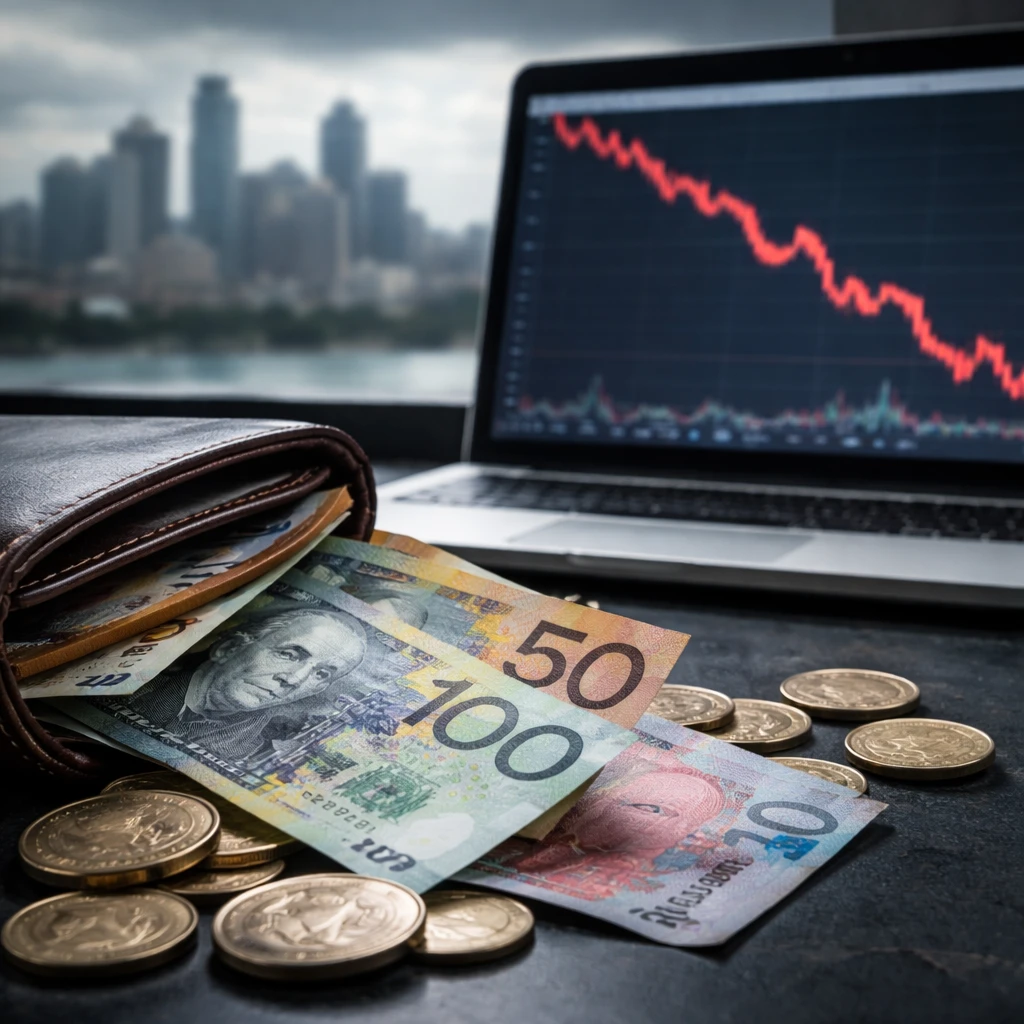
The Australian dollar slid sharply against the U.S. dollar, with the AUD/USD pair down roughly 1% to 0.6576 and touching a session low of 0.6559, marking its weakest level since December 2025. The move came after Australia published an October inflation report that, while showing a stronger-than-expected headline reading, was read by markets as evidence that recent monetary tightening is already weighing on the economy.
Inflation surprise interpreted as a negative for the currency
Headline consumer price inflation climbed to 4.9% year-on-year, above the 4.7% consensus and noticeably higher than September’s 4.3% pace. Rather than bolstering the Australian dollar by implying further policy tightening, the market reaction was counterintuitive: traders concluded that the Reserve Bank of Australia’s five cumulative rate hikes this year have already done enough damage to growth prospects to make additional near-term hikes unlikely. In this way, the inflation surprise removed what would normally be a key support for a currency — the prospect of higher rates — and instead highlighted the potential economic costs of past tightening.
RBA official flags restrictive financial conditions
Adding to the negative tone, David Jacobs, the RBA Head of Domestic Markets, described Australia’s financial conditions as "clearly restrictive," warning of downside exposure from a weakening housing sector and suggesting that earlier rate increases could deepen the economic drag on consumption if the housing downturn intensifies.
External factors amplify risk-off sentiment
Outside Australia, reports that the U.S. administration is preparing a new set of Section 301 tariffs affecting 16 trading partners triggered a broader risk-off response across Asian currency markets. That dynamic strengthened demand for the U.S. dollar as a safe-haven asset and exerted additional downward pressure on the Australian dollar, despite the domestic inflation print. Australia’s labor market also offered little comfort to policymakers: the unemployment rate has risen to a five-year high, further undermining the case for renewed RBA tightening.
U.S. economic signals widen policy gap
On the U.S. side, hawkish comments from influential Federal Open Market Committee members reinforced market expectations of a December Federal Reserve rate hike. At the same time, U.S. consumer confidence reached its highest level in nearly two years. Together, these developments widened the policy divide between a more cautious RBA and a Fed that markets view as ready to tighten further, supporting the U.S. dollar and weighing on AUD/USD.
Market and sector impact
The ASX 200 fell about 0.4%, dragged lower by declines in miners and banks, while broader Asian equity markets also retreated on the tariffs-driven risk-off mood. The deterioration in global risk appetite typically penalizes growth-sensitive and commodity-linked currencies such as the Australian dollar, and in this episode those dynamics combined with domestic signals to push AUD/USD to an 11-month trough. The pair is on track for what would be its steepest monthly drop in more than a decade.
In summary, a mix of an unexpectedly strong inflation print that markets viewed as evidence of already-restrictive policy effects, dovish-sounding RBA commentary, renewed U.S. tariff risks and a stronger U.S. economic and policy backdrop converged to drive the Australian dollar materially lower against the U.S. dollar.