
Overview
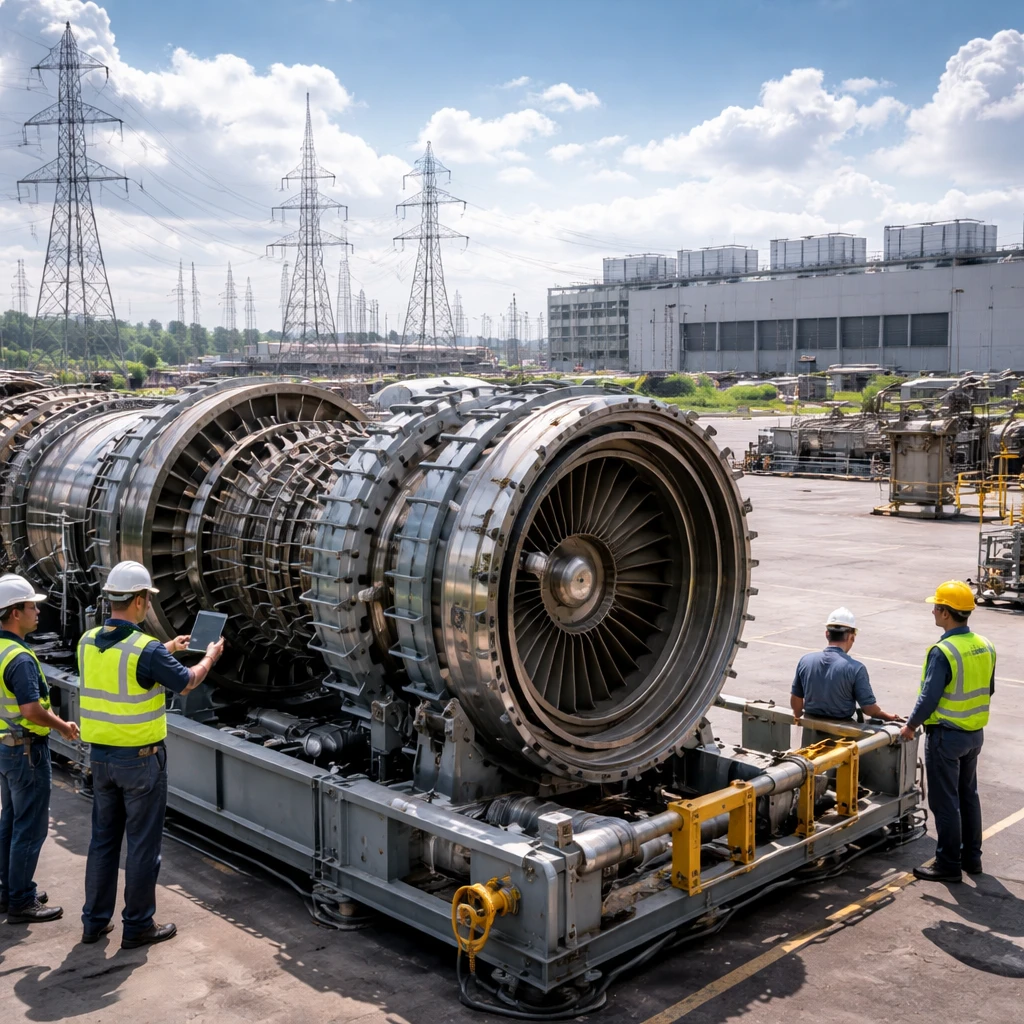
Demand for the power equipment needed to run AI data centers has crowded the turbine market to the point that utilities and developers are turning to secondhand units and restarting mothballed machines as new delivery windows stretch into 2030-2031 in the U.S. Global gas turbine orders now top 100 GW, surpassing the estimated production capacity of 60 to 70 GW. In that environment, GE Vernova (NYSE: GEV) has become a focal point - yet its shares fell 12.9% during the week to $699.33 and are down 15.4% over the last month.
Market dynamics and pricing
Supply scarcity has driven customers to pay up. Pricing on full-year 2026 gas turbine orders is tracking roughly 50% above 2025 levels, and pricing for orders placed in the third quarter landed more than 20% higher than equipment orders booked in the fourth quarter of 2025. That strength is visible in GE Vernova's order intake and backlog: third-quarter orders rose 96% year-over-year to $29.3 billion, producing a book-to-bill above 2.0x and lifting the backlog to about $200 billion from $176 billion in the prior quarter.
Those order trends are central to the company's franchise: it sells gas turbines and grid equipment into a tight market and then provides long-duration service to that installed base. As such, higher equipment pricing has begun to flow into reported results and margins.
Recent financial performance
In the third quarter, adjusted earnings per share of $4.81 exceeded the $4.00 consensus by 20%, while revenue came in at $12.64 billion versus a $12.0 billion forecast. Adjusted EBITDA rose 123% to $1.9 billion and margins expanded by 690 basis points. Cash generation in the quarter was especially notable: free cash flow reached $5.4 billion, and management raised full-year 2026 free cash flow guidance to a range of $16 billion to $17 billion, up from prior guidance of $11.5 billion to $12.5 billion.
At quarter-end the company held roughly $17 billion in cash. Management doubled the share-repurchase authorization to $20 billion and has repurchased 15.6 million shares at an average price of about $635.
Valuation and analyst outlook
On trailing earnings the stock looks inexpensive: the shares trade at 17.8 times trailing earnings and carry a computed implied upside of 18.2% relative to one fair-value estimate. Analysts on the street maintain bullish stances overall, with price targets ranging from $797 to $1,400 and a median target roughly $1,167 - well above the prevailing share price. Specific analyst calls referenced include a Buy rating at $1,210, another at $1,000, and a third at $1,375; other targets cited include $959 and an instance where the stock was rated Hold on November 18.
Consensus estimates embed robust forward revenue expectations - analysts forecast 23.8% revenue growth - and project EPS of $24.80 in 2027 and $38.07 in 2028.
By contrast, a separate Fair Value estimate described in company research sits at $826.66 per share, about 18.2% above the current price and below the analysts' median view. That gap reflects differing assumptions about how much of recent results are recurring.
The accounting nuance that matters
Underlying the debate is the composition of reported profit. Trailing 12-month net income to stockholders reached $10.4 billion, nearly three times reported operating income of $3.6 billion. That divergence reflects items below the operating line that boosted net income in the fourth quarter of 2025 and the first quarter of 2026. The consensus forecast calls for earnings per share to decline by 10.2% as those non-operating items are expected to moderate.
Moreover, the third-quarter cash inflow benefited from roughly $5.3 billion in working capital improvements tied to customer down payments - a timing effect that management warned is unlikely to recur at the same scale. Management also anticipates 2027 Power order profiles will look more like the second half of 2026 than the exceptional first half, suggesting order conversion and revenue timing could normalize.
Operational headwinds
Not all segments are in expansion mode. The Wind business faces near-term pressure, with expectations that the segment will post adjusted EBITDA losses of $400 million to $500 million for 2026. That outcome weighs on consolidated profitability and underscores that the firm's performance is not uniform across its portfolio.
How investors and models are responding
Some quantitative stock-selection models built to rank energy and industrial companies on earnings momentum, balance-sheet strength, and cash generation excluded GE Vernova from recent monthly lists. Those models, which apply a ruleset that emphasizes recurring cash generation rather than headline multiples, flagged the company because the apparent near-term profit contraction and the mix of below-the-line gains reduced the stock's standing relative to other cash-generating industrial and energy operators.
The valuation disconnect - a relatively low trailing P/E on one hand and concerns about earnings quality on the other - helps explain investor caution and the recent price weakness. The low trailing multiple would be attractive if the underlying profit picture were clearly recurring; stripping out non-operating gains makes the multiple look less compelling.
Investor considerations
For investors weighing the recent roughly 15% pullback, the critical questions are how quickly backlog converts to revenue, whether offshore wind losses persist, and if elevated free-cash-flow targets can be maintained without the one-time working capital boost. The company’s large backlog and elevated pricing create a strong top-line runway, but timing and the mix of operating versus non-operating gains will determine whether that runway translates into sustainable earnings growth.
Those dynamics create a classic active-investor tradeoff: exposure to one of the most sought-after equipment franchises in the AI-driven power buildout comes with the risk that reported earnings may reset as unusual items roll off. The concentrated nature of the trade - many investors are targeting the same set of power-equipment names - means a single earnings revision can produce outsized share-price moves.
Key takeaway
GE Vernova sits at the intersection of acute equipment scarcity, strong pricing, and substantial backlog. Those strengths are visible in orders, margins, and cash flow. But investors should account for the fact that recent reported earnings and cash flow included sizable below-the-line items and timing benefits. Determining whether the current valuation is a true discount therefore depends on whether future quarters deliver recurring operating results consistent with headline metrics.