
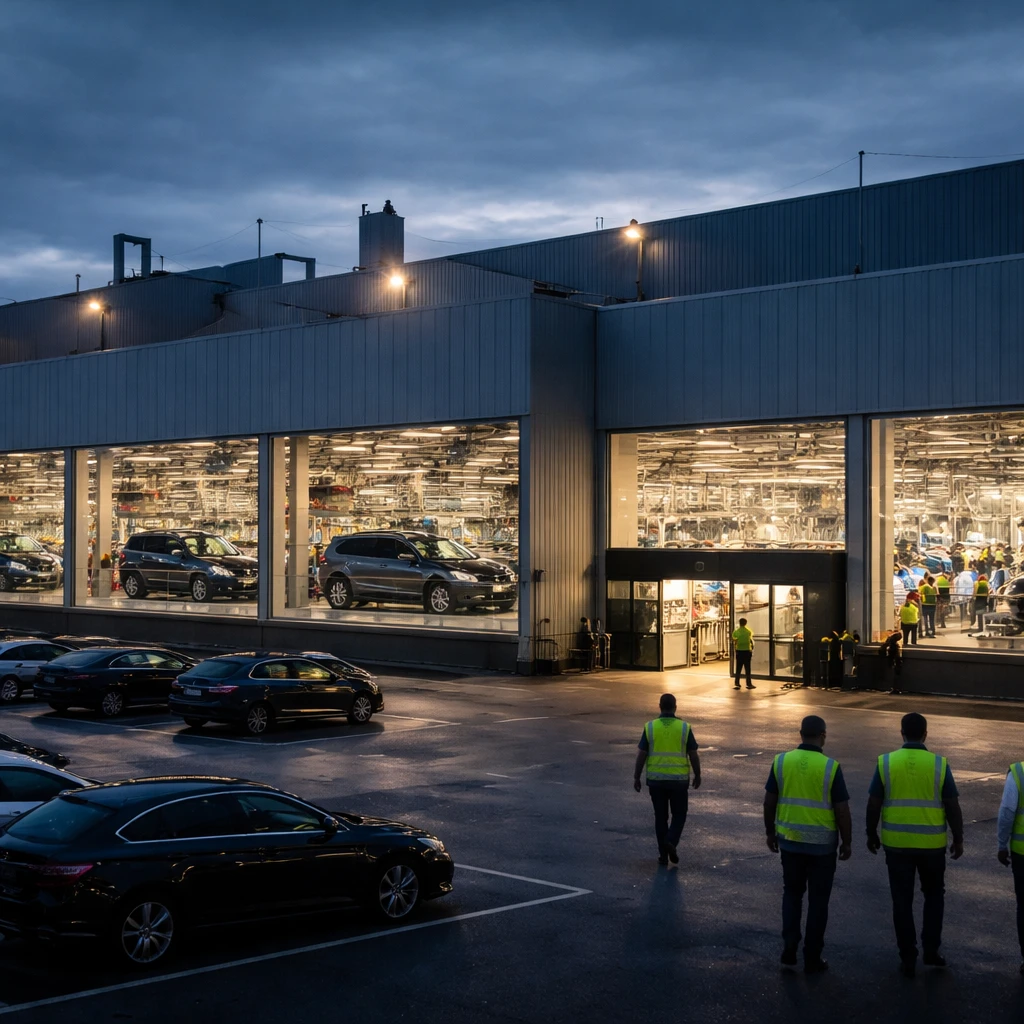
Stellantis announced it will stop operating the night shift at its Sochaux assembly plant in eastern France, a move that will return production to two daytime shifts only. The night shift, which had been added in November 2024 to support the launch of updated Peugeot 3008 and 5008 SUVs, is being removed as the company points to weaker demand and intensifying competition.
The company said the adjustment affects the plant’s temporary workforce: 500 of the facility’s 1,100 temporary employees will not have their contracts renewed when those contracts expire. Stellantis characterized the change as an operational realignment with current market conditions.
According to a company spokesman, "Given the current economic climate and market forecasts, we are adjusting our operations to a sustainably high production level of 850 vehicles per day." The spokesman added: "In a difficult context, with the arrival of new and aggressive competition, it is responsible to take this measure to avoid resorting to short-time work and to stabilize our industrial operations."
The decision has drawn criticism from the CFE-CGC union, which warned that not renewing temporary contracts - described by the union as a cornerstone of the site’s industrial flexibility - will worsen the precarious situation for many workers.
Sochaux is not the only Stellantis site in Europe to face production reductions. The company has implemented cuts at other plants across the region, including at Mirafiori in Italy, where output of the Fiat 500 has been repeatedly halted or slowed.
Not all nighttime activity at Sochaux will cease. A night shift dedicated to battery pack assembly for electric vehicles will remain in place. Stellantis also provided production-mix expectations, saying it expects electric versions of the Peugeot 3008 and 5008 built at Sochaux to constitute 47% of total output from January, up from current levels of 20-22%.
The company framed the move as a way to preserve overall operational stability without resorting to short-time work schemes. Unions, however, highlighted the human and labor flexibility impacts of ending a shift that had been used to manage peaks in production and to support the introduction of new vehicle versions.
As Stellantis adjusts scheduling at Sochaux, the firm will continue battery pack assembly overnight while scaling production to the stated target of 850 vehicles per day. The company described the measure as necessary given its reading of demand trends and competition in the market.
Analysis note: The change reduces night production capacity that had been added specifically to support model launches, while maintaining overnight work tied to electric vehicle components. The company provided explicit production and output-mix targets, and unions have publicly signaled concern about the impact on temporary staff.