
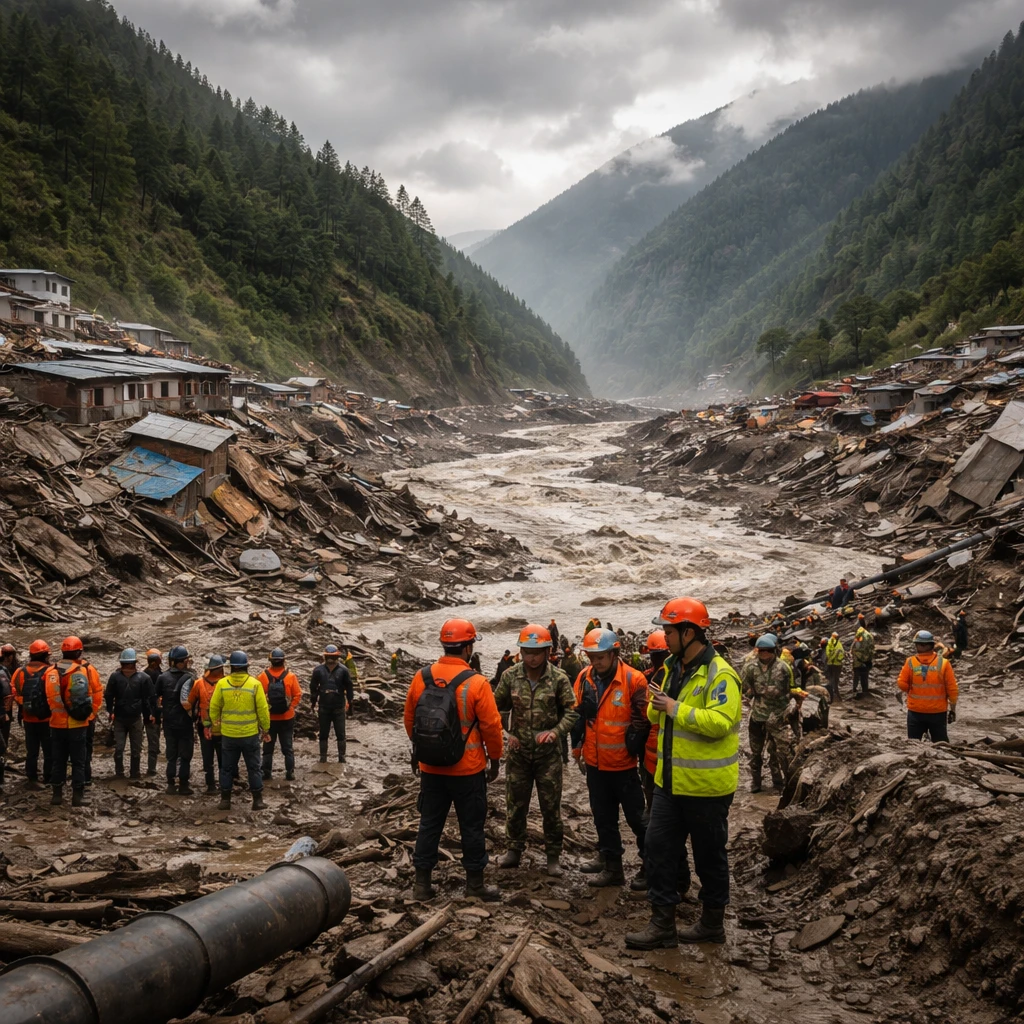
Nepal has informed several countries that it does not require foreign search-and-rescue teams after a flash flood ripped through multiple towns, the foreign ministry said on Friday. The disaster, which struck areas including Rasuwa district near the Chinese border, destroyed entire settlements, damaged hydropower facilities and has so far claimed close to 500 lives.
Despite offers of help from a number of governments - including those with nationals among the missing - Nepal's foreign ministry said domestic security agencies are executing the search-and-rescue operation and foreign teams are not needed at this time.
"The offer for help is natural. Our security agencies are doing the search and rescue operation. For now we don’t require such help," Lok Bahadur Chhetri, spokesperson for the foreign ministry, said, without providing further detail on operational capacity or timelines.
Local reports indicated that India, China, the United States, Britain, Japan, South Korea, Sri Lanka and Bangladesh had requested permission to deploy their search-and-rescue teams to assist. Nepal’s foreign ministry said it was managing the response internally and had not accepted those deployments.
South Korea has reported a significant number of its citizens affected by the flood. The South Korean foreign ministry said nine South Koreans employed at a hydropower plant were missing and 10 were stranded. Seoul has already sent a response team and stated it intends to dispatch an additional disaster relief unit. The foreign ministry added that Nepal had indicated it was not currently planning to accept foreign rescue teams and that "South Korea will keep negotiating with Nepal over the matter."
Seoul has also pledged $1 million in humanitarian assistance to be channelled through international organisations, the South Korean foreign minister said on X.
Commentators have suggested the decision to decline foreign teams may be influenced by the location of Rasuwa district, which borders Tibet - a region Beijing treats as highly sensitive. Dinesh Bhattarai, a former Nepali ambassador to the United Nations in Geneva, said the government’s reluctance to accept foreign search-and-rescue teams may reflect concerns about operating near that frontier. "They may have thought about the locational sensitivity of the region and decided not to accept foreign teams," Bhattarai said.
Chhetri, the foreign ministry spokesperson, rejected any suggestion that the choice was driven by concerns over China’s sensitivities, saying instead that Nepal’s own rescue teams were handling the operation.
The Foreign Ministry of China did not immediately respond to requests for comment about Nepal’s decision to decline foreign search-and-rescue assistance. Chinese state media reported that President Xi Jinping extended condolences to Nepal’s president on Friday.
Context and immediate consequences
The flash flood has levelled entire towns in affected areas and led to damage at hydropower projects, compounding the human toll with impacts on energy infrastructure. Hundreds of foreign nationals are still missing, prompting offers of help from a number of governments; Nepal has so far opted to rely on its own security and rescue agencies.