
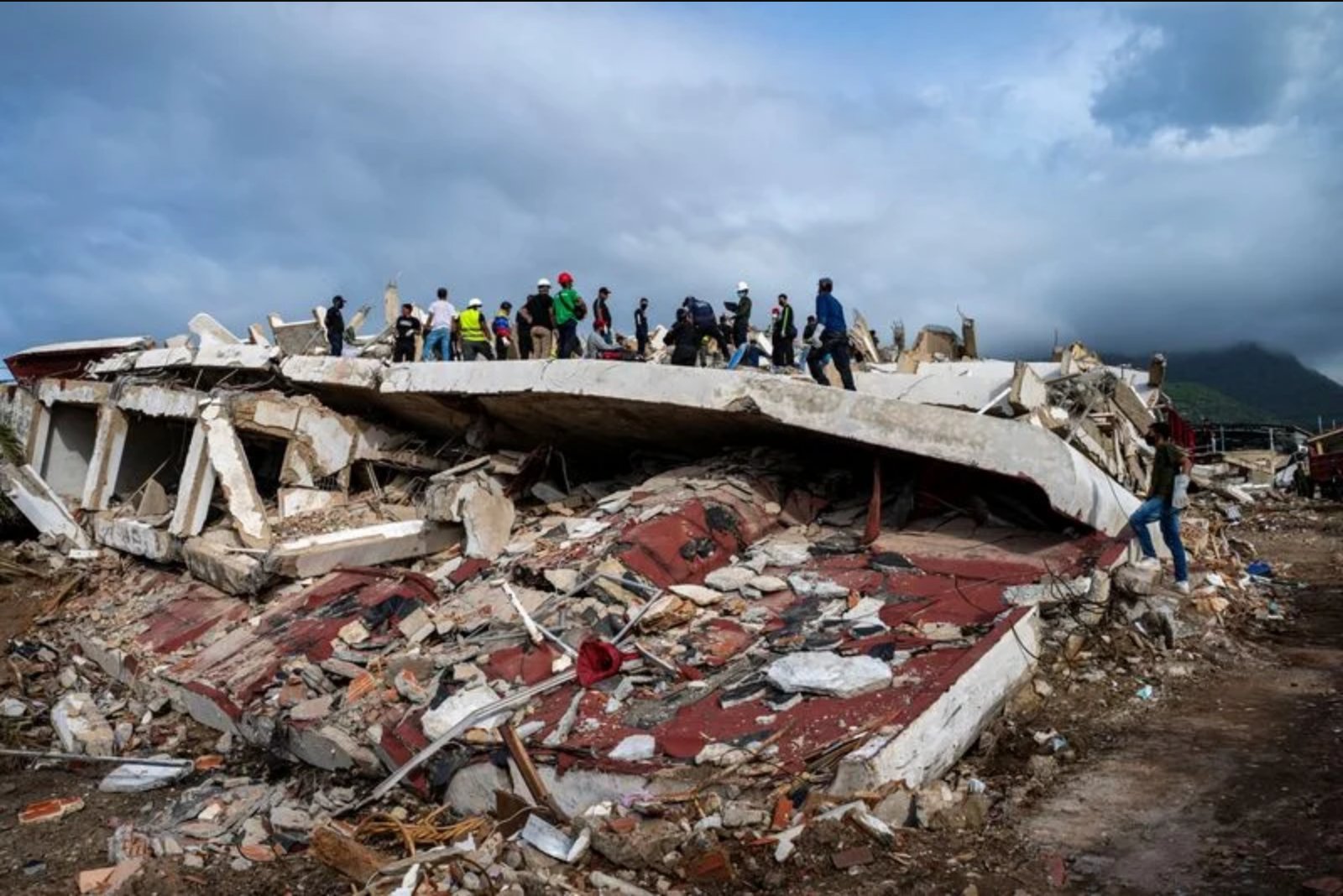
For most days, Alexander Delgado is a physical education teacher in Aragua state. In the week after a pair of powerful earthquakes shook Venezuela's central coast and parts of the capital, he traded a classroom for a search-and-rescue site in La Guaira, directing a changing group of neighbors and volunteers from other states as they tunneled into the ruins of an eight-tower public housing complex.
Delgado and fellow civilians have been working with simple tools - shovels, ropes and their hands - trying to locate survivors and recover victims from the collapsed Hugo Chavez housing development, where residents and volunteers say six of the towers have been reduced to debris. Their efforts, they say, have been necessary to compensate for what they view as an official response that has been too slow and insufficient for the scale of the disaster.
"You see the firefighters, (Mexican rescue team) Los Topos, but you don't see the state per se," Delgado said, describing the mixed presence of foreign and local professionals alongside mostly citizen-led efforts. Delgado, who had only basic first-aid training from his day job, arrived in La Guaira the day after the tremors to assist. Under the hot Caribbean sun, his team has spent days shifting rubble and listening for any sign of life. Local volunteers have supplemented the crew with water, face masks, ice and intimate knowledge of the housing complex's layout.
By the sixth day at the site, Delgado said, there were two international rescue teams and a number of local firefighters present, as well as one truck from the country's forensic service, but heavy machinery remained scarce. That afternoon, searchers uncovered the body of a woman lying between a floor slab and rubble; the team paused work to await forensic personnel to remove the body.
Alongside stories of grassroots rescue work, accusations have emerged that some members of Venezuela's military and police have interfered with relief efforts. Volunteers and at least one government employee manning a checkpoint in La Guaira told Reuters they witnessed officers and soldiers seize supplies from three aid trucks and later boast about what they had taken. The checkpoint worker also said they had seen officials film themselves with shovels in staged rescue footage before leaving abruptly.
Social media has been a vehicle for residents to broadcast videos of security officials picking through destroyed buildings and removing items such as clothing, appliances and cash. Reuters did not verify the footage. In a late Tuesday statement, the Interior Ministry said four crime scene police officials had been detained and removed from their positions and will be investigated for "appropriating financial assets acquired amid the ruins," while adding that police have generally been acting transparently.
Other eyewitnesses described military personnel making showy appearances - brandishing firearms and watching as volunteers and foreign teams rushed to find survivors - while some members of the security services were also reported to be actively helping search operations. Residents told Reuters they had observed soldiers removing belongings from buildings at the request of owners, and witnesses said police and firefighters in Chacao, an affluent Caracas neighborhood, worked continuously to manage humanitarian needs.
The Venezuelan government's communications office, which handles inquiries for the military and police, did not immediately answer requests for comment. Senior officials have acknowledged growing civilian anger but have attributed some of the reports and criticism to misinformation, urging people to disregard what they called "manipulation strategies on social networks" and to trust official information channels instead.
The backdrop to the dispute over the response is political tension centered on acting President Delcy Rodriguez. The article reports that Rodriguez has been working to consolidate her authority following the ouster of her predecessor Nicolas Maduro in January. Critics quoted in the article argue the administration has a predictable pattern of taking credit for positive outcomes, shifting blame for negatives and attempting to control the narrative.
Jimmy Story, the U.S. ambassador to Venezuela until 2023, characterized Rodriguez and her associates as operating with a single script, asserting they seek to control perceptions and messaging. President Donald Trump has publicly praised the U.S. relationship with Rodriguez, and some American companies have reportedly signaled interest in Venezuelan oil and gold opportunities, the article notes.
In contrast, some foreign officials publicly expressed confidence in local authorities' handling of the disaster. The U.S. Embassy's Charge d'Affaires John Barrett told Univision he had "a great deal of confidence" in local authorities.
Volunteers on the ground described different expectations. Veterinarian Mijaed Diaz, who joined university volunteers at a wrecked tower, said he wanted to see more active engagement from public agencies, which he contends bear ultimate responsibility for emergency response. "I would like more presence of public entities, who really are those responsible for this. But in the end we're used to making do with almost nothing," Diaz said as he moved across the debris, looking for body bags after four people were pulled from the wreckage.
After days of initially thanking civilian volunteers, the government moved to restrict public access to parts of La Guaira on Friday, a decision that angered people trying to help find survivors. Residents report frustration at the constraints and claim they have had to step in to keep search efforts going.
Among those searching personally for family members was Miguel Poleo, who joined Delgado's civilian rescue team at Los Cocos soon after the tremors. Poleo said he came looking for his stepdaughter, her husband and their child. He told Reuters that, despite reports of survivors knocking from under the rubble, authorities had not provided help where he believed it was needed. "We told them two days ago that there are survivors, that they are knocking, and nothing," he said. "They don't help anyone."
Non-governmental organizations and civil society groups have also re-emerged publicly to assist affected communities. Some had seen their activities curtailed by government restrictions imposed in 2024. Roberto Patino, founder of the NGO Alimenta La Solidaridad, said the group is operating to support communities and to demonstrate that their work aims to aid, not to be punished. Since the disaster, his organization has focused on delivering food, medicines, equipment and Starlink internet antennas to the hardest-hit neighborhoods.
The United Nations Development Programme has estimated the quakes caused around $6.7 billion in damage. In response, the United States has pledged $350 million, dispatched rescue teams and deployed military resources to repair airport infrastructure. The article also highlights public debate about funds generated from Venezuelan oil sales that are held in a U.S.-controlled account; former U.S. envoy Jimmy Story said the robust response raises questions about transparency around that oil fund and whether those resources will be released for the disaster response.
While accounts differ about the scale and character of official action, those closest to the rubble emphasize the role of ordinary Venezuelans in keeping rescue operations alive. Volunteers continue to dig and listen beneath collapsed concrete, supply water and masks, and push for more heavy equipment to be made available. For now, they say, much of the burden has fallen to citizens working with what they have.
As investigations proceed into alleged appropriations by some police officers, the immediate priorities remain the search for survivors, the recovery of the dead, and the delivery of food, medicine and communications equipment to communities left reeling by the quakes. The country's mix of local volunteers, international teams and partially engaged official services underscores both the scale of the disaster and the complex, sometimes fraught, nature of disaster response in Venezuela at this moment.