
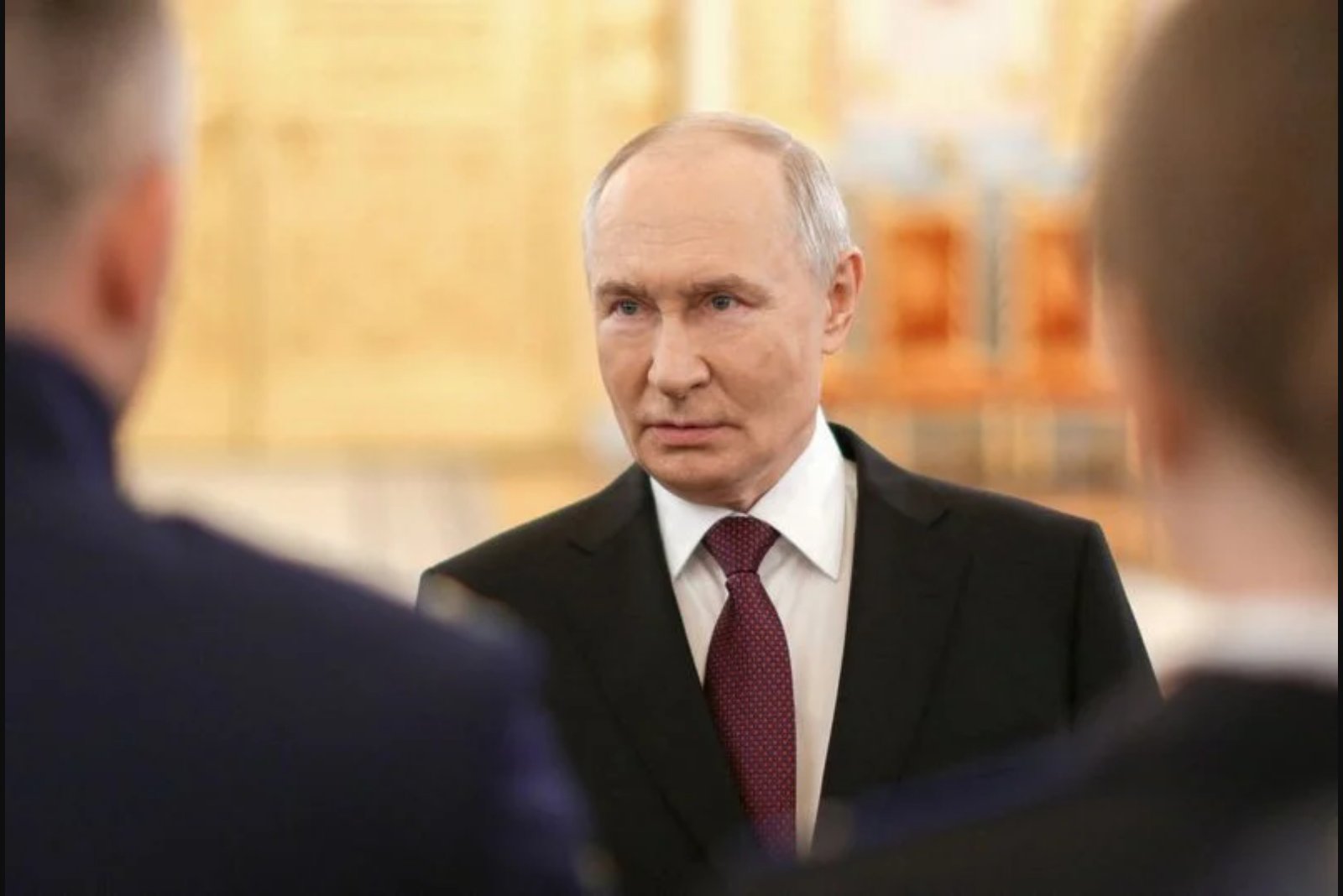
Russia has publicly charged the United States with not delivering on what Moscow describes as "understandings" struck between Presidents Vladimir Putin and Donald Trump at their Alaska meeting last August, a development that underscores growing irritation in the Kremlin.
Over a three-day span, three senior Russian officials said the United States had not followed through on unspecified elements of that summit, though they provided no additional specifics on what was expected from Washington.
The comments come as Ukraine has stepped up drone strikes deep inside Russian territory, including two attacks last week on a Moscow oil refinery, and at a moment when a Group of Seven summit heard Ukrainian President Volodymyr Zelenskiy argue that Kyiv was turning the tide in the war. Moscow rejects that portrayal and has maintained heavy offensive operations of its own.
How Russian officials framed the Alaska summit
Since Mr. Trump began to publicly pursue a role in trying to end the Ukraine war last year - sometimes criticizing Mr. Putin but more often singling out Ukrainian President Volodymyr Zelenskiy as a stumbling block to a deal - the Kremlin has repeatedly expressed gratitude for Mr. Trump's efforts. Russian commentary has frequently invoked "the spirit of Anchorage" as shorthand for what analysts say is Moscow's belief that Mr. Trump is amenable to Russia's central demand: that Ukraine cede the entirety of the Donbas region in return for a freeze of fighting elsewhere.
The United States has not publicly outlined any concrete agreement from the Alaska summit, and allied leaders were skeptical about the substance of Mr. Trump's gestures toward Mr. Putin. Barely a month after the meeting, Mr. Trump made comments suggesting Ukraine could recover all territory Russia had seized, provoking fresh Russian disappointment.
Senior Russian statements
In the first of the recent high-level comments, Kremlin aide Yuri Ushakov said that "only one side had remained committed to the understandings, while the other side, as it now appears, has not been fully able to do its part."
On Tuesday, Foreign Minister Sergei Lavrov suggested the summit may have been a U.S. "ploy to buy time to rearm the Kyiv regime." Lavrov's deputy, Sergei Ryabkov, told Interfax that Washington had departed from the "fundamental understandings" reached in Alaska, while also saying that dialogue with the United States would continue.
RIA quoted Ryabkov as saying that "we also see Washington's line moving closer to the most rabid anti-Russian policies pursued by the U.S.'s closest European allies - namely, the UK and France," a comment made with reference to last week's G7 summit in France.
Analysts and the Kremlin's calculation
Gerhard Mangott, an Austrian analyst and long-time watcher of Vladimir Putin, said Moscow's rhetorical shift reflects unease about what he described as "a very critical situation for the Russian economy and military" in light of a surge in Ukrainian attacks inside Russia. Mangott said Russia believes the United States is assisting those attacks.
"Putin needs to give a response that is visible to the population and that demonstrates that he still has cards to play," Mangott said, predicting further military escalation and a renewed Russian effort to bring Mr. Trump back onside.
Speaking about the recent Ukrainian strikes, Mr. Putin said that "the entire West" was working for Kyiv.
Oleg Ignatov, an analyst at the International Crisis Group, said Russia was displeased by the lack of U.S. mediation since February, when Mr. Trump launched what the source characterizes as a war against Iran together with Israel, and U.S. attention shifted. According to Ignatov, European governments have been consistently ruled out by Moscow as potential mediators because they have shown little or no indication that they would urge Kyiv to make major concessions.
Ignatov said Russia wanted the U.S. to resume diplomacy aimed at helping Moscow end the war on terms acceptable to the Kremlin. "There’s no structured diplomatic process, there’s no deal on the table, there’s actually nothing," he said. "The Russians are very disappointed about this, they really want the Americans to engage."
Implications and context
Russian criticism of the United States for not honoring the Alaska understandings has surfaced amid an intensification of cross-border strikes and high-level diplomatic activity at the G7. The complaints from senior Russian figures were voiced without detailing what precise steps Washington had failed to take, and they followed a period in which Mr. Trump both courted the Kremlin and later made comments suggesting Ukraine could regain lost territory.
For now, Moscow's public stance combines disappointment with a stated readiness to continue dialogue with Washington even as it signals mistrust of Western policies and points to growing military pressures at home and on the battlefield.