
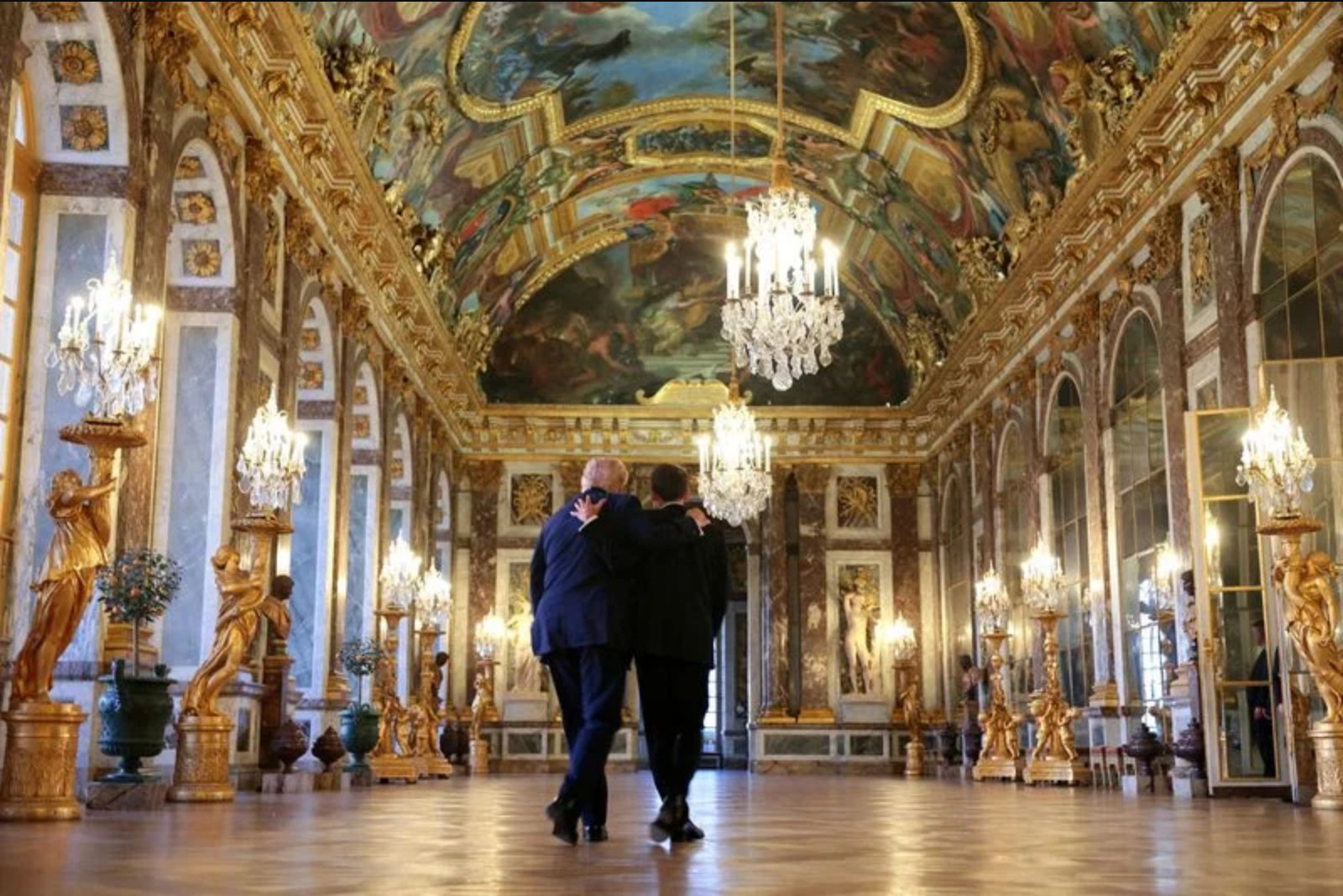
French President Emmanuel Macron and his wife Brigitte hosted U.S. President Donald Trump at the Palace of Versailles on Wednesday as part of efforts to reinforce transatlantic relations.
The three leaders greeted each other on the grand steps of the palace and posed for photographs. On arrival, President Trump commented: "It’s beautiful." Earlier, he had said he accepted Macron’s invitation to dine at Versailles near Paris because he was "a fan of beautiful places."
Speaking on Tuesday at the G7 summit in Evian-les-Bains, close to Switzerland, Trump described the palace in vivid terms: "Versailles is not gold leaf. Versailles is the real deal." He reiterated his enthusiasm for the visit on Wednesday, saying: "This evening I’m looking forward to a very special dinner with President Macron and his fabulous wife in the palace of Versailles. ... it’s a beautiful palace, maybe the most beautiful of all."
The meeting at Versailles followed G7 discussions that both sides characterized as productive, including agreement on a joint statement concerning Ukraine. Yet relations between the U.S. president and many European counterparts have been strained in recent years on a range of issues, notably tariffs and disagreements over the Iran war or Ukraine.
The choice of Versailles as the venue carries symbolic weight. The palace was conceived from the outset as a theatrical display of royal power and majesty under King Louis XIV, who oversaw its construction and transferred his court there in the late 17th century. Today, centuries after the end of monarchy, France is a republic, but successive French presidents continue to use Versailles as a setting to project authority and to host distinguished guests.
Commenting on the diplomatic calculus, Jeffrey Hawkins, a former U.S. diplomat who studies Franco-American relations, said hosting is an established way to cultivate favor with the U.S. president. "In any leader’s relationship, whether we’re talking about (Chinese President) Xi (Jinping), (Russian President Vladimir) Putin, or Macron, you want to be on this American president’s good side," Hawkins said. "And a way to do that is to host him, to welcome him, in a way where he feels well-received, where he feels important and respected."
As the presidential motorcade approached Versailles, a sizable crowd gathered to watch. The combination of historic surroundings, ceremonial hospitality and the symbolic staging of a state dinner underlined the diplomatic purpose of the visit: to provide a moment of ceremony and engagement amid a backdrop of ongoing policy disagreements.
Context and implications
The visit combined pageantry and diplomacy: a carefully orchestrated reception at a historic site followed by private and public interactions intended to smooth tensions and demonstrate continued lines of communication.