
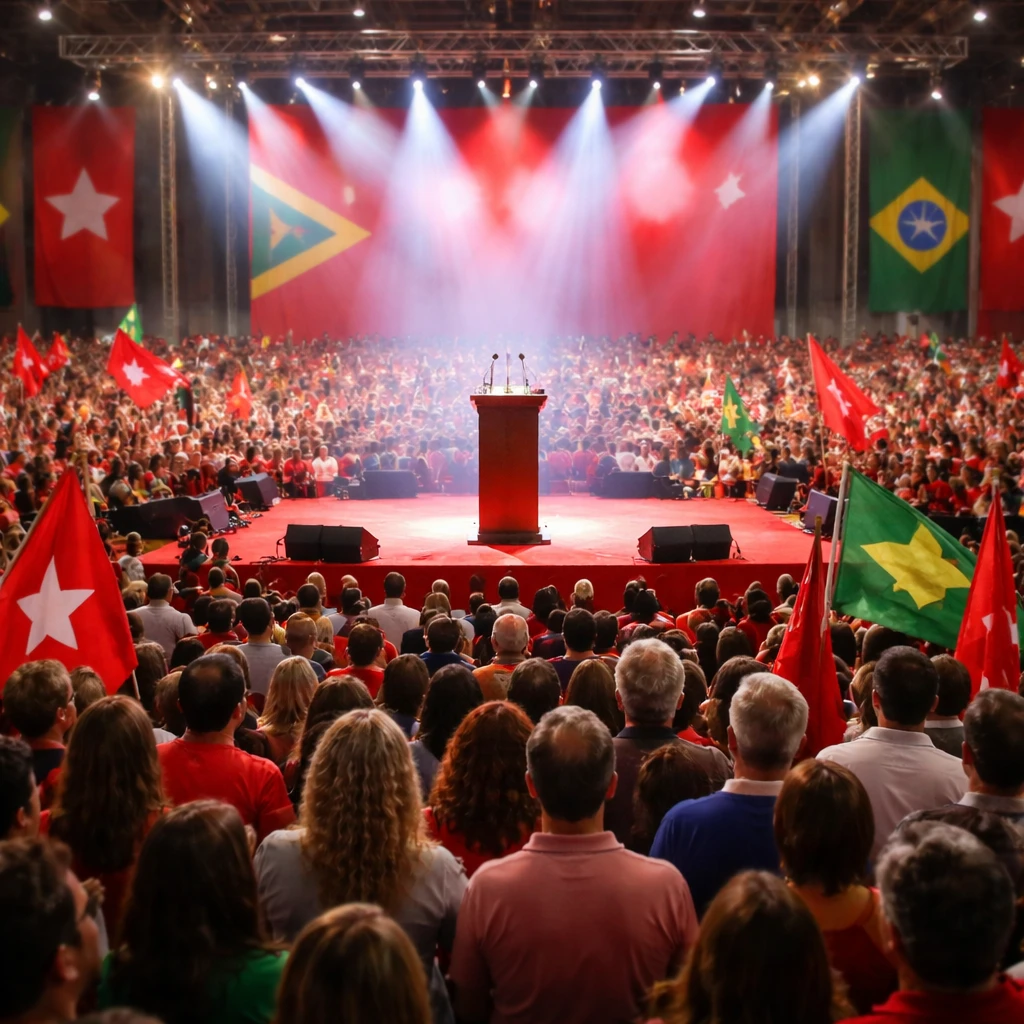
When Luiz Inacio Lula da Silva takes the stage at the Workers Party convention on Sunday to accept what is expected to be his seventh and final presidential nomination at the age of 80, the Brazilian left will be more consolidated around a single candidate than at almost any previous moment in his long political career.
For the first time in nearly 40 years, Lula is standing as the presidential choice of all five major center-left parties. That alignment reflects a tactical broadening of alliances as parties on the center-left unite around a common aim: to counter the growing influence of the far right.
But the very cohesion that has been built in opposition to a political rival raises fresh questions about leadership succession and the future of the left once Lula is no longer an option on the ballot.
"It won’t be easy," said Juliano Medeiros, the former president of the Socialism and Liberty Party, one of the parties in Lula’s coalition. "We’ll have to debate extensively to see if we can maintain a convergence on the left."
The expansion of a broad coalition around Lula is being read by many within the left as a survival strategy in response to shifting political attitudes among Brazilians. Researcher Felipe Nunes, author of the book Brazil in the Mirror, notes a marked change in self-identification across the electorate between 2014 and 2023: those identifying as right-wing rose to 37% from 26%, while self-identified left-wing voters fell to 23% from 29% over the same period. That movement in public sentiment has helped create fertile ground for far-right figures to rise.
Evidence of the far right's continued presence in national politics is clear in recent developments: former President Jair Bolsonaro, a prominent far-right figure, was convicted last year for attempting to overthrow democracy. His son, Senator Flavio Bolsonaro, is now running against Lula.
"The far right remains alive, and the popular democratic camp – which we represent – must unite," said Carlos Lupi, the head of the Democratic Labour Party. He noted the unusual nature of the moment: "We are at a very unique moment. The democrats will be on one side and the offspring of the dictatorship on the other."
The reference to Brazil’s past reflects a recurring theme on the center-left: the specter of a military dictatorship that governed Brazil from 1964 to 1985 and the way some far-right supporters evoke that era as an idealized period despite the political violence of the regime.
Regionally, the consolidation around Lula stands out. The article’s context shows that many South American countries have elected right-leaning leaders in recent years. Lula remains one of the few leftist presidents in the region following those shifts.
No clear successor has emerged to take Lula’s place when he steps down. Political scientist Creomar de Souza of the consulting firm Dharma Political Risk and Strategy said the left’s narrowing political space is compounded by difficulties the movement has had in developing an effective social media narrative. That challenge leaves parties with limited options to establish themselves independently of Lula’s influence.
"By joining Lula’s election campaign, they have the advantage of trying to anchor themselves in the political figure that Lula represents and in the electoral impact that figure currently has," de Souza said.
Opinion polls show Lula leading both rounds of the upcoming election by a small but persistent margin over Senator Bolsonaro. Analysts attribute part of Lula’s edge to a stable economy and slowing inflation, while also noting that Lula draws support from voters who explicitly reject Bolsonaro.
Eden Valadares, communications secretary of the Workers Party (PT), framed the current dynamics not as a decline of the left but as a sharpening polarization: the traditional right has lost ground to the far right even as the left adapts to the challenge. He emphasized that the endorsements from several parties were not automatic and required concessions, saying there is an active mediation process designed to make each ally feel included.
Concretely, the PT — normally hesitant to give up leadership in state-level coalitions — altered that practice on Lula’s instructions, agreeing to cede top positions on some tickets to allies as part of a broader accommodation strategy.
Still, the question of succession looms. Lula has been a fixture on Brazilian campaign trails since 1989, and if elected to another term he would be 84 at its close. Within political circles there is an expectation that any fourth term will spark a bargaining process over future leadership of the left.
Two former ministers, Fernando Haddad and Camilo Santana, have been identified by observers as emerging figures who could be considered potential successors. The article notes, however, that neither currently possesses Lula’s stature within the Brazilian left or on the international stage.
The broader task facing the left toward the 2030 presidential race — when the next presidential contest is scheduled — will be to keep the coalition intact without the magnetic presence Lula now provides. As Medeiros put it, the left benefits today from a leader who can speak beyond the left-wing bubble, and the coming years will require a debate over a common national vision and a shared strategy if unity is to persist.
Summary
Lula’s expected acceptance of his seventh and likely final presidential nomination marks a high point of unity across Brazil’s center-left, with all five major parties backing a single candidate for the first time in nearly 40 years. This unity is driven by the need to counter a persistent far right but leaves unresolved the question of who might lead the movement when Lula is no longer running. Polls show Lula ahead of Senator Flavio Bolsonaro amid a stable economy and slowing inflation, yet the left faces structural challenges including diminished political space and difficulty building a new narrative on social media.
Key points
- Unprecedented unity: All five major center-left parties in Brazil have rallied behind Lula, reflecting a strategic alignment to oppose the far right - sectors impacted: political landscape and electoral dynamics.
- Polling and economic backdrop: Lula leads in polls by a consistent margin over Senator Bolsonaro amid a stable economy and slowing inflation - sectors impacted: financial markets and consumer confidence.
- Unclear succession: There is no obvious heir to Lula, with potential contenders lacking his current national and international standing, leaving the future cohesion of the left uncertain - sectors impacted: political institutions and governance.
Risks and uncertainties
- Resurgence of the far right: The enduring strength of far-right actors, illustrated by the conviction of former President Jair Bolsonaro and the candidacy of his son, represents a persistent political risk - sectors impacted: political stability and investor sentiment.
- Fragmentation after Lula: The left’s ability to remain united beyond Lula’s candidacy is unproven, and internal debates or power struggles could weaken collective electoral prospects - sectors impacted: policymaking predictability and government coalition stability.
- Reduced political space and communications challenges: The left’s difficulty in developing an effective social media narrative and shrinking political base constrain independent party growth and electoral options - sectors impacted: political campaigning and voter engagement mechanisms.
Disclosure