
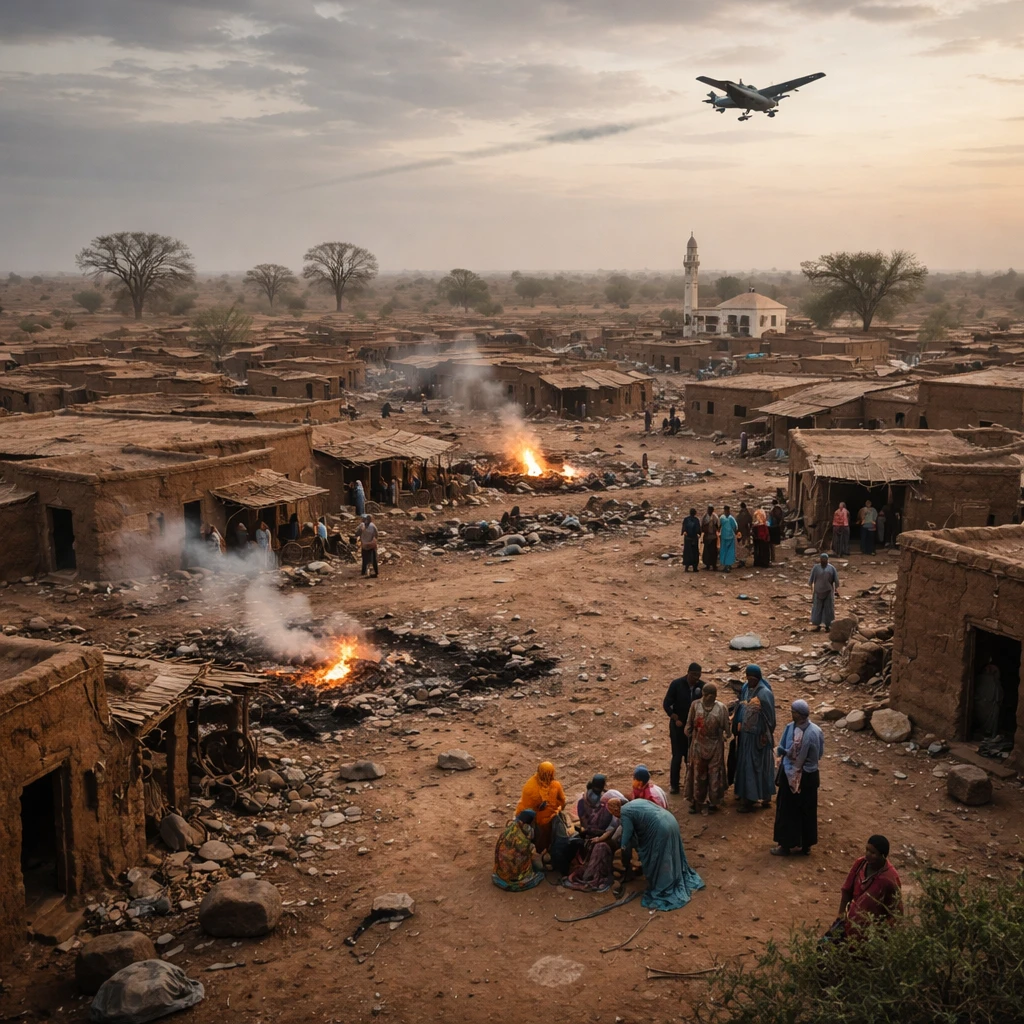
Human Rights Watch (HRW) reported that air strikes on June 15 in the central Mopti region of Mali killed eight civilians, among them three children, and described the strikes as "unlawfully indiscriminate." The campaign group's investigation located the incident in the village of Kyrnia and attributed the munitions to an aircraft two Malian military sources identified as a Sukhoi Su-24.
HRW's findings indicate at least two munitions were dropped on Kyrnia. One impact occurred near the home of the village chief and killed his wife, two of his children and another child. A second strike hit a nearby cattle market, where four men were killed, according to HRW. The rights group said it did not believe any fighters from Jama'at Nusrat al-Islam wal Muslimin (JNIM) - the al Qaeda-linked group HRW reports has controlled the village for six years - were killed in the strikes.
Residents of Kyrnia told HRW that three of the village chief's sons were known JNIM fighters but were not present in Kyrnia at the time of the attack. They also said that about 100 JNIM fighters were in the village the day of the strikes, but were mostly gathered at the mosque, which HRW reports was not struck.
HRW concluded that the strikes "did not appear to target specific military objectives, which would make them unlawfully indiscriminate." The organization geolocated aerial footage posted online by Africa Corps - a paramilitary unit established by Russia's defence ministry that has taken on much of the Wagner Group's activities in parts of Africa - and matched it to Kyrnia. Africa Corps had posted footage on Facebook and X asserting it had struck a "gathering place of terrorist groups" in Mopti on June 15.
Independent verification of the incident was not available at the time of HRW's report. Authorities in Russia and Mali did not immediately respond to requests for comment.
Mali's military-led government has been conducting operations against armed Islamist groups with Russian support after the government expelled French forces. JNIM is among the insurgent groups active in the country. In April, JNIM and the Azawad Liberation Front (FLA) reportedly carried out nationwide attacks that killed the defence minister and struck Mali's main airport. Russia said last month that its personnel were helping Malian forces regain territory after that offensive.
Both Malian soldiers and their Russian allies have faced accusations of rights abuses. The United Nations and Amnesty International have called for investigations into possible war crimes by JNIM and the FLA. Monitoring group Armed Conflict Location & Event Data (ACLED) reported that last year Mali's military together with Russian paramilitary fighters killed 918 civilians, a figure HRW noted as being nearly four times the civilian deaths attributed to their main Islamist adversaries.
HRW has urged Mali's government to open a credible investigation into the Kyrnia strikes and to hold those responsible to account. Ilaria Allegrozzi, senior Sahel researcher at Human Rights Watch, said: "By handing the Russian authorities a blank check, the Malian government should be aware that it too is accountable for allied forces' atrocities."
The HRW account highlights tensions in the Sahel where international partnerships, shifting military allegiances and persistent insurgent activity intersect with civilian harm. The report underscores calls from human rights bodies for transparent probes and accountability for operations that result in civilian deaths.
Methodology note: HRW's investigation combined witness interviews, geolocation of open-source footage and analysis of strike patterns. Where possible, HRW matched the footage posted by Africa Corps to Kyrnia; HRW's conclusions are drawn from those combined lines of inquiry. Independent public confirmation of the specific incident was not available at the time of HRW's reporting, and Mali and Russian authorities had not offered a response.