
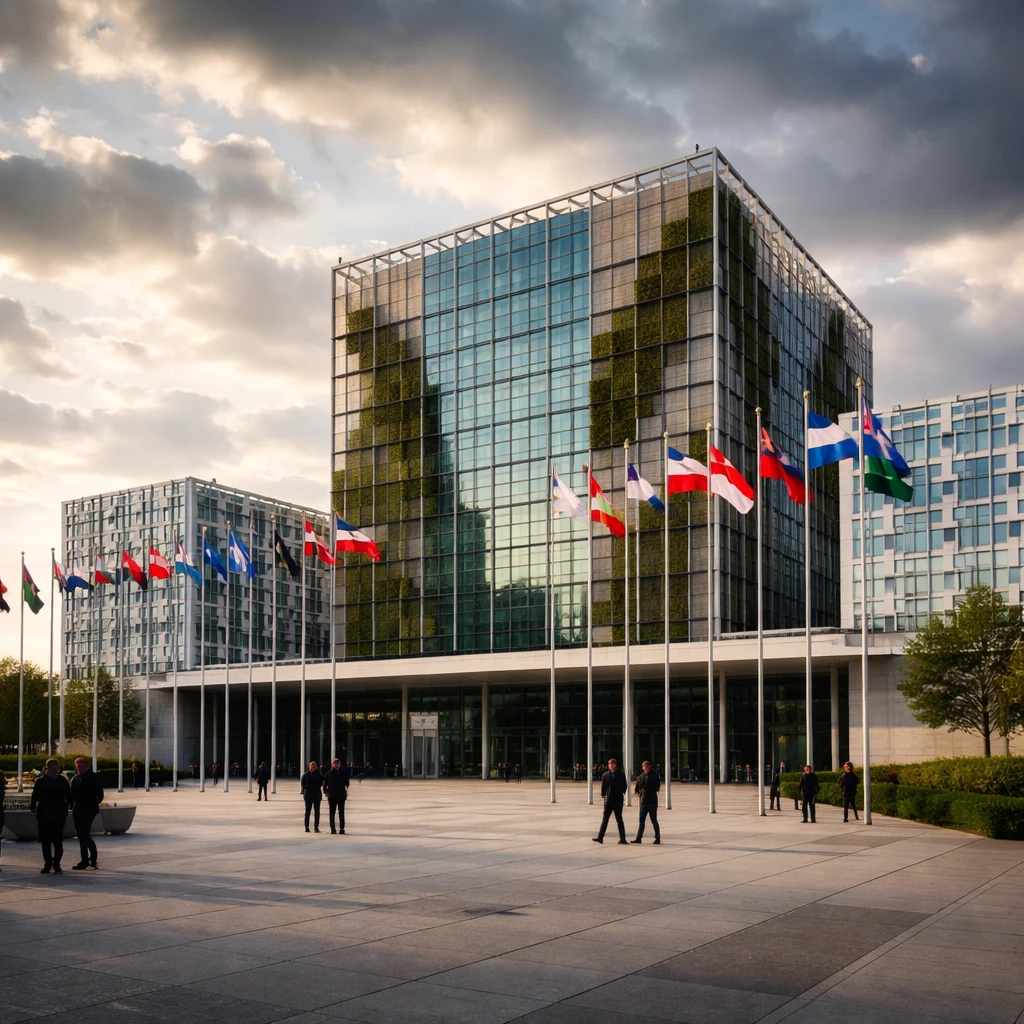
Former Philippine president Rodrigo Duterte has begun a trial at the International Criminal Court in The Hague on allegations of crimes against humanity tied to his administration’s anti-drug campaign, during which thousands of people were killed. The proceeding is among the most prominent in the court’s more than two decades of existence and comes amid sustained political pressure, including sanctions from the United States that officials say may jeopardize the court’s capacity to operate.
What the ICC was created to do
The International Criminal Court was founded in 2002 with a specific mandate: to hold individuals accountable for the gravest international crimes when national authorities are unwilling or unable to prosecute. Its statutory crimes include war crimes, crimes against humanity, genocide and the crime of aggression. The court may assert jurisdiction over offences committed on the territory of any of its 125 member states, or by nationals of those states acting elsewhere.
Membership spans all 27 European Union countries, a number of other wealthy democracies and many developing nations. Notably absent from the roster are the United States, China, Russia and India. The State of Palestine holds membership despite not being a full member of the United Nations, while Israel is not a member. In the case now involving Duterte, the court says it retains jurisdiction because the Philippines was a member state for part of the period in question and withdrew only partway through his term.
Track record: cases, convictions and arrest warrants
Since its creation the court has handled 34 distinct cases, some of which involved multiple defendants. Those proceedings have produced 15 convictions in total, including 10 for the court’s core offences of crimes against humanity and war crimes. All 10 of those convictions relate to African militia leaders from the Democratic Republic of Congo, Mali, Sudan, the Central African Republic and Uganda.
ICC judges have issued 68 arrest warrants to date. Of those, 34 suspects remain at large. The appearance of Duterte marks only the second time a former national leader has been brought before the court on allegations tied to his conduct while in office - the first was Laurent Gbagbo of Ivory Coast, who was acquitted in 2019.
There are also four sitting national leaders currently subject to ICC arrest warrants: Israel’s Prime Minister Benjamin Netanyahu, Russia’s President Vladimir Putin, Afghanistan’s Taliban leader Hibatullah Akhundzada and Myanmar’s military leader Min Aung Hlaing. Separately, Kenya’s President William Ruto and his predecessor Uhuru Kenyatta both attended the court concerning allegations that predated their terms in office; charges in those matters were subsequently dropped. Other former heads of state who have faced ICC arrest warrants include Sudan’s Omar el-Bashir and Libya’s late Muammar Gaddafi.
U.S. opposition and sanctions
The United States has never been a member of the ICC and successive U.S. administrations have varied in their posture toward the court. Under the administration of former President Donald Trump, Washington adopted a strongly adversarial stance, portraying the ICC as politicized and as a potential threat to U.S. service members. Trump’s administration imposed sanctions on certain court officials during his first term, and later extended sanctions to the institution itself. U.S. officials have characterized those measures as intended to compel significant reforms or to end the court’s operations.
U.S. displeasure has been heightened by two developments in particular: an arrest warrant issued for Prime Minister Benjamin Netanyahu and the court’s investigation that included alleged actions by U.S. troops in a broader Afghanistan probe. ICC judges closed the Afghanistan portion of that case two weeks ago.
Operational resilience and institutional response
The sanctions imposed by Washington have the potential to restrict the court’s access to elements of the global financial system, although they have not yet been fully enacted. Court officials say they have taken steps to preserve continuity of operations, including plans to replace proprietary software on office computers with open-source alternatives. The ICC has publicly rejected U.S. criticism, describing the sanctions as an attack on the principle of international justice.
This explainer outlines the ICC’s mandate, membership, caseload and the political pressures it faces as a high-profile trial proceeds. Where the public record is limited or specific outcomes remain uncertain, the account reflects those limits rather than drawing inferences.